Showing posts with label mystery. Show all posts

Thursday, November 12, 2020

Floppies

I don't remember ever seeing mushrooms like these before.

Small brown mushrooms on a stump, drooping.

They look like the lichen agarics, by the shape (depressed centre, pie-crust edges) and location (on decayed wood, although I don't see the lichen that should be there), but why are they so droopy? I've looked at hundreds of photos; they always seem to maintain their shape, even tipped over or broken. But not these!

A closer look.

Unhappy with two days of no rain? Too much sun? The stump is in deep shade on the Elk Falls trail.

~~~~~~~~~~~~~~~~~~~

Nunca he visto antes hongos tan tristes, tan decaídos. Parece que son otros de los hongos de liquen, los lichenomphalia umbellifera, por su forma, con el "ombligo" en el centro y las orillas onduladas, y por su sitio, creciendo en madera podrida, con musgos, aunque no veo los líquenes que los deben acompañar. Pero he mirado cientos de fotografías, y no veo ninguno que se dobla de esta forma; todos, aún rotos y tumbados, mantienen su rigidez.

¿Qué les habrá pasado? ¿Falta de lluvia? Ya que hacía dos dias que no había llovido. ¿O demasiada luz? Pero estaban en sombra densa en el sendero hacia las cataratas.


Sunday, April 30, 2017

Mystery # 1

This is an trio of pink-tipped green anemones. They're a dime a dozen in the intertidal zone. But look again.

Anthopleura elegantissima, with whelks and Wosnesenski's isopod.

First, what has it been eating? It looks like a black snail shell, and, separate from that, two pieces of very white flesh. Is the anemone in the act of expelling the snail shell and simultaneously swallowing the meat?

Second, and this really leaves me wondering; look closely at the right bottom of the anemone. Look through the translucent flesh. See the circle of what looks like snail eggs inside?

Zooming in.

How did they get there? Did a snail crawl in, avoid being digested, exit the stomach, and lay her eggs? How is that possible?

Or are these part of the usual anemone anatomy that I have never seen, and can't find in any cross-section diagram?

Or did the anemone just crawl along the rock and station itself on top of eggs?

And no, they can't be seen from the opposite side; I'm not looking through the entire animal.

What do you think?

Wednesday, June 29, 2016

Two Boat Pond

Now this is just strange.

A few miles out of Gold River, there is a pond beside the highway. Just another of hundreds of nondescript water holes in the rainforest; half swamp, half brownish water, shallow enough to wade if the bottom is solid, which I doubt. There's no pathway to the edge, anyway; the water starts somewhere under a hardhack thicket. It's probably full of leeches or mosquito larvae.

Last March, I was driving by slowly, rubber-necking, looking for ducks, or I would never have seen the boats. There were two of them; foot-long, two-masted, flat-bottomed wooden boats, anchored at either end of the pond.

In March, the hardhack was bare, the grasses brown. Dead trees line the pond, their roots drowned in the wet winters.

We passed the pond again a couple of weeks ago. I had to stop and see if the boats were still there. One is. The other has disappeared; foundered and buried in muck, stolen by a curious bear, retrieved by someone in hip waders?

Boat # 2, in June. The grass is green, now, and the hardhack has leafed out. Otherwise, nothing has changed.

I took a series of photos to make a panorama of the ghostly trees on the far shore. There were too many conflicting colours, too many variations in the light as I turned. A black and white is closer to what I saw than a colour photo.

Boat # 2 is at the far left. Last March, boat # 1 was in the corresponding position on the right.

Who put the boats there? Why? How? I wonder.

Wednesday, November 18, 2015

Completely out of character

I'm flabbergasted. I've never seen this behaviour before.

Spiders are predators, right? They eat insects, other spiders, even birds, if they're big enough. They don't eat fruit. So what was this one doing with papaya?

Young male philodromus dispar. Apparently eating papaya.

I had cut up a papaya for supper, and when I went to clean up, I found this little guy working on a speck left on the counter. I brushed him away and he returned immediately, twice. After that, I cleaned around him and watched. He stayed with the piece of papaya another 10 minutes or so.

The spider is about 5mm long; it feeds on flies and other insects. It does not build a web, but hunts its prey by remaining stationary in ambush and awaiting prey to come near it. (Wikipedia)

After I wiped the counter clean, he ran about in the area for a while, as if searching, then gave up and went home.

I've still got half a papaya. I'll put out a bit for him tomorrow, to see if he's still interested.

UPDATE: I found an article about this behaviour, by crab spider males. (Philodromus dispar is a crab.)

Adult male crab spiders hardly eat at all. They live mostly on energy from food they captured before maturity. Finding and guarding females can take a lot of effort, though, and some recent studies have found that male crab spiders sometimes dip into flowers and drink nectar, which would provide considerable energy without the extended effort of capturing prey.
Simon Pollard and fellow researchers propose in the journal Animal Behavior that
nectar may also provide male spiders with much-needed liquid. All spiders drink rainwater and dew to replace the body fluids they lose through evaporation. But males lose water faster than females because of their relative size, and they do not gain liquids from consuming insects as females do.
(From Charlotte without a Web)

Monday, November 03, 2014

Another puzzler

I discovered these little white capsules on the outside of my bedroom window. I don't know what they are.

About half the size of a grain of rice.

These were taken from the inside, through double panes, while it poured rain outside. The window is relatively sheltered, so the white capsules were just damp.

I went outside to check, and they looked the same from that side. But I was getting wet, so I took no photos.

There were several clumps, all with those little cyan spots in them. They have the texture, to look at, of bird poop. Formed pellets of bird poop.

What do you think? Insect eggs? Bleached snail poop? The beginnings of a stealthy invasion of interstellar pod creatures?

#UPDATE: I went out and brought a clump in. It detached itself from the glass with only a touch. (That goes against insect eggs, which would be glued down.)

In spite of the heavy rain, they felt barely damp. They crumbled easily.

I looked at them under the microscope. The little cyan specks are still there, and the white mass has a bit of sparkle, like sugar crystals.

Crumbled, they are the same all the way through. The crumbs look fluffy, sort of like my sugar substitute, the kind you spoon into your coffee, not the packet stuff.

There is no odour that I could detect.

I vote for snail poop, bleached. I've never seen white snail poop before. I wonder what they've been eating.

Wednesday, July 03, 2013

Headless dog walkers

Remember these?

Walking the dogs on Semiahmoo Beach

Zooming in. Two topless walkers, one cute doggie.

Long, long ago, in February of 2010, I promised you I'd explain these. I never did. I just found my old close-ups on the hard drive, so I'll do that tomorrow.

Thursday, May 28, 2009

Two for the price of one

Last week, while I was harvesting fresh maple flowers for my carpet beetles, I noticed a couple of silvery-brown lumps on the underside of a leaf, so I cut that, too. They turned out to be tiny fat beetle-like insects, decorated with four neat rows of studs, each with its own blond hair. They were stuck firmly to the middle vein of the leaf, and didn't respond to tickling with a paintbrush. Dead, dormant, or in the middle of some buggy process? I couldn't tell.


I put the piece of leaf into my little viewing tin, where I could watch and see what happened next. Later on, I had a better idea, and looked over the tree until I found two more leaves with the sleeping bugs; these leaves I harvested with stems, and put them in water in a small aquarium with a good lid.


These "beetles," like the first two, were also lined up on the central vein of their respective leaves.

I've been watching all week; nothing changed until tonight, when I noticed that one of the tinned bugs had a big hole in the rear abdomen:


Evacuated bug on a drying leaf.

A tiny fly was flitting around in the tin. I checked the aquarium; sure enough, both bugs had holes in more or less the same location. And a tiny fly raced up and down the walls.


And another on a still-fresh leaf.

The flies were very small, very fast. I managed to photograph one:


Black fly on a vintage cats-eye marble.

The other, the one in the tin, I trapped (it took me a while) and dumped in a container where a lame spider was resting; he woke up and caught it in less than a minute.


"Just what the doctor ordered!"

So what has been happening? Were these bugs parasitized by the flies before they settled on the leaves, or afterwards? Or are they a previous stage of the flies themselves? (This doesn't seem possible, but I keep running into "impossible" things.)

Help! I don't even know where to start looking for these. Any and all hints, suggestions, wild ideas are welcome.

*Update: see comments for answers, also the follow-up post, The Case of the Pregnant Mummies.


.

Tuesday, October 21, 2008

Green and yellow and bumpy eyes

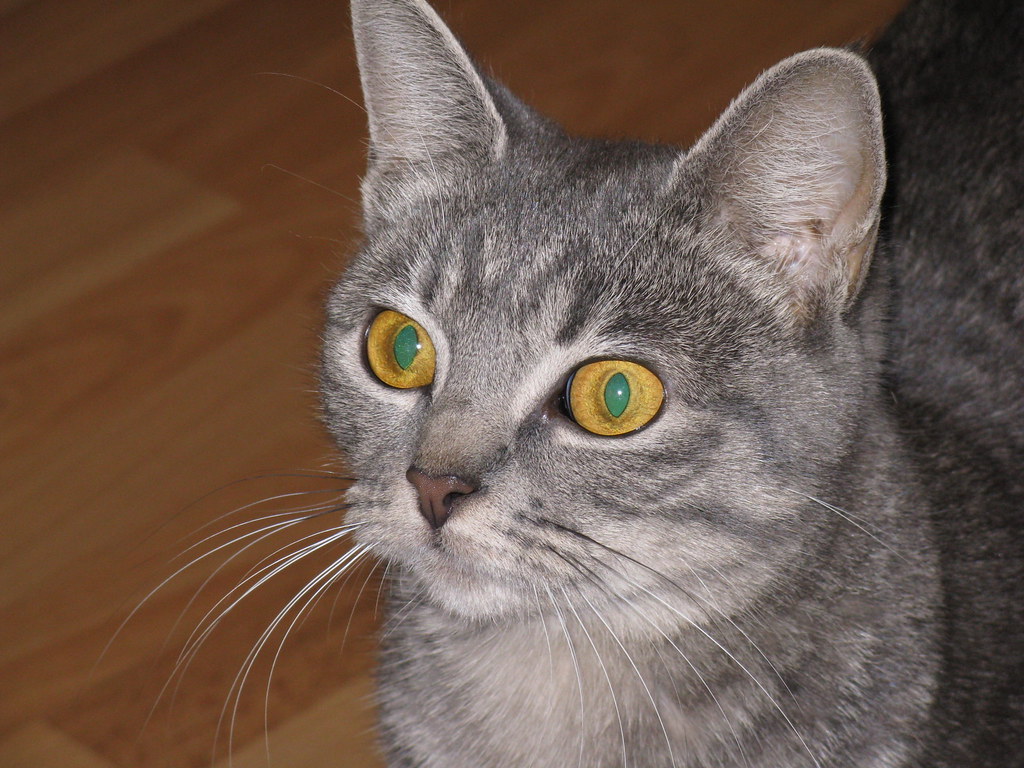
Sometimes the flash does weird things to the cat's eyes.


Look at this full-size (click) to see the hills and valleys in the irises. Is that the muscles contracting to respond to the flash, or an optical illusion?

This world is so full of mysteries ...
.

Monday, July 07, 2008

Woah! What is this all about?

This is weird ...

We were visiting with a neighbour this afternoon in his back garden, when I saw, on a toolbox, an ant. Nothing unusual about that; there were ants all over his place. But this one was behaving oddly, running around and around in a circle a couple of inches in diameter, always clockwise. I took a few photos, blurry ones because it was running fast.


We came home and I made tea. While we were drinking it, Laurie suggested that I could videotape the ant. Good idea: I finished my tea and walked back to the neighbour's place. (All that rigamarole to define the time span; 15 minutes to half an hour.)

The ant was not on the toolbox any more, but my neighbour thought it had gone down the crack. I moved the toolbox a few inches, and sure enough, there it was, going around in circles.

Here's the video (27 seconds).

.

.

Note how the ant responds to the fuschia petal when it blows into its pathway; it deals with the obstacle, then returns to the circling behaviour.

I checked out some of the other ants in the vicinity; they were all behaving normally.

What is going on? Some sort of parasite in its brain? Poisoning?

Anybody know?
.

Tuesday, December 04, 2007

Fell asleep at my desk

Question; how is it that my pillows on the bed have to be just "so", or I can't sleep, but I can manage to sleep with my head on papers on the desk?

And now I've woken up, at 2:30 AM.

And I'm going to bed.

Tuesday, November 27, 2007

Help wanted; identify these, if you will

Last week, at Crescent Beach, we noticed this large bull kelp caught on the pilings of the pier. The tide going out dragged it into the sunlight, and we could see these white jelly-like things on it.


I had never seen anything like this before. Can anyone identify them?

Laurie climbed through the railing onto a slime-covered board a few inches wide and bent 'way around the corner to take this shot. I almost had a heart attack.


I hung over the railing, zooming in as far as I could.


Cropping and increasing contrast to show the things more clearly. Click on the photo for a full-size view.

How about it? Does anyone recognize them? Are they what they look like to me?

Help!

Monday, August 06, 2007

Weekly Five

I have been remiss; I missed last week's five science links. I was going to make up for it by posting 10 tonight.

But I just went over the whole last week of my web browsing and discovered that most of my time has been on Google, looking for marine life or insects. Repetitive, mostly.

So, stretching the concept a bit, my "science" will include nature photography. And one question, since Google has been no help at all; maybe someone out there has an idea.

Beasties: Sand bubbler crabs. This was down a blind alley on my Google search. Interesting, even if far afield; I wasted a good hour on these. AbelKane Adventures, Wikipedia and a photo on Flickr.

Julie Zickefoose discovers a new cockroach. Not my favourite animal, but then, I spent too much time in Texas battling with cockroaches the size of mice. This one seems a little more congenial. A slowpoke.

An article on insect photography. I adapted a technique from here.

And this, from yesterday. Amazing and funny and somehow sexy, even if I'm not a spider. A jumping spider mating dance. From Zooillogix.

Nude mice, and why coffee is good for me. From The Cheerful Oncologist.

Owls and heat relief. Scroll down to the end of Susan's post. That last photo is a classic begging for a caption. Can you think of one?

How to make a lemon battery. From YouTube.

PZ is Mostly Normal. I'm not. (I got a 38) How about you?

And, the question:

I found this on the beach last week. This is the 4th I have found so far, at Boundary Bay and off the Ladner dykes.
And no, it isn't a scoop of chocolate ice cream. It is a piece of what looks like pumice. It's rock, but it floats. I have had them in water for 3 days to see if they would get water-logged and they are still as buoyant as ever.

The ones I have found vary between marble-size and pea-size.

Somewhere, I think I heard something about bubbles of lava. I know there are great floating beds of pumice in some areas of the ocean. But none of the photos I found, or websites dealing with this, show little round balls.

Anybody have any hints?

~~~~~~~~~~~
Update: I just found Carnival of the Blue II over on Malaria, Bedbugs, Sealice and Sunsets. Lots of good links!

Wednesday, July 18, 2007

Jawbone of an Ass

... or something similar. A horse, maybe.

And this introduces a mystery.


I picked up this bone in the bush outside of Chase, in the BC interior, a few years back. And carted it all the way home because it intrigued me; what was it from, what was it doing out in the bush, with no other bones in the vicinity?

At home, I put it aside and forgot it. Cleaning out old junk a few months ago, I found it again, and put it out on the patio; better there than in my cupboards.

I kept hearing this odd clicking from outside, after that, and finally investigated. There was a black squirrel chewing at it, banging it against the table it was on. I have watched since then, and he comes back every day or so to have a go at it, chewing away as if he were a dog.

Here is a closer look at the end; see the tooth marks?

Why would a squirrel be doing this? Any ideas? Anybody?
Powered By Blogger