Friday, December 16, 2011

A few more birds at sunset

Coot with a blond streak

Low, reddish light wreaks havoc with body shapes and feather tones.

Mallard on ice, with reflected office building.

Reifel Island,  December 9th.

Thursday, December 15, 2011

Catching the red eye

This black crowned night heron was sleeping soundly in a tree by the Reifel Island warming shed, but I made too much racket, and he opened a bloodshot eye to glare at me.

Sorry about that. I'll go away quietly now.

His scientific name, Nycticorax nycticorax, translates as "Night raven night raven";  repeated twice, emphasizing that he really, really appreciates being left to sleep in the daytime. He works the night shift, hunting the same grounds as our great blue herons do in daylight, catching frogs, fish, crustaceans and other small animals.

He's not a raven, but got the name, doubled, because his call is like a crow's. Listen to it here. (Cornell "All about Birds")

From Cornell's "Cool Facts":
Young Black-crowned Night-Herons often disgorge their stomach contents when disturbed. This habit makes it easy to study its diet. ...
Adult Black-crowned Night-Herons apparently do not distinguish between their own young and those from other nests, and will brood chicks not their own.

Wednesday, December 14, 2011

Brainy dust

I was sweeping the kitchen floor, when a speck of dust escaped from under my broom and ran for cover. Not fast enough; I was faster.

"Dusty", running still, under glass. She's about 1 to 1.5 mm long, not counting legs. It's hard to measure a critter that won't stop running.

Smithsonian Science posted an article yesterday, entitled "Brains of tiny spiders fill their body cavities and legs, Smithsonian researchers discover." They measured the brains of nine species of spiders, of all sizes, giant to pinhead size, like Dusty, here.
As the spiders get smaller, their brains get proportionally larger, filling up more and more of their body cavities. ... “The smaller the animal, the more it has to invest in its brain, which means even very tiny spiders are able to weave a web and perform other fairly complex behaviors,” said William Wcislo, staff scientist at the Smithsonian Tropical Research Institute. “We discovered that the central nervous systems of the smallest spiders fill up almost 80 percent of their total body cavity, including about 25 percent of their legs.”
I am amazed, but this does help to explain the ability of such a tiny bit of life to hunt, build webs, and escape dangers like my broom. I'm trying to imagine these legs, full of brains down to the knees. And brain surrounding the heart and lungs, the digestive system and muscles.

When she lost half a leg, did she lose IQ points?

Until I had time to photograph the spider, I kept her in a plastic container, 1 inch tall by 1 inch diameter. She spent her time building a messy web; when I opened the container, I found her hanging upside-down in the center, hoping to catch some lunch, no doubt.

I moved her, took photos, and released her to go back to work patrolling corners for dust mites and other invisible (to me) beasts.

A while later, I found a carpet beetle near the bedroom window, and dropped it into the same container without thinking. (I may not be as smart as a spider.) When I went to look at it, I found the poor beetle all tangled up in sticky web.

Carpet beetle, cleaned up. He's almost 3 mm. long.

Walking on the bottom of a leaf. Note the hooked claw.

Tuesday, December 13, 2011

Holes in the water

We stopped on a shady curve in the trail at Reifel Island, where a mixed flock of ducks, dabblers and divers together, rested in a shallow, muddy little bay. I tossed in duck seed, and they splashed, up-ended, dived, collided, and occasionally fought, each after his preference.

Northern pintail, coot, and mallards.

I was surprised at how well the water seemed to hold its shape, sometimes bubbly, sometimes in a slow upwards splash, sometimes leaving depressions and outright holes in the surface, even after the ducks had moved on to the next handful of seed. Could the mud content and the temperature, just this side of freezing, have anything to do with it? Or were our cameras faster than usual? Or have I just not been noticing?

Scaups and mallard rear ends.

When the divers went down, they carved out a hole for their head and made another for the feet, rolling from one to the other. (Look closely at the duck in the middle, above.) In our photos, several of these double holes show up with no diver visible at all.

I'll have to watch the water more closely next time; maybe that's the way it always is, and I've been distracted by the ducks themselves.

Monday, December 12, 2011

Mute swan, on water, on paper

Last month, I posted a photo of a mute swan at the Westham Island bridge:


One of my readers, the artist Elva Paulson (Elva Field Notes), loved his pose, and did a painting based on it, which she posted on 100 Paintings Challenge. We (Laurie and I) love it!

Isn't he beautiful?

To see more of Elva's sketches and paintings, visit her blog, or the Challenge blog. (8 other artists post there, too. The challenge refers to the goal of posting 100 paintings in a year. Elva is on her second 100.)


Sunday, December 11, 2011

Talking sandhills

One of the hoped-for highlights of any visit to Reifel Island is meeting some of the sandhill cranes. This Friday, we found five, three together on the office lawn, and two near the outer edge of the Sanctuary.

In the shade of the office building. Probably the  year-round resident pair.

The Reifel Island website has a helpful, up-to-date page on the sandhills.

If there are just three birds, there is a very high probability you are looking at our resident pair and this year's young.

Laurie took this next photo between the rails of the fence:

This would be the youngster, or colt, born last May. His forehead is showing some red now, but it is still spotty. Compare it to October's photo.

By the outer path, we found another two small cranes, but these have the full red adult forehead. The young adults congregate with groups of other 1 to 5 year-olds, until it is time to find a mate.

"Is that a bag of food I see?"

By November, numbers generally drop to just our resident pair plus a select small group of visiting birds (less than 10 usually) that then spend the winter together. In the spring our pair chases out all other cranes, including their own young from the previous year, and defend the 300 hectare Sanctuary as their territory.
.
"It is! Gimme!"

These two cranes were more talkative than any I have met before. Every minute or so, one or the other would open a wide beak and let loose with a long, rattly squawk, sounding rather like a heavy barn door with very rusty hinges.

"Thank you! More, please!"

Listen to the call. (All About Birds, Cornell.) The youngsters' voices were not quite so resonant as this.

Saturday, December 10, 2011

Sunset over Reifel Island

We started out for our afternoon walk late, delayed by conversation with neighbours, and slowed, once on the road, by the fast-dropping sun in my eyes as we drove west. We arrived at Reifel Island about the time we normally would be leaving, with less than an hour before they started closing the gates.

I'm glad; otherwise, we would have missed this.

A hot orange sun slips over the horizon,

painting dried grasses with warm light,

and highlighting the red-brown of a hooded merganser.


The sun drops out of sight, but the orange light spreads upward,

tinting even the sky opposite.

The moon rises in the east, over pink mountain peaks. It will turn red towards morning, so another visitor tells me.

A Skywatch post.

Thursday, December 08, 2011

Wishing for ice

I have been tidying up my storage disk, reviewing and deleting old photos, sorting and renaming. I was surprised to realize I had been wearing my down jacket last November; here it is December, this year, and I'm still wearing my summer rain jacket. Either I've gotten younger (unlikely), or it's been unseasonably warm.

With that in mind, I checked over the November/December 2010 photos more carefully. It was definitely colder:

November 23, 2010. The lagoons at Reifel Island were frozen solid.

Looking down from the warming shed onto the frozen pond.

Aside: coots are even more ridiculous on ice than they are on land or water. Ducks walk, carefully but neatly; only when they come in for a landing do they skid on their bellies far beyond where they planned. But coots ...! They try to run, as if they were running on water, but it doesn't work, and they scramble across the ice flapping their wings madly, squalling, skidding from side to side. They can't stop, either, without belly-flopping, feet one way, wings the other. I'd like to see them on snow, though. They may be quite proficient at that: they're wearing snowshoes, after all.

December, Centennial Beach duck pond. Thin ice, even down here in the "banana belt".

All the ice we've gotten this year. An inch deep, in the birdbath one morning, gone by noon.

December, 2010, Boundary Bay. The north shore mountains are snow-capped.

If I put my rain jacket in storage, will the weather co-operate and freeze? Or will that just guarantee another two weeks of rain? Should I be dreaming of a grey-green Christmas?

Wednesday, December 07, 2011

Hopalong, how you've grown!

Two  months ago, Laurie brought me a spider on a tip of a pine branch. It was so small, so nearly transparent, and so active that it took two weeks to get a photo; it must have been about 4 millimetres long by then.

Hopalong, on a pine needle.

I kept it, and a second like it, in a jar for a month, then transferred them to an old, scratched-up aquarium with a fresh batch of pine tips and the latest crop of fruit flies from my trap in the kitchen. They've been hard to see, hiding among the needles, mostly.

Hopalong, not hiding too well at the moment.

But yesterday, one was out on the side wall. She had just molted, and was resting above the abandoned exoskeleton, stretching herself out into her fresh skin, still soft.

Growing up.

The old molt. She splits the body, then shucks it like a coat, pulling the 8 legs out last.*

And now she measures about 8 mm fangs to spinnerets.

(I had to photograph her through the scratchy glass; she's just as excitable and hoppy as ever. I edited out most of the scratches, but didn't touch her in the photo.)

*I found this YouTube time-lapse sequence of a tarantula molting. This can take from an hour up to 12 hours, including the drying time, when the spider is too soft even to right itself.


Sunday, December 04, 2011

Tiny big cone community

I had a hankering for snails; it's been a while since I've been nose to nose with one. I poked around the garden, and found none. No slugs, either.

So I brought in an old cone from a big cone pine tree, and shook it out to see what it was hiding. One small milliipede, two miniscule earthworms, three infant slugs, four mini pill bugs; those were the bigger critters snuggled cosily under the scales.

Then there were the really teeny-tinies, starting with the snails at 2 millimetres long (Yes! I found some!), and going down from there.

"Hmm ... What's down there, I wonder?"

"I'll just slither down and see."

Pair of beetle mites*, about 1 mm. long, covered with bristles and droplets of water.

Mite, dried off, the bristles barely visible. He has a passenger, at the tail end.

Springtail, about as long as a mite, but a lot skinnier. And bouncier.

A different springtail, also about 1 mm. long.

And half their length, a variegated globular springtail. Extremely boingy.

*Thank you, Christopher!

Saturday, December 03, 2011

Friday, December 02, 2011

Now you see me ...

Wednesday had been such a bright, summery day, and we'd spent it in traffic and malls. But we got home with maybe half an hour before the sun set and the chill returned, so I dashed across the street to the vacant lot, to get at least a taste of wildness into the day.

It had been raining off and on for days, so the ground was soggy and puddly. The plants, except for a dandelion and two fading daisies, were all dry stems and crumbled brown leaves. Only the goldenrods held some shape. I picked a handful and headed home; the sun had already dropped behind the evergreens to the west, and the wind was cold.

When I spread out the goldenrods at home, two spiders and a black stick that wriggled dropped out.

I posted the tiny jumping spider yesterday; here is the second:

Hunting spider, blending in to the shapes and colours of the goldenrod.

I tried to photograph the spider on the table; she wasn't interested, so I caught her and replaced her on the plants. Then I spent a good part of the evening looking for her. She was so perfectly camouflaged that I could look straight at her and not see her until she moved.

She's somewhere in here, but I can't see her. A few seconds after I took the photo, there she was, in plain sight.

Goldenrod flowerhead, now fluff, and seed with parachute.

The tiny stick that wriggled was about the size and colour of the seeds. Worse; it was clinging to a bit of the fluff, which made it look even more like a seed. But it was moving, slowly. I brought out the lens.

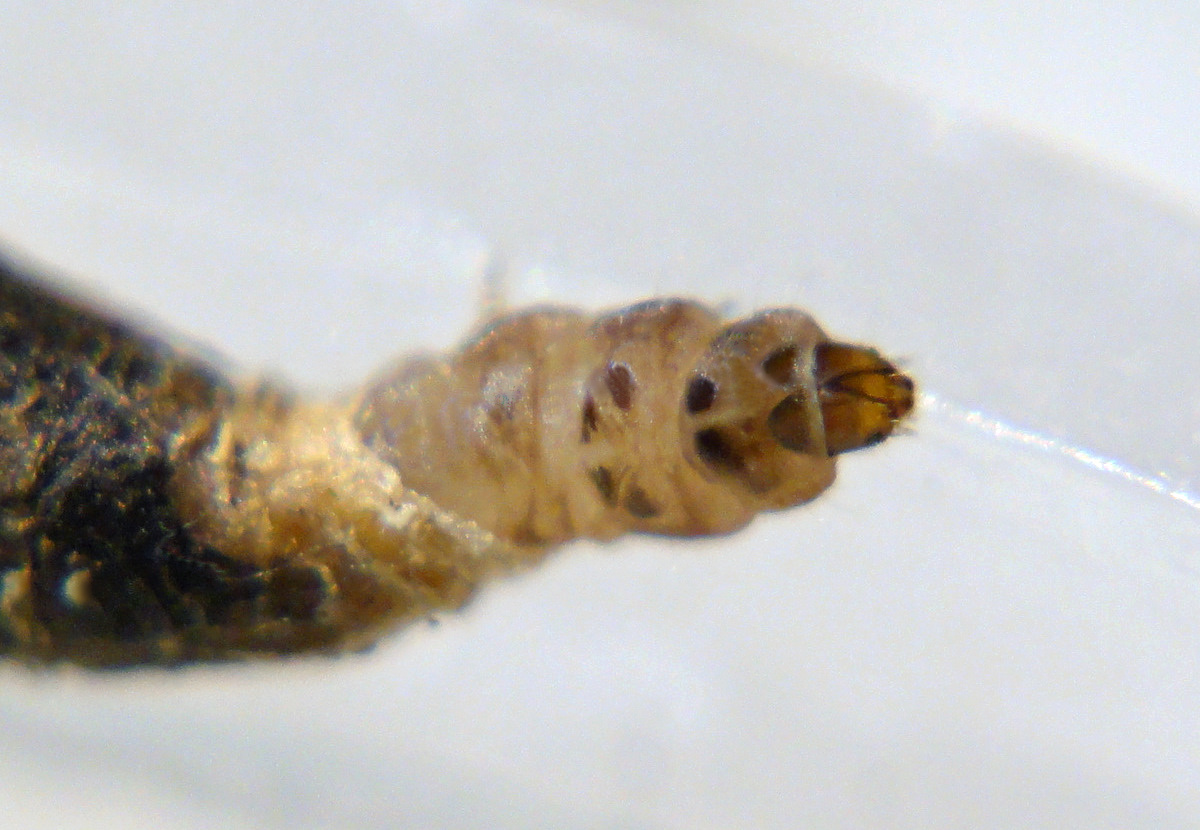
Bagworm moth larva, 5mm long, with only head showing.

It's a bagworm, the second I've seen. (Dahlica triquetrella, on a wall.) This one doesn't look like the same species, however; the body pattern is different, and instead of sand, it has chosen bits of the goldenrod to make its case.
Head end.

Bagworm moths live all or almost all their lives in these cases. Some species are parthenogenic; there are no males, and the females lay their eggs without needing fertilization. These females never leave their cases. Males of other species do, but only to find a female and mate; then they die.

Larvae hatch from eggs inside the mother's case, leave and immediately start building their own case, using materials and patterns specific to their species. The case has two openings; the head end, where the larva stretches out to walk about and to eat, and the tail, which allows the worm to excrete waste materials.

Some cling to walls or stone, where they eat lichen. Some hang from evergreen trees and eat the needles; a large infestation can seriously damage the tree. This one probably eats goldenrod leaves, and it seemed, watching it, that it was also eating the fluffy parachutes of the seeds. The leaves are dry and brown by now, anyhow. When it has eaten enough, it will pupate and wait out the winter in that state.

Making the case out of local material, in this case goldenrod fiber, helps to protect the moth by making it blend in to the background. Once I had replaced the bagworm on top of the goldenrod, and looked to see how it was managing, I couldn't see it at all.

I shook out a lot of the fluff and examined it, shaking it and blowing it about for a while, until I found a second larva.

4mm. Much more timid; by the time I'd brushed the seeds away from it, it had retreated into the case and refused to come out.

One last critter showed up in the pile of sorted fluff; a small ladybug, the eleven-spotted lady beetle, seemingly dormant. When I moistened the cloth she stood on, she woke, took a drink, groomed herself, struggled past the clinging seeds, and flew away.

Coccinella unidecimpuntata, 5 mm. long. Not camouflaged at all.


Thursday, December 01, 2011

Big, scary monster. Not.

I brought home a bouquet of dead goldenrods, long gone to seed. Two spiders hopped out as soon as I put them down; this one was a mere running speck.

Jumping spider, about 2 mm., toe to toe.

For a few years, after a bad experience, (here: "Sleeping with tarantulas") I was afraid of spiders. That has long passed, but a ridiculous residual effect remains; when a jumper jumps in my direction, I recoil. I can't seem to control it. Even with this little critter; I'd get him in focus, and then he'd jump. He is so small that one of his leaps took him only an inch or two, and even if he "got" me, he couldn't do any damage, but still, I'd shy away. Once I even dropped my lens on the floor. He finally jumped back into the goldenrod fluff, and I let him be.

I'll post the other spider, and what else I found, tomorrow.

Powered By Blogger