Showing posts with label sunset times. Show all posts

Friday, December 20, 2024

Turnaround day

We made it! The shortest day of the year has arrived, and will soon be past. By Sunday, sunset here on the 50th parallel will be one whole minute later, at 4:22 PM.

These little minutes matter, the farther north (or south) you go. In Bella Coola (52°N), where I used to live, sunset today was at 4:16; they got 7 hours, 40 minutes of daylight. Up at the top of the Yukon (64°N), the sun didn't come up at all, and won't until the 28th of this month.

Here's a pair of mallards relishing the warm sunlight.

The male's purple head colouring may depend on the angle of the light.

Happy Solstice!

~~~~~~~~~~~~~~~~~~
¡Por fin! Ya llegó el dia más corto del año, y ya mañana habrá pasado. Para el domingo, aquí en el paralelo 50°N, el sol se pondrá un minuto completo más tarde, a las 4:22. 

Estos minutitos tienen su importancia, especialmente entre más nos acercamos a las regiones polares. En Bella Coola (52°N), donde antes vivía, el sol se puso hoy a las 4:16, dándoles 7 horas, 40 minutos de luz de dia. En el pueblo más norteño del Yukon (64°N), el sol ni siquiera apareció; no subirá hasta el dia 28 de este mes.

Foto: una pareja de patos ánade real disfrutando del calor del sol. El color morado de las plumas de la cabeza del macho probablemente depende del ángulo de la luz; el color usual es un verde intenso.

¡Feliz dia del Solsticio!


Saturday, December 04, 2021

Another view of Hoomak Lake

The weather people promised us snow earlier this week. We got rain instead. Now they say it will be tomorrow.

I got impatient; couldn't wait. So I drove north, looking for snow. I found frost, in spots, but no snow. So much for taking things into my own hands.

I went as far as Hoomak Lake, just out of Woss. 120 km. from home, but as it works out on the map, only 20 km. to the north; the rest of the distance, as the crow flies, is to the west, to the interior of the island, where it should be colder.

But there was no snow; barely any even on the mountain peaks.

Hoomak Lake was still and dark when I arrived, at 3:30. The sun had dropped behind the mountains already, though sunset wasn't due for another three quarters of an hour.

View from the bottom of the stairs and the beginning of the trail.

Trees and mist on the far shore.

I'd been here several times before, once, three years ago, looking for snow, which I didn't find that time, either. Still, it's a pleasant drive, between evergreen walls and through drifting mists. Worth it, snow or no snow.

~~~~~~~~~~~~~~~~~~~~~~~~~~~~~~~~~~
Los meteorológicos nos prometieron nieve hace unos dias. Llovió. Ahora dicen que neverá mañana.

Se me acabó la paciencia. Tomé la carretera hacia el norte, buscando nieve. Encontré, en algunos sitios, escarcha. No había nieve. No se le fuerza la mano a la Sra. Naturaleza.

Llegué hasta el lago Hoomak, cerca de Woss, a 120 km. de la casa, pero viendo la mapa, solo 20 km hacia el norte; lo que resta del camino, a vuelo de pájaro (si es que algún pájaro alguna vez vuele en linea recta) va hacia el oeste, hacia el interior de la isla, donde debe hacer más frio.

Pero no había nieve, casi ni en las cimas de las montañas.

El lago Hoomak estaba quieta y oscura cuando llegué, a las 3:30 de la tarde. El sol ya se había ocultado tras las montañas, aunque la puesta del sol, sin montañas en medio, no sería hasta las 4:15.

Fotos: el lago desde el pie de las escaleras, y el principio de los senderos que dan vuelta al lago, y el lado opuesto del lago, con la neblina.

He estado en este sitio varias veces. Una vez, hace tres años, tambien vine buscando nieve sin encontrarla en esa ocasión tampoco. Pero de todas maneras es un paseo lindo, entre muros formados por los árboles, y pasando por neblinas flotantes. Vale la pena, con o sin nieve.

Wednesday, September 25, 2019

Sky and reflections, Oyster Bay

I'm still catching up with photos from the last busy month. These are from Oyster Bay, just after sunset, three weeks ago.

The sky, facing northwest. The sun has dropped behind the trees. 7:44 PM

And the reflection of that sky in the water of the bay.

Sundown today was earlier: 7:12 PM. And sunrise tomorrow will be at 7:11 AM. We're down to 12 hours of sunlight, and it is shrinking fast.

A Skywatch post.

Monday, June 25, 2018

Late afternoon at Oyster Bay

In these days, just around the solstice, the sun slides down the sky slowly, so slowly. At this latitude, 50°North, it reaches its highest point at about 1:30 PM, not directly overhead, but at about 64° above the horizon. And sunset comes at 9:30 or thereabouts, so it takes 8 hours to drop those 60°.

At 8:30, the sun is just under 8° over the horizon. And its light is orange. I wandered in the pre-sunset dusk at Oyster Bay.

Hawthorn, half green, half red, side-lit. 8:27 PM.

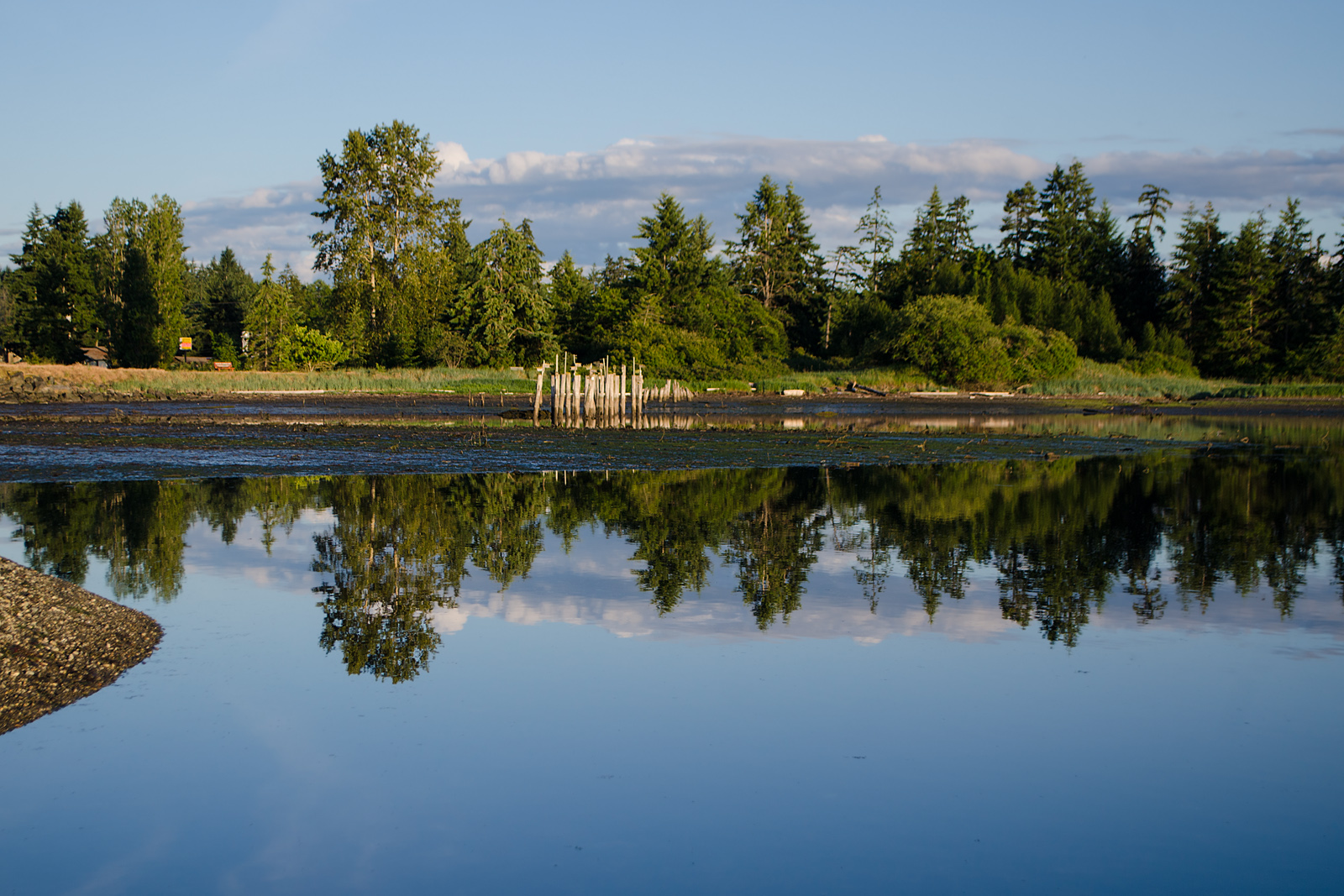
View from the far side, looking south. The pilings and purple martin nest boxes, normally a dingy grey, look warm in this light. 8:31.
Pilings, eagle, rocks. Looking from the breakwater east across Georgia Strait. 8:32.

New pickleweed plants and sand ripples, inside the breakwater. 8:38 PM.

8:54. The sun no longer reaches this area of the shore, but there's still a reflected mauve light from the sky. Daisies and logs.


Sunday, October 09, 2016

One hour before sundown

It's that time of year again, when the days grow noticeably shorter. The long, slow dawns, when the orange glow warmed my window at 5:00 AM, are no more. Now, I make my morning coffee in the dark. And a short walk on the beach after supper means that I come home with the headlights on.

This is Stories Beach, just south of the 50th parallel north, four days ago, starting at 5:47 PM. Sunset is at 6:49.

5:47, looking Southeast. The sun is off to my left, 9° above the horizon.

Looking up.

10 minutes later, looking Northeast. The beach and the lower trees are in shadow already.

And today's sunset will be at 6:40, nine minutes earlier. Our day will be just over 11 hours long. It will go down to 8 hours by mid-December, with the sun barely 16 degrees over the horizon. Time to dig out my winter coats!

I've been looking at a site that gives all sorts of data on the sun's position at any given time or place, SunEarthTools; a map, graphs, tables; anything you can think of to ask. One curious number I noticed is that noon today is at 1:08 PM. Words mean different things depending on the context.

A Skywatch post.

Wednesday, November 25, 2015

5:09 PM

It gets dark early these days, here at the 50th parallel north. Driving home this afternoon, I had to stop near Oyster Bay to look at the moon. It was only a few minutes after 5 o'clock. Sunset was at 4:27 PM.

Taken with the little pocket Sony, using the car as tripod.

The hints of pink at the top of the hills are snowy mountain peaks on the mainland, lit by a full moon.

Tuesday, February 17, 2015

Burning sky

We've had a couple of glorious days. Yesterday and today, I took Laurie down to the Garden Walk to bask in the sun. (He basked, I sought out too-narrow stripes of shade.) And then, on the way home this afternoon, I was treated to a head-swivelling, eye-blistering sunset. Pink everywhere overhead, to the south, east, and north; and to the west, flaming yellows and oranges, simmering down to reds in my rear-view mirror as I turned into our driveway.

The traffic was heavy, so I pulled into a bus stop by an open schoolyard near home to get a photo.

5:43 PM. 

This was 10 minutes past the "official" sunset time, as given by timeanddate.com. But isn't this a sunset?

Looking at one of the sunrise/sunset pages, I noticed that our "sunsets" fall after sunset, during the twilight period. To confuse the matter, there are three ways to measure this twilight: there's Civil twilight, Nautical twilight, and Astronomical twilight.

Definitions:
  • Sunset is
 "when the last part of the Sun is about to disappear below the horizon (in clear weather conditions)." (And over a flat horizon.) (timeanddate.com)
  • Civil twilight
... begins at sunset and ends when the geometric center of the sun reaches 6° below the horizon (civil dusk). Civil twilight can also be described as the limit at which twilight illumination is sufficient, under clear weather conditions, for terrestrial objects to be clearly distinguished; at the ... end of evening civil twilight, the horizon is clearly defined and the brightest stars are visible under clear atmospheric conditions. (Wikipedia, CT)
  • Nautical twilight begins
... at sunset and end(s) when the center of the sun is 12 degrees below the horizon. In general, nautical twilight ends when navigation via the horizon at sea is no longer possible. (Wikipedia, NT)
  • And Astronomical twilight goes on until 
... the center of the sun is 18 degrees below the horizon. From the end of astronomical twilight in the evening ... the sky (away from urban light pollution) is dark enough for all astronomical observations. (Wikipedia, AT)
There's a handy diagram on Wikipedia that sort of clears this up.

Wikipedia, by TWCarson


Complicated, and irrelevant to my purposes. I would like to propose a useful new category of twilight: Fiery Twilight. I'll define it as beginning when the first tinge of yellow or pink shows up in the eastern sky and ending when the last hint of glowing embers dies in the west. The length of time will vary, except that it will invariably be too short.

Another Skywatch post; two this week!

Powered By Blogger