Showing posts with label Bioblitz. Show all posts

Sunday, September 28, 2008

In a handful of duff

It keeps raining. And raining. Except for the times I can't get out of the house.

And I had a Bioblitz assignment to do this week.

So, I improvised. I did a mini-blitz. I went out with a pair of plastic bags and filled them, one with the duff from under a nearby pine tree, the other with assorted cones dropped in the vicinity. And inside, warm and dry, and with good lighting, I examined my haul.

There were a dozen Douglas fir cones, and a few tiny cedar cones. I was surprised not to find any cones under the pine tree; last year they were plentiful. I think the squirrels have been harvesting them, because I did find quite a few individual seeds, broken off the cones.

Douglas fir.

And the duff, about two double handfuls: It looked good, brown and rich and fragrant. Just the stuff for acid-loving plants and insects looking for a warm place to winter. Sorting through it, I found:
  • pine needles and seeds - the bulk of the duff
  • dying ivy leaves
  • skeletons of deciduous leaves
  • tendrils of assorted mosses
  • broken twigs
  • tiny cedar cones
All well and good. But there were also:
  • a ball of fibers, seemingly scrapings from a plastic rope
  • strips of transparent plastic
  • a couple of chunks of styrofoam
  • shreds of treated lumber from a recent roof job.
Not so good.

A sampler of duff ingredients.

Both the bags, duff and cones, were crawling with assorted beasties, the same general mix in both.


Pillbugs were everywhere.


So were springtails.

These little guys were really hard to pin down for photographs; they would be right in front of the lens as I pressed the shutter, and by the time it had clicked, they were several inches away. I never saw them go, they bounced so quickly.

Here's the mechanism:


A long spring attachment that folds under, then releases with a snap. (This guy had been inadvertently squished; I think that's brains leaking out the top end. It's the only way he would have lain still for a photo.)

I tried to capture a springtail by floating them in water; it worked before with the little white ones. Not these; they sprung off the water just as merrily as on solid ground.

But:


Here they are, on water, directly under my lamp. They come in all sizes; some of the tiny specks are also springtails. Note those little round critters; I'll get back to them in a minute.


Detail of the previous photo. See how the springtail's feet make deep depressions in the water surface? And yes, that is just plain water.

And here's another of those little round things:


I've seen these before; they're barely visible to the naked eye. (If you know where they are, and they're on a white background, you can see a tiny dot moving.) Under a hand microscope, they're semi-spherical, reddish-black; no features visible except for toe-tips. And they're tough; I've sandwiched them between strips of Scotch tape, and watched them crawl (slowly but steadily) through the glue and out to freedom.

I don't know what they are. I've got some more Googling and BugGuiding to do.

This one was easier:


Isn't he cute? He's on the tip of my microscope tool, about as thick as a sewing-machine needle. And below him is a snail, not much bigger than he.


The snail. I don't know what species this is; I've never seen a beehive-shaped one here before.


And another snail, a bit smaller. This one is our common grove snail, I think.

There were a few of these white springtails. They scuttle in and out of crevices, always busy, never stopping...

One last photo. I am wondering about this one.


Just another pillbug. But see, down at the bottom, that black and white strip? What is that? It almost looks like another of the western conifer seed bugs, except that there are too many sections, and it is too small.

I was surprised to find no slugs, nor centipedes. A few metres away the soil is full of them. And I think I saw one tiny earthworm, but it slid out of sight into a fir cone before I could be sure.

The other half of the Bioblitz project entails identifying the finds. My eyes are burning already.
.

Saturday, September 27, 2008

Working late

I've been bioblitzing. And now I have a bunch of critters to identify. I'll post some of them tomorrow.

For now, here's a root and a creeper of some sort from next door.

See you tomorrow!
.

Thursday, September 25, 2008

Embarrassing!

Is there such a thing as foot-in-keyboard disease? 'Cause I think I've got it.

Yesterday I typed out a description of my new guests, the Western Conifer Seed Bugs, dutifully changing every "bug" for "beetle," assuming that "bug" in this case was a misnomer. I thought of double-checking with BugGuide, but, no, I was too tired for that, I decided.

So, this afternoon there is a comment from Christopher Taylor; "Ummm.... that's not a beetle." Oh. It's a bug. I looked it up; he's right. And I knew that; I'd studied the BugGuide page last year. Dumb!

(The blogosphere is a wonderful place; so many, many helpful people live in it!)

So I've gone back and made a few corrections. And I've done my homework, re-read the BugGuide page and Googled for more info.

Bug One and Bug Two are Leaffooted Bugs, Leptoglossus occidentalis. Which translates as "Western thin tongue", as far as I can make out. They're "leaffooted" because of the flattened section of the hind leg; it's like a narrow leaf, spine in the centre and all.

Here's the classification, from BugGuide:
Order Hemiptera (True Bugs, Cicadas, Hoppers, Aphids and Allies)
Suborder Heteroptera (True Bugs)
Family Coreidae (Leaffooted Bugs)
Genus Leptoglossus
Species occidentalis (Western Conifer Seed Bug)
They live on Douglas fir and pine trees, and "can be a pest". (U. of Guelph fact sheet) This is why I won't put them outside; the first ones we found, last year, were on Laurie's dying conifers. BugGuide says,
"Nymphs and adults use their piercing-sucking mouthparts to feed on sap from green cones, twigs, seed pulp, and sometimes needles of several species of pine, plus hemlock, spruce, and Douglas-fir."
And that book, "Care and Feeding of Seed Bugs as Pets," that I was looking for? I don't think I need it, after all. When the weather turns cold (about now), they burrow down into leaf litter or move into human houses to spend the winter. They do not breed indoors; they're here to sleep. In the spring, they will look for fresh Douglas fir needles to lay eggs on. Maybe I'll be able to provide some. In captivity, of course. I don't want their babies eating our trees.

Meanwhile, Bugs One and Two are not sleeping; they're wandering around their container, mostly staying close together. They wave their antennae at me when I check on them.


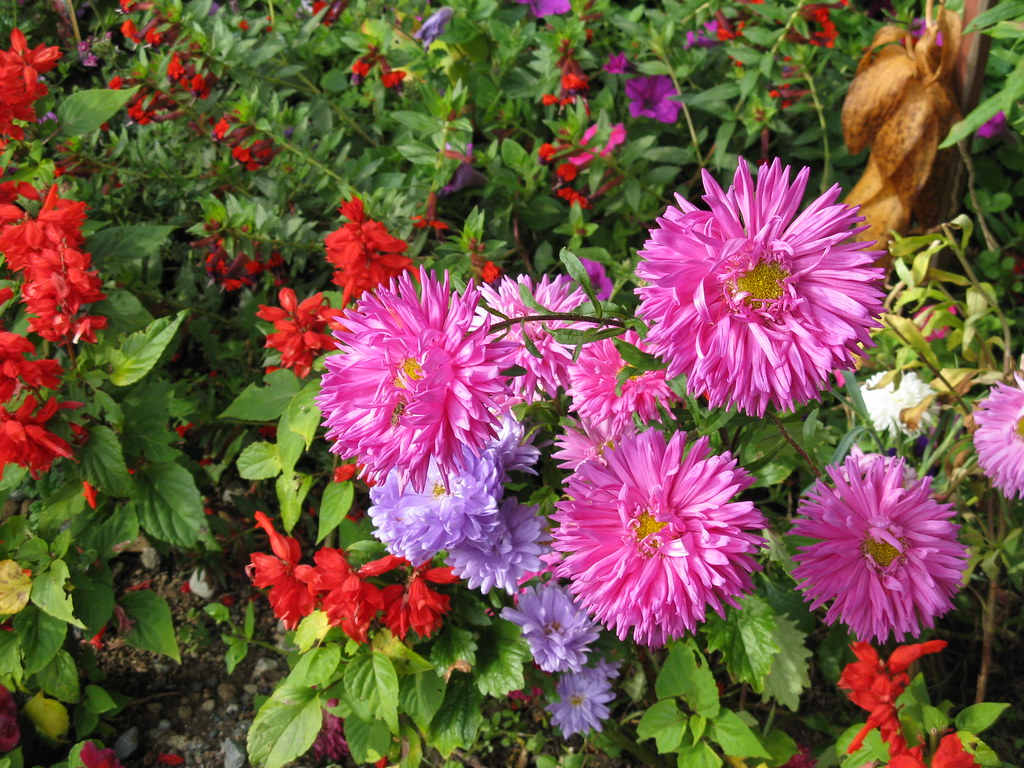
Off-topic. My neighbour's garden, yesterday.

Another thing I had forgotten; in all the hustle and bustle of the last month or so, I wasn't checking on the dates for the Annual Bloggers' Bioblitz. I found out Sunday that it is this week, Sunday to Sunday. So I think I'll do a mini-bioblitz this weekend. I do hope it's not pouring rain.
.

Wednesday, June 13, 2007

Intrepid Explorer

We've been too busy these last few days to go far afield, but we took a few minutes to check out the vacant lot across the street, the one I bioblitzed just a couple of months ago. The grass has now overwhelmed even the blackberry vines.

And now, back to chasing the clock.

Tuesday, May 08, 2007

The Case of the Reluctant Brides

In the couple of weeks since I bioblitzed the vacant lot across the street, Laurie and I have been keeping an eye on it as we passed by, watching it grow and bloom. Today, we went over to get a closer look.

The wild mustard is in full bloom, daisies (which I missed in the BB, not recognizing the seedlings) are ready to open, the Scotch broom is doing its thing. On one right by the edge of the lot, Laurie found this for me:
And a few steps farther along, a small rabbit hid under the blackberry canes, hoping to be invisible.
Birds sang and fluttered everywhere; sparrows of some sort, starlings, crows. And Laurie says he heard a red-winged blackbird. We scrambled over a few gravel piles fast turning into alder and blackberry bush, and down a shallow ditch, where kids had laid down solid boards for a path. Laurie shot a roll of film. Water, ooze, blackberries, young alders, sparrows, more blackberries. Still, it was pleasant down there, in the sunshine and out of sight and sound of the traffic.

We ended up at the small pond where I had found the water striders a week ago. It's just the remains of an old boggy creek, very shallow, only a dozen feet or so across. But very much alive:

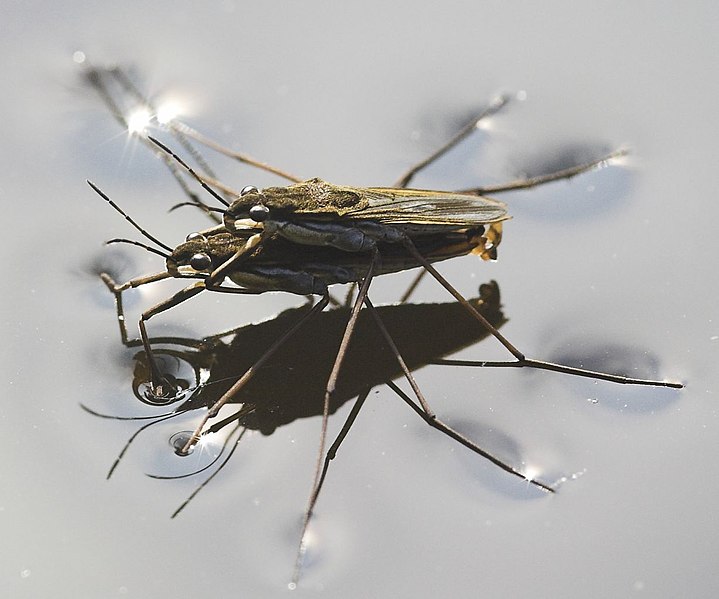
And yes, the water striders were there, half a dozen, at least. We watched them for a while before I realized that several of them were engaged in wild chases around the pond, two by two. I tried to aim the camera at them, but -- those guys are fast! It was hopeless.

I was tracking one couple when the chaser caught up with the chasee. And then, I was astounded. These two bugs started leaping together into the air. Down to the water surface, roiling it up, and up again, belly to belly. Again and again and again. At one point, their efforts took them a good 6 inches above the pond. Finally, they broke apart and went their separate ways.

Another couple ended their chase with a milder, shorter dance.

I got, I don't know by what luck, a couple of photos. Here is the first couple; you can see the ripples in the water surface marking the launching pad, the two striders above and their shadows below. Click on the photo to get a better view.

(Or, here it is, a bit larger.)
What was going on? They didn't seem to have been in a position for mating. Unless they were quicker than rabbits.

At home, I dug out my books and fired up Google.

Turns out that female water striders are reluctant to mate*. In fact, they only need to mate once in order to produce their broods. But the males want to mate frequently. Evidently, the last male to mate with a female is the one whose DNA gets passed on to the next generation.

So the males pursue the females, who flee, and then fight. Which is what we were watching.

From the Abstract of "The costs of mating and mate choice in water striders" by Locke Rowe, UBC, dep. zoology, Vancouver BC:
Mating behaviour in this species includes frequent harassment of females by males (mate searching), pre-mating struggles that may function as mate choice by females, mating which includes copulation and male mate guarding, and post-mating struggles. Each component of the mating behaviour of females increases predation risk. Escape by females from harassment by males increases the movement rate of females and predacious backswimmers are attracted to movement at the water surface. Capture success of backswimmers is almost tripled on females engaged in pre- and post-mating struggles relative to single females.
Rowe says, as reported in National Geographic News:

Males want to spread their genes far and wide and mate with as many females as possible. Females would rather keep mating to the minimum.

(skipped paragraph)

Male water striders have evolved grasping hooks that grip the female in place as he tries to mate with her. To foil the males, females have evolved spines to dislodge unwelcome lovers.

(most of article skipped)

When a female water strider has mated, she rejects all subsequent males, both high and low quality. "When she hasn't mated, she accepts the duds at the same rate she accepts the studs," said Rowe.

That explains the "dances"; they were battles, with the female winning and the male giving up.

But none of the sites I found mentioned the intriguing leaps that make up this struggle.

~~~~~~~~~~~~~~~~~~~~~~~~~

*Abstract by Rowe's colleague, Goran Arnqvist, of the University of Uppsala in Sweden.

Wikipedia, with a good photo of a mating pair of water striders.

Friday, May 04, 2007

Oh, to have the energy of a 5-year-old!

Little girl with balloon, not slowing down to notice an adult with a camera...
I could use some of that zip, kiddo. ... Please? ...

Looks like she's not going to lend me any. Oh, well...

~~~~~~~~~~~~~~~~~~~~~~~~~~~

One of the main things I learned, doing the Bioblitz, was just how much I don't know. I'm fine with the bigger things and the general categories; I know the difference between a cedar and a fir; I don't confuse buffleheads and coots, even at a distance. But when it comes to the picky details, I find myself limited to writing "Moss # 1, Moss # 2", or "white lichen, grey lichen, grey lichen #2". And beetles are beetles are beetles, differing only by colour, size and broad pattern.

So much to learn!

And there are so many marvels yet to be seen, if only my eyes were better trained!

I've been re-reading Robin Wall Kimmerer's "Gathering Moss: A Natural and Cultural History of Mosses". A beautiful small book, well-written, a pleasure to pick up and open at any page.

(Which I just did, this minute, and read, where the page fell open, "The shape of the water is changed by the moss and the moss is shaped by the water." Our relationship to our environment in a nutshell. Or should I say, sporophyte?)

I've been reading the 12th section, titled, "City Mosses". She writes about Silvery Bryum, Bryum argenteum, a tiny moss adapted to dry cliff faces and seabird rookeries that finds our vertical cities stained with pigeon droppings perfectly acceptable "cliffy" environments. It can be found in any city, from Hong Kong to New York to Quito; it travels with us. Next time I'm in downtown Vancouver, I will be looking for it.

And in the meantime, I think I have some studying to do.

~~~~~~~~~~~~~~~~~~~~~~~~~~~~
One more of those things that gets labelled "Lichen #2": this one was on the pathway near the cabin where we stayed at Chase Creek, in BC's interior. We haven't been able to find a name for it. Do you recognize it?
That was resized, for easy loading. Here is a detail section, at 100% (after you click on it, of course). I can see some tiny cup-like structures on the top of the "leaves".
Spore cases? Or what?

Tuesday, May 01, 2007

Just a peaceful walk

After the concentrated seeing of the Blogger Bioblitz, a casual, aimless stroll down Cougar Creek was just what we needed.

The last couple of times, we started at the West end; this time we drove to the east end of the official park area; on the Google map, the green belt went on east, skirting school playing fields. We crossed the bridge to the east, following the creek.
A caucus of crows was holding a meeting in the trees above us and a couple of mallards dabbled in the deeper pools. Sunlight shone through open bush on the other side; we crossed on a line of rocks. Beyond, the red elderberry flowers were in full bloom.
The bush opened out into a clearing behind a row of housing, marked off with logs and mowed, not too closely. A red-headed woodpecker shouted out from a tall cottonwood; although we looked from all angles, we couldn't see him. As we walked, he moved ahead of us, calling from one tree after another, always invisible.

The creek turned north, between the playing fields and a cement retaining wall topped by chain-link fence. Along here, it was lined with cherry and plum trees, blooming pink and white.

The green belt over the creek dwindled to a mere line; we crossed it and turned back, across the field. And here we found the trilliums*, three of them. A real treat; something we don't expect to see close to populated areas. *(Or should it be "trillia"? Laurie says he doesn't bother himself with such a trivium.)
And back in the "Park" area, proper, where this winter dozens of mallards dozed and puttered, mushrooms dotted the ground. Some, I hadn't seen before.
Detail of the gills:Time to turn around. At the bottom of the main lagoon, a kid was fishing. He told me that once, he caught a big carp. Enough motivation to sit patiently for hours.
And a final delight. A queue of ducklings trailing Mommy across the lagoon.

In spring, for us, every day becomes a Bioblitz.

Monday, April 30, 2007

More photos added. ..

... to the Flickr Blogger Bioblitz group. (And that's a tongue-twister, of sorts. Or I should have been in bed long ago. Or both.) Including a "Mystery Tree", and some unidentified seedlings.

Help needed. Do you recognize any of them?

And here is another mystery: this is a wild mustard. The flowers are brilliant yellow. (See detail, below.) To the naked eye, this mass of buds looks a dark purplish-brown, as do the stems. I took the photo in lieu of making notes. At home, the photo showed the buds as bright pink. Today I went back, found the plant, and brought a sample home. Took a pile of photos, under different light conditions. Same thing; the purplish mass always turns out a bright pink.

Why? Can anyone explain this?

Sunday, April 29, 2007

Loaded a stack of photos...

... to Flickr. And drove Laurie crazy looking up elusive weeds in all our manuals and guide books.

Another couple of days, and we'll be back to normal. Except a bit sleepier.

For now, I have 6 books stacked on the desk, 7 on the floor, 2 back on the shelves as they turned out to be useless, and 3 on Laurie's desk. The invertebrate ones are still waiting in their places. I never realized how many of these books we had!

Just checking in, to make sure she gets counted. Her mate is small and black, and doesn't pose.

Saturday, April 28, 2007

Bioblitzing the creepy crawlies

Years ago, I read a book by David Bodanis, The Secret Garden: Dawn to Dusk in the Astonishing Hidden World of the Garden, and was enthralled by this vibrant, busy, teeming world that we so heedlessly pass through. I have since spent many a peaceful evening examining the inner parts of tiny plants and the beasties that live on and under them.

So it was inevitable that I would start and end the Bioblitz with my eye to the magnifying lens.

This, however, is my first attempt at photographing what I am finding. Not the best photos, but definitely better than my scrawled notes and sketchy drawings.

These are all inhabitants of the soil around my back door; most too small to see with the naked eye; some, even with the 40x hand microscope are just little dots with legs. You'll see what I mean here:
The larger beetle-like thing* here was barely visible without a lens. Up on the left, there is a tinier beetle. I found quite a few of them; I could see them walking around, sometimes see that they are green, sometimes even see the two antennae. Nothing more.

About that larger one; they hop, like a grasshopper, whenever they are disturbed. There were many of them in a couple of pine cones. (*Later: these have been identified as springtails, Orchesella cincta. See note below photo on Flickr.)

This one was big enough to track without a lens. I caught him and photographed him on a paper towel. About 1 1/2 cm. (5/8 inch).
A millipede. Very tiny.
A pale brownish mite.
A centipede, the "large" variety. A bunch of smaller ones were impossible; too fast, too pale, too tiny.

A spider on a clay pot.
On the bottom of that pot, collembola, springtails. Isn't this one cute? I love these things; so busy, always, so shiny white, even in a bucket of mud, so irrepressible. (See note by Frans Janssens.)
Miniatures: red, shiny mites. These guys are really, really tough; put a piece of Scotch tape on them to hold them still while you go for a better light, come back and find them walking around in the glue. Pour alcohol on them, to disolve the glue; they slow down a bit, then recover and go on about their business as if nothing had happened. (Other beasties would die instantly.) I don't know if they get a hangover.
And macro-biota; an earthworm, trying to get out of the light. I left this in the larger size, so you can click on it and see the "ribs"; it looks rather like one of those outlet hoses for your dryer.
Not photographed: something that scuttled out of view very quickly. Baby slugs. Sowbugs. And, in the water in the bottom of that pot, some tiny swimming worms, about the length of the springtails, but much skinnier, of course.

~~~~~~~~~~~~~~~~~~~~~~~~~~
Flickr Blogger Bioblitz Photo Pool

Thursday, April 26, 2007

Notes along the way: Bioblitz homework

Later tonight, animalia from my lawn.

But for now, bits and pieces picked up as I organize and fill out my notes:

  • Centipedes have one pair of legs per segment. Millipedes have two (mostly). They move them in sequence, so it looks like a wave moving down the body. So the one I found in the vacant lot was a centipede. One closer to home (and smaller) was a millipede.
  • Sow bugs and pill bugs are not the same. Pill bugs form a ball when disturbed; sow bugs do not. (And I always called them all wood bugs, rolled up or not.)
  • Google images works, unless you don't know what you're looking for. It helps to have at least a genus name.
  • It was Montia exigua. Was. Now it's Claytonia exigua. At least I found it.
  • Carex macrocephala is red-listed.
  • Something weird: I am not in the least squeamish about assorted bugs and beasties, but whenever I see a photo of a millipede on someone's finger, I shudder involuntarily.
  • Bug Guide is a great source. Of bug id, naturally.
  • "Although they look white to the human eye, many springtails are beautifully colored. Since they are so small, people can't see the colors without a microscope." From The Field Museum.

Tuesday, April 24, 2007

Golden blondes, with mud: Bioblitzing the vacant lot

It rained all morning, as expected. Which was just as well, because I had work to do. But around supper-time, the sun came out, brilliantly. I grabbed a sweater and my camera and headed across the street.

There was a young guy, 20ish, poking at something in the leaf litter at our gate. I stopped to see what he was doing, and he came over, holding something on a twig. A small vertebra, he said, probably from a raccoon. How it got to our gate, he didn't know; there were no other bones in evidence.

He wanted me to take a photo, which I did. I explained what I was doing with the camera. "You'll find raccoons over there," he said. "And skunks."

It definitely is raccoon and skunk heaven. A boggy, weedy field, a stand of small weed trees, and a huge mound of blackberry bushes; no human can enter there, no hawk or eagle attack. And all around, houses with garbage cans to raid.

The north end, though, is flat and open, with a trail of sorts. Which I skipped, cutting across along the edge of the blackberry thicket, keeping to the hummocks of grass, where it was drier. (Much good that did me; one of the dry-looking areas turned out to be deep, soft mud.)

The field boasts a grand mix of weeds. Tall bog grass, escaped turf grasses and buttercups form the base, interspersed with trailers of blackberry, on its way to claiming the whole area. Mixed in, thistles, clover, dandelions, vetch, dock, two varieties of horsetail, bindweed, sorrel, broom and young alder trees. There are others that I can't identify, this being the pre-flowering season. In the pools, rushes and green slime.

(I'm going to be busy the next couple of days, just looking up the species names!)

And, as it happens with far too many vacant lots, the area was littered with castaways from the houses around. A bookcase, well rotted. Drawers, likewise. Two tires, car and truck. Assorted remnants of carpet, old fans, a propane tank, moldy lumber, one nice shoe and wind-blown fast-food containers. As expected.

But these additions are often used as havens by the smaller residents. I turned over boards and the small tire, and things scuttled for fresh cover.

Except for the slugs. They oozed. Easily photographed, were it not for the precarious footing. I got a few decent shots, anyhow.

First discovery: a tiny grasshopper on a board. About 1 cm. long.
Slug # 1. More or less a normal slug for this area, but still rather small; it's early in the year. Compare with the sowbug below him.
A black beetle on dry reeds. He didn't stay around for a second shot. 2 cm.
Water striders, on the lower left of the photo. (Click to see the indentations their feet make on the water.) These were at least 2 cm. long; a tiny, blackish one was too fast to catch.
Another slug. This is more like the ones I find in my garden plot, across the street. Brown, but probably the common gray slug, which varies in colour.
A snail shell, the common local variety. The resident seems to have left home.
Here's where things start to get strange.
An earthworm, burrowing through one of those compressed-wood planks.
A sowbug and a -pede (centi- or milli-? I counted 20 legs. Something more to look up.) Hiding in the angle of an up-turned desk drawer.
On that tire, I discovered a blond slug. I had never seen one around here this colour; Googling, I found its mate in the UK.
(And look closely: is that another black beetle in the tread?)
On the same tire, a tiny golden spider, in a big hurry.
A golden beetle. This one was about half the size of the black ones, and in a position where I could barely reach across with the camera. Sorry for the poor quality of the photo.
And the find of the day: an albino sowbug, on the bottom of another board. I didn't know such a thing was possible.
And no, I didn't see any raccoons. Nor skunks. Maybe if I went back at midnight, with a flashlight.

~~~~~~~~~~~~~~~~~~~~~~~~~~~~~~
Flickr Blogger Bioblitz Photo Pool.
Powered By Blogger