Showing posts with label western conifer seed bug. Show all posts

Tuesday, October 25, 2022

Bugs and a bug

I bought a replacement for my 6-year-old computer on Saturday, and have spent the last three days arguing with it, trying to get it to work with me. Getting there. There are a few more bugs to get rid of in  the photo handling programs.

Meanwhile, here's a bug I didn't mind keeping:

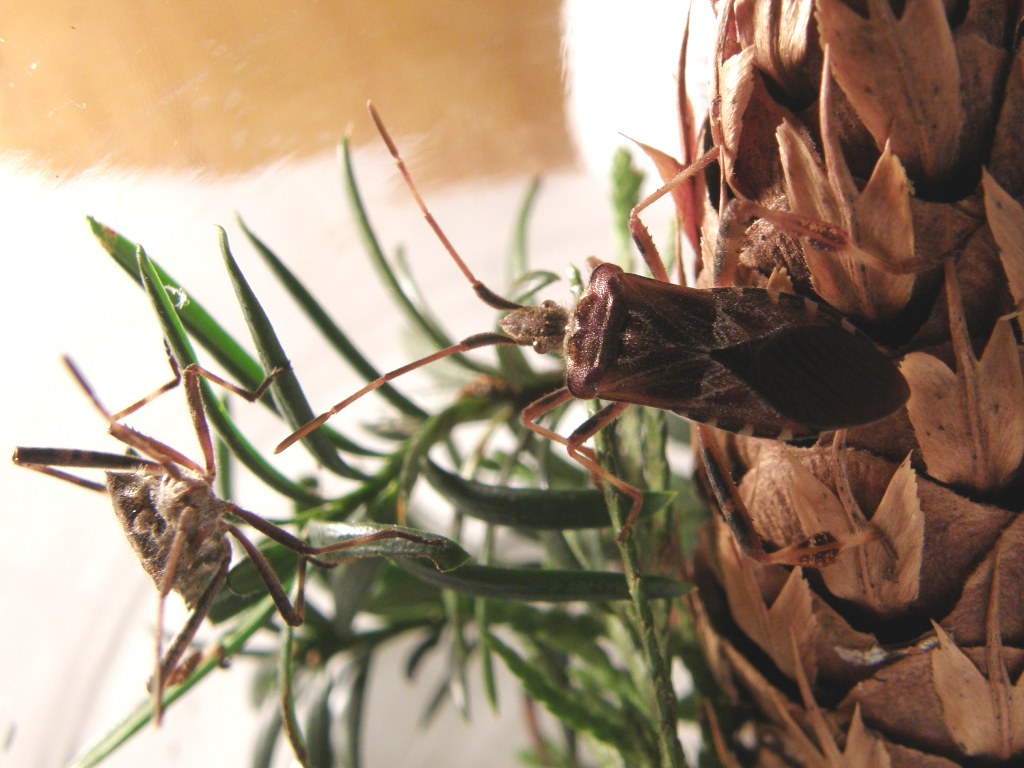
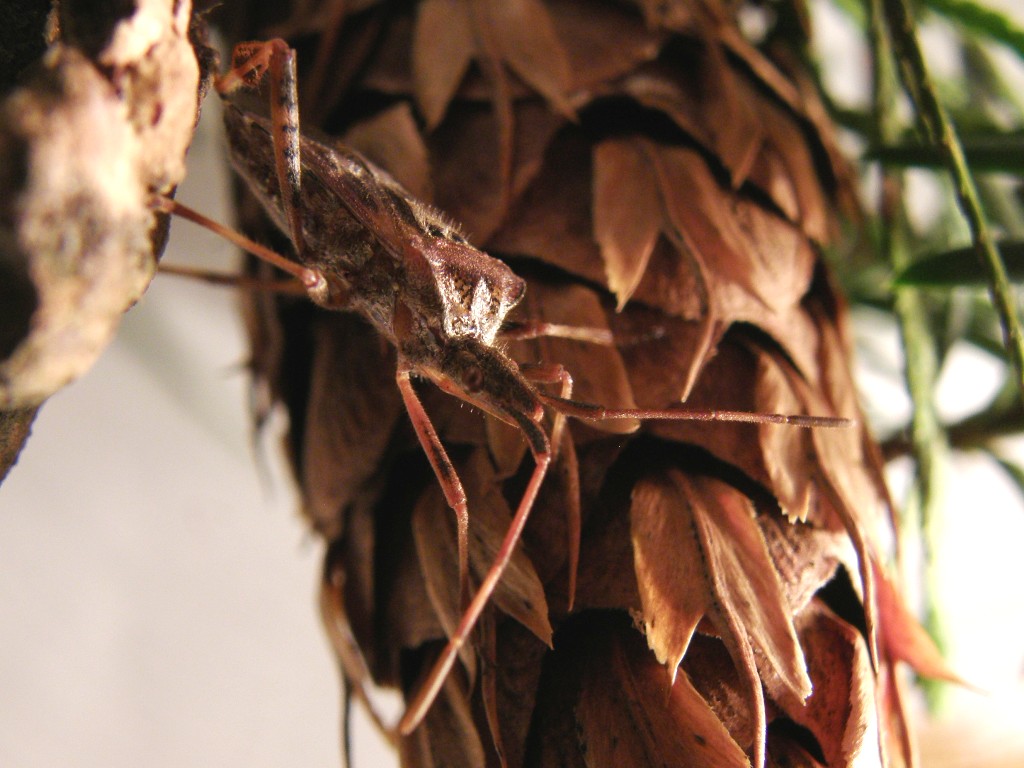
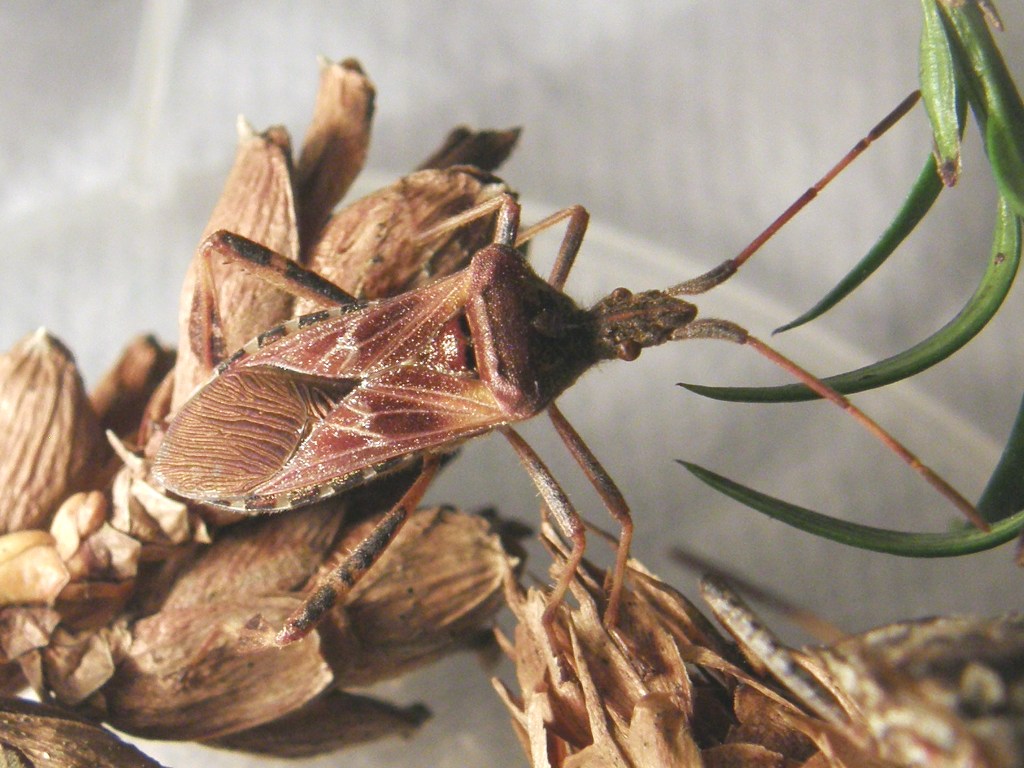
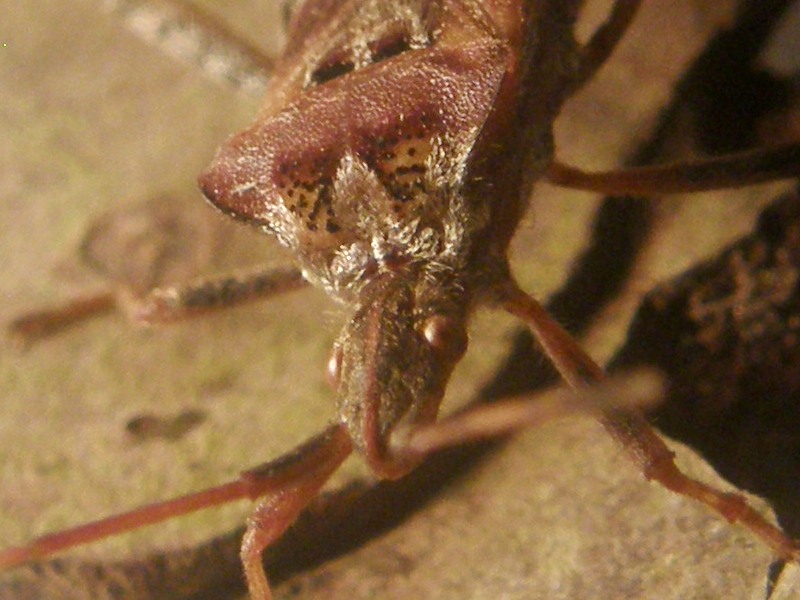
Western conifer seed bug, Leptoglossus occidentalis.

He was on the wall of the Information post at Elk Falls, probably looking for a way inside. These seed bugs look for a warm spot to hole up for the winter in; human houses are favourites.

And it's raining! About time!

~~~~~~~~~~~~~~~~~~~~
Mi computadora andaba cogeando; tiene 6 años, mucho para una computadora en estos dias. Me compré una nueva el sábado, y he pasado los últimos tres dias tratando de convencerla a hacer las cosas a mi manera. Casi, casi. Me falta ajustar los programas que organizan y procesan mis fotos, y ya.

En inglés se dice que estoy eliminando los insectos, los "bugs". Y aquí hay un insecto que no tengo que eliminar.

Foto: una chinche americana de los pinos, Leptoglossus occidentalis. Este bicho estaba en la pared del puesto informativo de las cataratas Elk. Probablemente buscaba manera de entrar. Estos bichitos buscan un lugar calientito para dormir durante el invierno; les gustan las habitaciones humanas.
 
¡Y está lloviendo! ¡Ya era hora!


Tuesday, October 06, 2015

Study in browns

Western conifer seed bug on Bosc pear.

He loved the pear; kept walking around and around it.

10 more days. This time the 15th, I'll be settling into Campbell River. I'm packed and ready; what's going to be difficult is moving my little aquarium, critters and all, without stressing them. I'll discuss my preparations for this in a day or so.

Wednesday, March 18, 2015

Just another lost hospital visitor

Hospitals are for humans. Multi-legged critters are not invited. But somehow, this western conifer seed bug found his way in, down the hallways, through automatic doors, around corners. And couldn't find his way back.

"Which way is the exit?"

We found him in a sunny window, on the sill. I took a couple of photos before my battery died. So instead, I picked him up and let him wander around my hand. After a bit of exploring, he flew off, smacked into the window, and dropped to the sill where we had found him.

He was all tangled up in threads and dust; no telling how long he'd been roaming, looking for a way out.

So I picked him up and carried him carefully around those corners, through those doors, down the Garden Walk, to the door to the outside. And he flew off my hand, up and away over the garden wall.


Tuesday, February 03, 2015

Swimming lesson

So the bugs think it's spring, too. A western conifer seed bug, Leptoglossus occidentalis, woke up from his winter's nap somewhere in my woodwork, and went exploring. The water in the aquarium looked good and he stopped in for a drink. I found him there, struggling, upside-down under the flow from the pump, and rescued him; salt water is no place for a landlubber bug!

I poured some tap water over him to wash off the salt, and dried him off with a J-cloth. Afterward, he was quite content to sit on the cloth and watch me, so I took a couple of quick photos.

"Thanks for the bath!"

He was quite interested in the camera, and left the J-cloth to walk up my hand for a closer look.

These bugs are always so calm, and so interested in their surroundings; as curious as kittens, but without the brain power to account for it. I wonder what goes on in their tiny heads. And whether they remember what they just discovered. Will this guy, once he gets back inside, go for a drink in the tank again?

I put him outside in the rain; it's warm enough already, and the water's fresh.

Tuesday, February 18, 2014

Bed and breakfast fail

Laurie caught this western conifer seed bug, out for a stroll around the house while the weather was warm. I housed him in a gallon jar with a tiny spider I've been watching since she was a pinhead. He liked it there; a comfortable, even temperature, a few dry leaves to hide in when he wanted to sleep, an interesting view out the door. He wandered over there every day to look at me, ask for a drink. He wasn't hungry; eating can wait for summer and running sap in the trees.

The spider wasn't a problem; she hangs out in a miniature web at the top of the jar, rarely moving, waiting for some tiny flying insect. A skinny mosquito is a week's meals for her.

I took the bug out when I cleaned the jar, and he walked tamely along my fingers, then without any fuss ambled back into his leaf litter. A friendly guy; these bugs usually are.

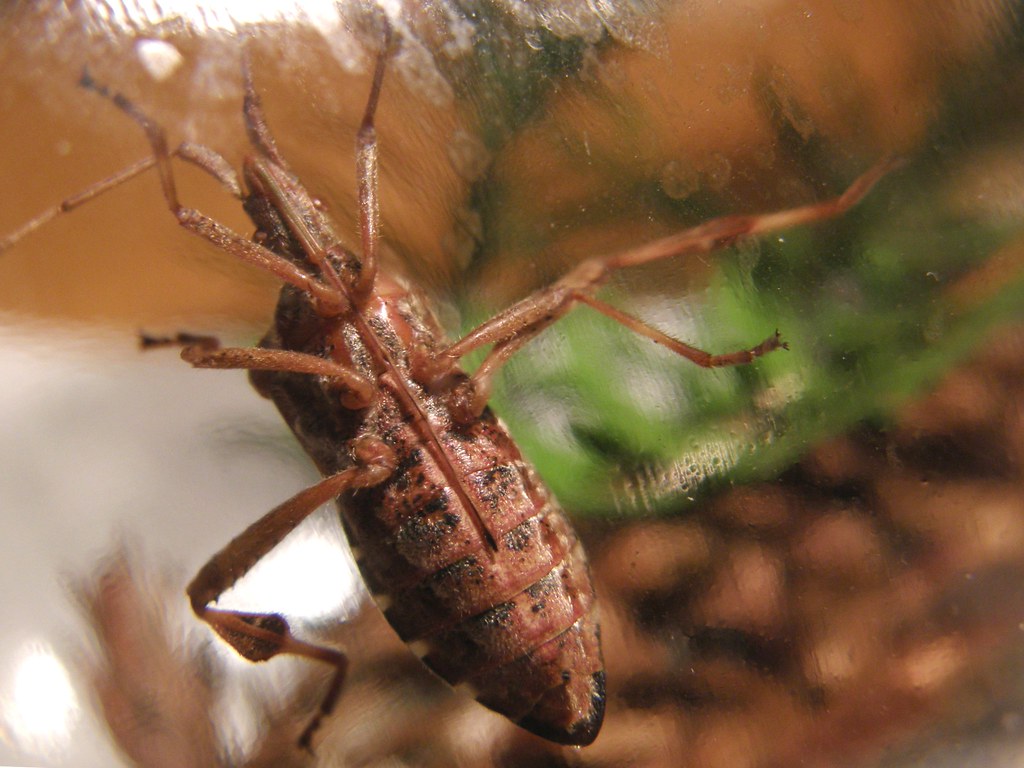
When the light was right, I took a photo of his underside as he walked on the glass.

That long needle-like tube is what he uses to bore into the trees for sap. He's missing one leg.

I planned to bring him out and get some good photos; face shots, back shots; he wouldn't mind posing. But I was busy, and I waited. And yesterday, he turned up all wrapped up in spider web, upside-down and dead.

They do like to come inside for the winter, but they are so vulnerable to spiders! But I never expected his quiet jar companion, no bigger than this guy's head, to have done him in.

So sorry, pal! Next time, when your cousin comes by asking for a warm corner, he'll get a whole jar to himself. No spiders, not even minispiders.


Thursday, October 17, 2013

Prospective tenant

The days are still sunny and warm, but the nights, this week, are getting cold, with the temperatures moving towards zero. I have brought my prayer plant in for the winter; the Christmas cactus will be moving inside in a week or so.

And the Western conifer seed bugs are also thinking of warm winter quarters. One was hanging out on my car door the other day. Not a good choice; the car sits outside all winter, in this climate.

This one (or maybe it's the same one, wising up) was waiting just outside the front door for someone to let him in.

"Can you spare a quiet corner? I'm a good house guest, friendly, don't smoke, don't sing, don't eat carpets."

Well, no. Not today. But I'm sure he'll eventually find his way inside when I'm not looking. And maybe my spiders won't eat him this year. Maybe.

Tuesday, October 30, 2012

In his natural habitat

It's that time of the year again; the Western conifer seed bugs are moving indoors for the rest of the year, as they always (attempt to) do. I found one on the window a couple of mornings ago, captured him* and brought him in, safely contained in a pill bottle.

I've photographed them before, in plastic containers, on white paper, in a glass container. I thought this time, I'd try for a natural background, and brought in a fallen maple leaf as a backdrop. It's what's around, this season; it should have been a familiar resting spot.

But no. He up and left  the minute he was freed.

Western conifer seed bug, Leptoglossus occidentalis.

The photo I managed to take while he opened his wings and flew away caught the upper part of his abdomen  It shows an interesting pattern of black chess pieces on yellow, and two red tail lights, which I had never seen before.

I couldn't see where he'd gone, but didn't worry. He's harmless, at least until spring, when his nymphs will start work on my evergreens. For now, all he wants is a warm place to sleep.

Later, while I sat reading, I saw him on the baseboard behind a lamp. A good spot; clean background, bright light. And for him, that was, really, a natural habitat, at least in the winter. So I crawled up to him and took photos.

Kneeling on the  baseboard, leaning on the wall. He stayed in variations of that posture while he looked me over.

He's very much aware of me, but not bothered at all by my proximity. Even when I touched his antenna with the tip of a finger, he didn't mind.

These are very social insects. When I've kept them in containers, they went into a sulk until I added a companion; then they woke up and started grooming and waving antennae at each other. And the more, the merrier. Even when that "more" includes a big human with a camera. This time, as I took photos, the bug suddenly disappeared. I found him right on the camera lens, checking it out.

I brushed him off, back onto the baseboard. He was fine with that, too.

"Maybe I'll just mosey along down this road, and find a nice spot to sleep."

I was about an inch away from his face. He stretched up one antenna to me, as if to say goodnight, then walked slowly off behind a cabinet.

* Or her. I still can't find any information on differences between the sexes. Maybe they're identical, to our eyes. The bugs seem to know which is which.

Wednesday, September 22, 2010

Chocolate bug

Every year about this time, we begin to find leaf-footed bugs near the doors and windows, as they come in looking for a warm place to sleep over the winter. Every year, I take photos.

I love these bugs, even though they have killed a couple of our young evergreens. They are calm, patient critters, as curious as cats, sociable and co-operative. And so elegant! And so, each year, I try to capture some of that personality on camera, with variable success.

Here's this year's attempt.


They're always neat, in their formal coat with its inset of chocolate pleated silk, and a short cape for warmth on the shoulders.


See what I mean by "co-operative"? He's perfectly willing to sit still for long photo sessions, unrestrained, on whatever background I choose for him, under hot lights, only occasionally swinging an antenna my way, as if to ask, "Almost done?"


The hind part of the forewings reminds me of those chocolates we get at Christmas.


The sides, belly, and legs are marked in a checkerboard pattern in vanilla, cinnamon, and chocolate tones.


And on the back of his head, he wears a regal crown.


Two-toned antennae bases , and a sprinkling of gold dust over all. Ready to go!


His curiosity got the better of him. He left his assigned place and came to look at the camera.


And crawled up over the lens. End of this photography session!

Now he's waiting in a pill bottle until I find a companion for him. I won't put him outside in the cold, but he's not allowed to hole up in my furniture or carpets, either.

Saturday, September 12, 2009

Storm shelter for bugs

It's that time of year again; the rains have started and the nights are chilly. And the Western conifer seed bugs are looking for winter quarters. Laurie found the first one of the season on the blinds this afternoon.

I checked back; last year, they showed up the 15th of September. In 2007, it was not until October.


First house guest.

Last year, I tried to keep two over the winter; after all, they're just looking for a place to sleep, so there is no care or feeding involved, just proper housing. They made it most of the way through, but in the spring, they died before they got around to breeding. I'll try again this year, if a second one shows up. (They like company.)


Good-looking guy, although a bit bug-eyed.

These are leaf-footed bugs. Since this one was being really co-operative (interested in the camera, and willing to pose), I took a few shots of the hind legs.


A very tiny, hairy, brown leaf.

There's a bit of reddish fibre caught in his toes. Most bugs and spiders I catch around here have some of it. Bits of my carpet? Could be. I sometimes wonder how much of my surroundings are being carted off by assorted beasties.
.

Thursday, September 25, 2008

Embarrassing!

Is there such a thing as foot-in-keyboard disease? 'Cause I think I've got it.

Yesterday I typed out a description of my new guests, the Western Conifer Seed Bugs, dutifully changing every "bug" for "beetle," assuming that "bug" in this case was a misnomer. I thought of double-checking with BugGuide, but, no, I was too tired for that, I decided.

So, this afternoon there is a comment from Christopher Taylor; "Ummm.... that's not a beetle." Oh. It's a bug. I looked it up; he's right. And I knew that; I'd studied the BugGuide page last year. Dumb!

(The blogosphere is a wonderful place; so many, many helpful people live in it!)

So I've gone back and made a few corrections. And I've done my homework, re-read the BugGuide page and Googled for more info.

Bug One and Bug Two are Leaffooted Bugs, Leptoglossus occidentalis. Which translates as "Western thin tongue", as far as I can make out. They're "leaffooted" because of the flattened section of the hind leg; it's like a narrow leaf, spine in the centre and all.

Here's the classification, from BugGuide:
Order Hemiptera (True Bugs, Cicadas, Hoppers, Aphids and Allies)
Suborder Heteroptera (True Bugs)
Family Coreidae (Leaffooted Bugs)
Genus Leptoglossus
Species occidentalis (Western Conifer Seed Bug)
They live on Douglas fir and pine trees, and "can be a pest". (U. of Guelph fact sheet) This is why I won't put them outside; the first ones we found, last year, were on Laurie's dying conifers. BugGuide says,
"Nymphs and adults use their piercing-sucking mouthparts to feed on sap from green cones, twigs, seed pulp, and sometimes needles of several species of pine, plus hemlock, spruce, and Douglas-fir."
And that book, "Care and Feeding of Seed Bugs as Pets," that I was looking for? I don't think I need it, after all. When the weather turns cold (about now), they burrow down into leaf litter or move into human houses to spend the winter. They do not breed indoors; they're here to sleep. In the spring, they will look for fresh Douglas fir needles to lay eggs on. Maybe I'll be able to provide some. In captivity, of course. I don't want their babies eating our trees.

Meanwhile, Bugs One and Two are not sleeping; they're wandering around their container, mostly staying close together. They wave their antennae at me when I check on them.


Off-topic. My neighbour's garden, yesterday.

Another thing I had forgotten; in all the hustle and bustle of the last month or so, I wasn't checking on the dates for the Annual Bloggers' Bioblitz. I found out Sunday that it is this week, Sunday to Sunday. So I think I'll do a mini-bioblitz this weekend. I do hope it's not pouring rain.
.

Tuesday, September 23, 2008

Matchmaker, matchmaker

It's been over a week since Laurie brought me that Western conifer seed bug. ** And it spent most of the week sitting alone in a plastic container, with only a few twigs off my evergreens for comfort. It was looking pretty sad, when I checked up on it last Saturday; lethargic, uninterested in life (barely twitching an antenna when I tickled it with a paintbrush).

That has changed.

Sunday morning, back in Strathcona, I noticed another bug on the floor under my daughter's window. I brushed it into a plastic bag, bundled it into my backpack and brought it home. I dropped it into the first bug's new home, with a handy pine cone for a perch.


"Aha! A companion! A new best friend!"

Immediate result; a whole lot of grooming going on. Every time I looked, one or the other beetle was busy scrubbing hands, scraping back legs, or smoothing its forewings (elytra). Antennae waved wildly, capturing data. Bug # 2 roamed about. By Monday evening, # 1 was following suit.


These are interesting bugs; intelligent, as bugs go, brave and inquisitive. They seem to have no fear of my camera lens, a bare centimetre away from their faces. They neither run away nor play dead, but instead wave their antennae at the camera; "Hi, all my fans!" One kept following the lens around, as I tried to position it where the light was good.

They wear a brick-red formal jacket trimmed with a large garnet, opening to reveal an inset of luxurious chocolate-brown silk, a red and black shirt-front with checkered trim and a thin, red tie.


Jacket. (Hemelytra or front wings)


Shirt-front, with tie. (Mouth parts, actually.)

And around the shoulders, they wear a feathery collar, with jester's corners and cream lace inserts:


"Handsome, aren't I?"

By Monday night, both bugs were alert and busy; they kept opening and closing their wings, and occasionally attempting a short flight. I caught a glimpse of a back, yellow and black, like a wasp.

It took a while, but I got a photo:


Three layers: hemelytra (forewings). Gauzy, transparent flight wings underneath. And below that, the upper abdomen.

I don't know how to tell if they are male or female. Or when, or whether they will be interested in breeding if they are opposite sexes. Something to look up. And I'll keep an eye on them for mating and/or fighting.

I'm keeping them both in the plastic container. I don't dare let them go; they, or their young, destroy our evergreens. Nor can I "put them down", not after I've been watching them for a week. So I'll have to provide a home for them, I guess.

I wonder if there are books on the Care and Feeding of Seed Bugs as Pets.

**Corrections made after input from Christopher (see comment #1). Thanks, Christopher!
.

Monday, September 15, 2008

Don't bring me chocolates!

Laurie biked down to Home Depot to look for some tools today. On the way back, he picked up a gift for me:


Western conifer seed bug.

I am so fortunate!

(Really. He knows what I like.)
.

Thursday, October 11, 2007

Western Conifer Seed Bug

This leggy character was planning to move indoors for the winter. Laurie found him on the curtains this morning.


He's handsome enough, but...

He and his family have been feasting on our trees all summer. Which was not appreciated. So, no, we are not extending our hospitality to cover the winter, as well. Sorry, guy.

From Cornell U., I learn that,
The leaf-footed bugs use piercing sucking mouthparts to pierce the scales of conifer seeds and suck out the seed pulp. The list of host plants includes white pine, red pine, Scotch pine, Austrian pine, mugo pine, white spruce, Douglas fir and hemlock. Often these trees are planted or are growing near homes, and if that is the case, the bugs may seek the nearby buildings as an overwintering site.

...

In spring these bugs move out of doors to coniferous trees nearby. The bugs feed on the developing seeds and early flowers of different species of conifers. Females are reported to lay rows of eggs on needles of the host trees, which hatch in about 10 days. Young nymphs then begin to feed on tender cone scales and sometimes the needles. The nymphs are orange and brown, becoming reddish-brown to brown as they develop. Nymphs pass through five stages and reach adulthood by late August. Adults feed on ripening seed until they seek overwintering quarters.

See that long tube down his belly, 3/4 of his entire length? That's the business end of his "piercing sucking mouthparts". Eep.

Iowa State U. tells me that,
This sap feeding is of no consequence to otherwise healthy trees.
Well, maybe. But we have a couple of new conifers that have been struggling this summer. Dropping needles, failing to thrive. So, Leptoglossus occidentalis, you are being relocated. Elsewhere.
Powered By Blogger