Showing posts with label alders. Show all posts

Thursday, November 24, 2022

And there were 'shrooms

I've been disappointed this fall in my searches for mushrooms. But in this alder wood, when I was not looking for them, there they were. Small to teeny, and only two species, but there they were in abundance.

Almost pure white with a faint piecrust edge and pale brown stalks.

These white mushrooms were everywhere. The ones in this photo were the largest, maybe 1 cm. across. The others? Too small to identify, usually too small even to get down to their level. Look:

Pinhead mushroom, stretching up through the moss.

And there were turkey tails or their look-alikes:

Chilled and exposing their undersides on a fallen tree.

They sprouted out of the trunk from top to bottom (now end to end).

This tree still stands. And the mushrooms are more the usual colour.

And a cluster of moss, for good measure.

And I'm not done yet with that walk through the alder woods. More tomorrow.

~~~~~~~~~~~~~~~~~~~~~~~~~~~~~~

Este otoño no he encontrado los hongos que siempre espero ver. Pero finalmente, en este bosque de alisos, cuando no los buscaba, ahí estaban. Pequeñitos a miniaturos, y de solo dos especies, pero ahi estaban, y en abundancia.

Fotos:

  1. Estos hongos blancos (con un leve baño de color crema claro), con los bordes ondulados y los tallos lisos y color café, pero con todo eso demasiado pequeños para identificarlos, estaban en todas partes. Estos, de la foto, eran los más grandes que vi, a hasta 1 cm. de diámetro.
  2. La mayoría eran del tamaño de este honguito; un hongo como la cabeza de un alfiler.
  3. Estos, los llamados "cola de guajolote" o "cola de pavo", Trametes versicolor, llenaban el tronco de un arbolito caído.
  4. Desde la raiz hasta la corona.
  5. En un aliso vivo, tienen el color más acostumbrado.
  6. Y una ramita de musgos creciendo en un aliso.
Y sigo con este bosquecito de alisos, con más fotos mañana.

Wednesday, November 23, 2022

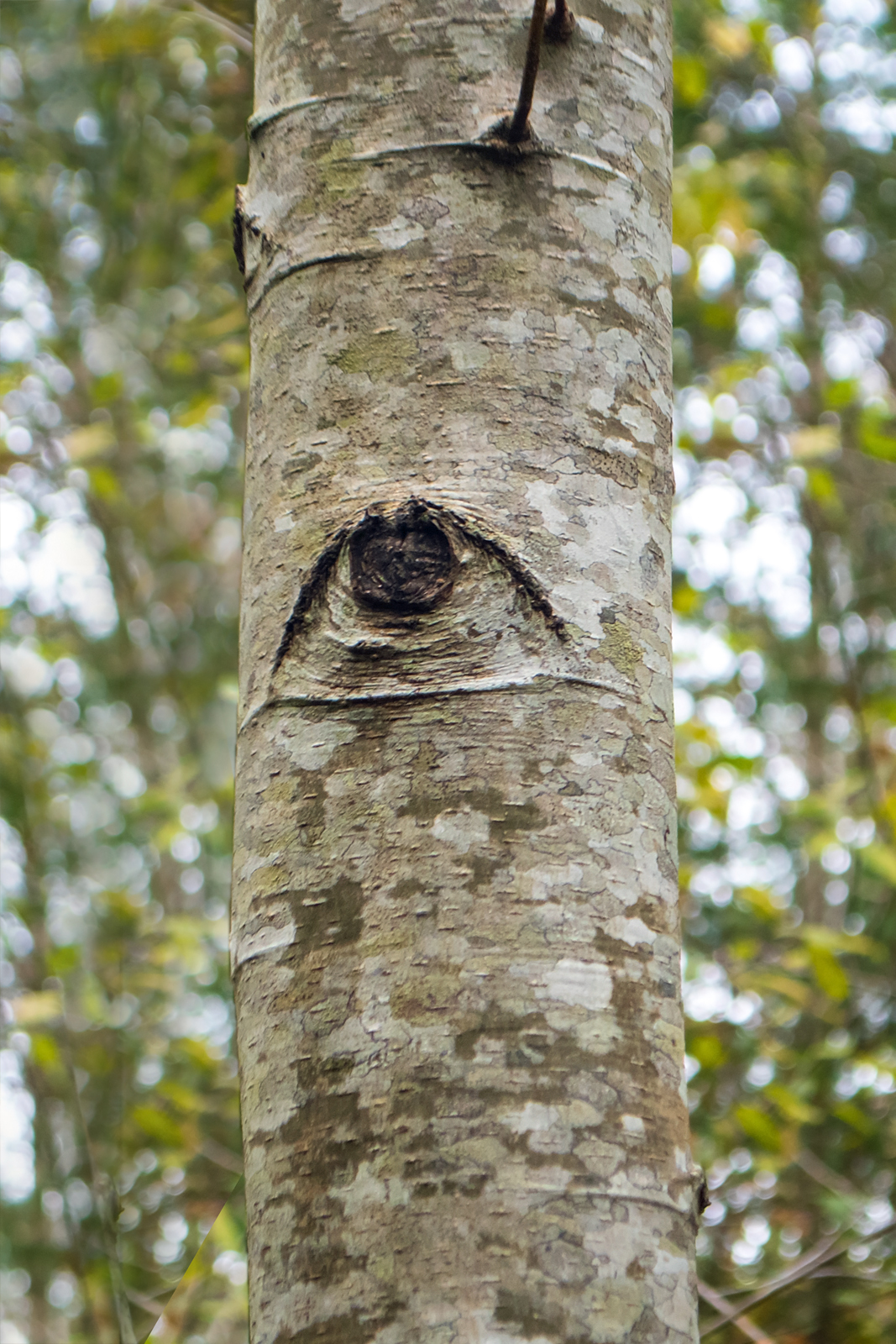
The forest has eyes

 Dryads. They've got their eyes on you ...

And they don't look happy.

Or maybe they're birds flying away.

Tree tattoo?

We walked along, speculating on the cause of this, and then a bit further along the trail, we were given the answer.

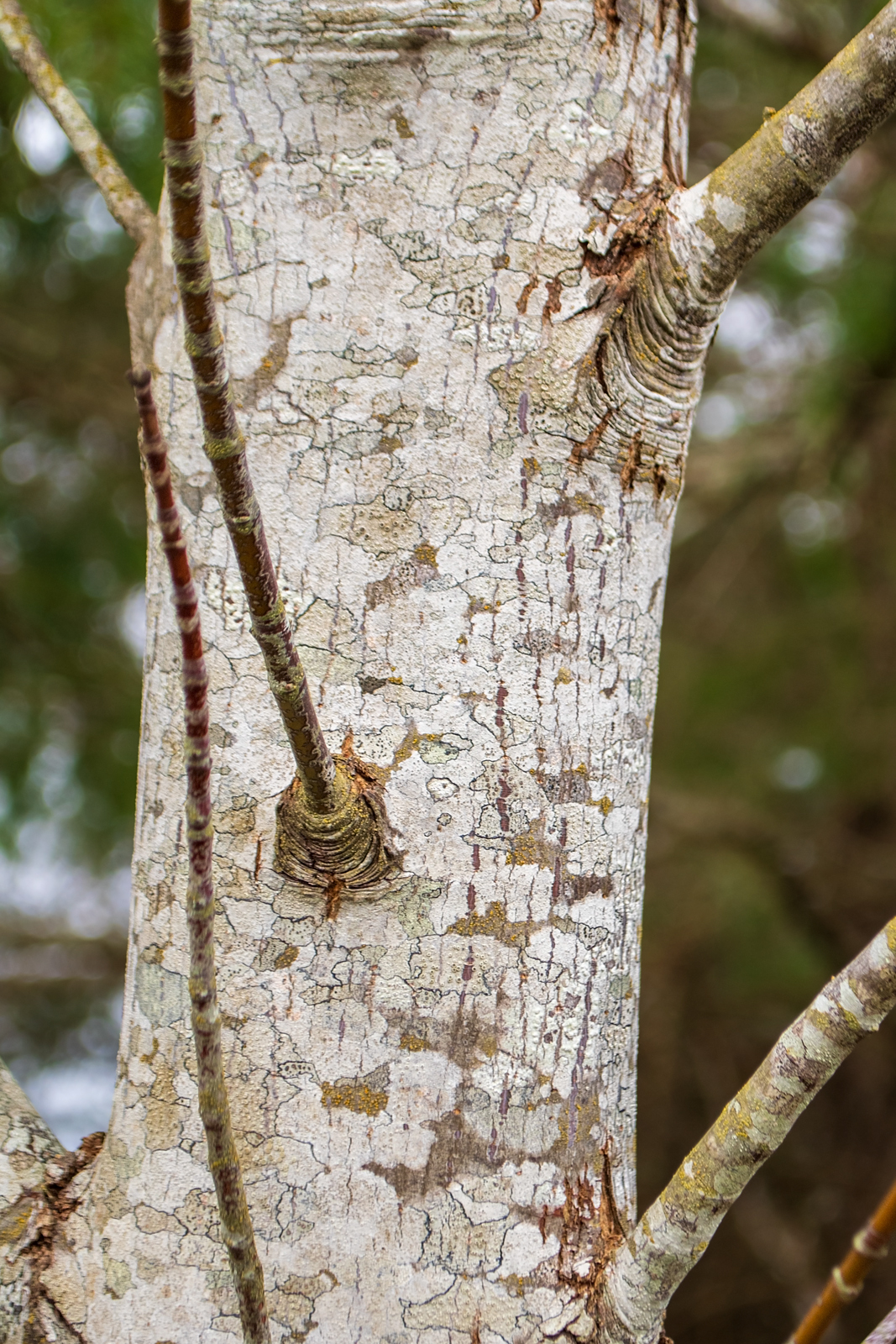
Branch insertion sites. With moustaches.

Now that we knew what to look for, they were everywhere. In my photos at home, I found another:

Smaller branch insertions, without the blatant moustaches. Oyster Bay, on the edge of the forest.

"On the edge of the forest." That's a clue. These trees, the ones with "eyes" were along the trail. Deeper into the woods, the trees wore more branches, fewer old branch scars.

On the web, I searched for tree defense mechanisms, thinking that maybe being out in the open exposed the trees to more stress from wind, snow, even humans whacking their way along. And found this explanation:
Their branches have to resist being bent down under their own weight, and both the trunk and branches have to resist being bent sideways by the wind. ... the tree lays down wood where the mechanical stresses are highest. ... It ensures that branches are strongly joined to the trunk by expanding like the bell of a trumpet at their base; stresses are concentrated where the branches join the trunk and this causes the branch to grow thicker there automatically. (Agroforestry)
And this:
Trees respond to wind stimuli at multiple levels. ...
The first response is the formation of ‘flexure’ wood on the lee side of the tree. This flexure wood is laid down along the trunk, branch bases and branch nodes. (Bee Sweet Nature Company)
And I learned a new word: thigmomorphogenesis, "the response by plants to mechanical sensation (touch) by altering their growth patterns. In the wild, these patterns can be evinced by wind, raindrops, and rubbing by passing animals." The word comes from Ancient Greek: θιγγάνω, to touch, μορφή,  shape, and γένεσις, creation.(Wikipedia)

Agroforestry and me: 
Trees mainly have to resist bending forces. (wind, snow, heavy rainfall, the weight of the branches themselves, climbing raccoons, deer rubbing their antlers, humans) ... These bending forces ... subject the wood inside to forces which are parallel to the trunk or branch; the concave side (under the branches, for example) is compressed, while the convex side (above the branch) is stretched. ... The long, thin wood cells are well suited to resist the forces; the cells on the concave side  resist being compressed, rather like pillars, while those on the convex side resist being stretched, rather like ropes. The compression would cause the under-eye wrinkles.
One other thing. This helps to explain the long scratches with raised borders.
It also is the reason why tree wounds heal fastest along their sides - bending stresses along the trunk are diverted around the sides of the wound, and so growth proceeds fastest there.
The article, "How Trees Stand Up" that I took these quotes from is well worth reading in its entirety. I have subscribed to the Overstory, where it was published, as well.

~~~~~~~~~~~~~~~~~~~~~~~~~~~~~~~~
El bosque tiene ojos.
Fotos:
  1. Las dríadas te están mirando. Aliso con "ojos".
  2. O tal vez son dibujos de pájaros volando, mostrándote las colas.
  3. ¿O tatuaje de árboles?
  4. Seguimos caminando, pensando cual sería la causa de estos ojos, y un poco más adelante, vimos la explicación. Son sitios donde crece o crecía ramas.
  5. Ya que habíamos visto uno, pudimos ver más. Y en casa entre mis fotos viejas encontré otro, este con ramas más chicas, sin los bigotes. En un árbol a la orilla del bosquecito de Oyster Bay.
"A la orilla del bosquecito." Es un indicio que apunta a la causa. Estos alisos, los que tenían "ojos" lindaban el camino. Más adentro del bosque, los árboles retenían la mayor parte de sus ramas, y no presentaban tantas de estas marcas.

En el web, busqué mecanismos de defensa de los árboles, pensando que al estar más expuestos estos alisos al clima, al viento y hasta a las actividades de humanos al pasar, resultarían con estas cicatrices. Y encontré esto:
Las ramas tienen que resistir doblarse bajo su propio peso, y tanto el tronco como las ramas tienen que resistir estar doblados hacia un lado por el viento. ... El árbol construye madera donde el estrés mecánico sea mayor. ... Asegura que las ramas se unen fuertemente al tronco por medio de ampliarse como el cono de una trompeta en su base; los factores estresantes se concentran donde las ramas se unen al tronco y esto causa que la rama se hace más gruesa en este sitio automaticamente. (De Agroforestry)
Y esto:
Los árboles reaccionan a los estímulos del viento en muchos niveles. ... La primera respuesta es la formación de madera de "flexión" en el lado opuesto al alcance del viento. Esta madera de flexión crece a lo largo del tronco, a la base de las ramas, y en los nódulos de las ramas. (Bee Sweet Nature Company)
Y aprendí una palabra nueva: La tigmomorfogénesis, que es la respuesta de las plantas a la sensación mecánica alterando sus patrones de crecimiento. En la naturaleza, estos patrones pueden evidenciarse por el viento, las gotas de lluvia y el roce de los animales que pasan. La palabra viene del Griego Antiguo; θιγγάνω, tocar, μορφή forma, y γένεσις creación. (Wikipedia)

Yo, con AgroForestry:
Los árboles tienen que resistir principalmente fuerzas que los hacen doblarse. (El viento, la nieve, el peso de hojas empapadas, el peso de las mismas ramas, mapaches que se trepan a las ramas, venados raspando sus encornamentas, humanos ...) ... Estas fuerzas de torsión ... someten la madera interna a fuerzas paralelas a la rama o el tronco; el lado cóncavo (y debajo de la unión de la rama con el tronco) se comprime, mientras que el lado convexo (arriba de la rama) se estira. ... Las células largas y delgadas de la madera son bien capaces de resistir estas fuerzas; las células en el lado cóncavo aguantan la compresión, actuando como pilares, mientras que las del lado convexo resisten ser estirados, algo como cuerdas. (Esta compresión será lo que forma las arrugas debajo de los "ojos")
Una cosa más. Esto ayuda a explicar los rasguños con bordes elevados del otro dia.
También es la razón por la cual las heridas en los árboles se curan más rapidamente en los bordes — factores estresantes de flexión en el tronco se desvían alrededor de la herida haciendo que el crecimiento es más rápido en este sitio.
El artículo referido, "How Trees Stand Up" bien vale la pena leerse todo. También yo me he suscrito al sitio que lo produjo, "Overstory".


Monday, November 21, 2022

Scratch marks and a hidden family

My friends and I were in those spooky woods to look at markings and scarrings on alder trunks. Could be bird doings, sapsuckers and woodpeckers looking for food. Or bears sharpening their claws, deer rubbing their antlers on wood. Beavers snacking on their favourite inner bark? Humans doing what humans do? Or fungi? Or ... Maybe looking more closely at the marks would give us some clues.

Today's batch I've categorized as maybe animal activity. And the trees' response to the trauma, perhaps.

Looks bearish to me. The main scratch marks started down from about my eye level.

These are the four shorter scratches, about 2 metres up the trunk.

Looking closely at the scars, I see that the tree has healed them over with new bark, but along the edges there's a raised welt. It's hard and tough; I couldn't break a piece off with my hands.

A long, single cut. 

This one has the outer welt, the inner new bark, and then another, lighter welt down the centre. A deeper part of the cut?

And then there's this one. A large wound in the trunk, and when I came close I realized that the lighter part in the centre is the heartwood. Smooth and undamaged; not what I would expect from a woodpecker hole. So what made it?

Wrinkled curtains around a boarded-up window.

But wait! What's that black spot?

Zooming in, adding light, darkening the target areas.

Do you see the spiders? A female on the heartwood, guarding her egg sac. And off on the edge, another of the same species, probably the male, waiting for her to be in a good mood.

I always blow my photos up and look them over carefully; you never know what's hidden there.

What do you think? Any ideas as to what made these marks?

~~~~~~~~~~~~~~~~~~~~~~~~~~~~

Estábamos, mis amigos y yo, en ese bosque oscuro para examinar las heridas y las cicatrices en la corteza de los alisos. Podrían ser agujeros que hicieron los pájaros, los chupasalvias y los carpinteros, buscando comida. O tal vez marcas de las garras de osos, o de las cornamentas de venados. ¿Castores comiendo la corteza roja que tanto les gusta? ¿Humanos haciendo de las suyas? ¿Hongos? ¿Qué más? Tal vez al mirar más de cerca, podríamos entender mejor.

Las fotos de hoy son las que clasifiqué como "tal vez lo hizo un animal". Y el árbol se apuró a sanar la herida.

Fotos # 1 y 2: Se me hace que esto es obra de un oso. Las marcas superiores estaban a unos dos metros sobre el suelo. Mirando las huellas, veo que el árbol las ha curado con corteza nueva, dejando un borde elevado alrededor. Este borde es muy duro; traté de despegar un pedacito, pero no pude.

Foto #3: Un corte largo, a solas. Este tiene el borde elevado, la corteza nueva en medio, y en el centro, otra linea elevada. Como si la herida fuera más honda en el centro, y no se pudo curar simplemente.

Foto #4: Esto es algo raro. Una herida, ya bien cicatrizada, pero con un espacio claro en el centro. Cuando me acerqué me di cuenta que es la madera de corazón, lisa y sin daño alguno. Muy extraño. No parece obra de un pájaro carpintero. ¿Qué sería?

Me acerqué aun más. Y ¿qué es eso, esa cosita negra en la madera de corazón? Aumenté la luz de la foto, y luego oscurecí dos areas alrededor de los habitantes de este sitio. Dos arañas; la hembra con su saco de huevos en el centro, y el macho algo lejos, esperando a que ella esté de buen humor.

Nunca se sabe que vas an encontrar en la naturaleza.

Pues, ¿qué crees? ¿Sabes quién hizo estas marcas?

Sunday, November 20, 2022

Abandoned

 It was a dark and spooky wood ...

Alders in winter

We were looking at scratches and scarring on tree trunks there in the dark. (More about that, later.) And it was dark, too dark for my camera, too dark for my old eyes. A ways off the trail I saw a blob high up against a trunk. Just a blackish, dark brownish blob, but I was curious, so I took a photo. At home, I lightened it 'way up.

What is it?

Zooming in. It's an abandoned hornet's nest, with all its levels exposed.

I counted over 100 visible cells in the top two layers. There must have been around 400 baby hornets in the whole nest.

Checking to see if my estimate was reasonable, I found this, about bald-faced hornets:
At the height of activity, a paper hornets' nest may contain as many as 400 individuals. At the end of the summer, the queen produces a few males from unfertilized eggs, and a few fertile females that will become next year's queens.
After mating, the males die, along with all the workers and old queen.
The new queens leave the nest and overwinter in protected locations. (From SILive)

And life goes on, the old home becomes compost and feeds the tree it was built on.

~~~~~~~~~~~~~~~~~~~~~~~~~~~~~~

Era un bosque oscuro, misterioso ...

Foto: un bosque invernal con alisos sin hojas.

Estábamos mirando lesiones y cicatrices en la corteza de los árboles, allí en lo oscuro del bosque, un dia gris, sin sol. Y era de veras oscuro, demasiado oscuro para mi cámara, demasiado para mis ojos viejos. A una poca distancia del camino, vi una masa arriba en uno de los alisos. Una masa café, casi negra; imposible ver qué era. Pero me intrigaba, y le saqué una foto. En casa, le aumenté la luz a la foto.

Fotos: la masa, con mucha luz resulta ser un nido de avispas abandonado.

Conté hoyitos; en los dos niveles superiores conté más de cien celdas; calculé que debe haber habido unos 400 avispitas en el nido.

Buscando para ver si mis números eran razonables, encontré esto, hablando de las avispas de cara blanca, las que tenemos por este rumbo:

En la época de más actividad, un nido de avispas papeleras puede albergar hasta 400 individuos. Al final del verano, la reina produce unos cuantos machos de los huevos no fecundados, y algunas hembras, las que llegarán a ser las reinas del futuro. Después del apareamiento, los machos se mueren, además de todos los obreros y la reina vieja. Las reinas nuevas abandonan el nido y pasan el invierno en sitios protegidos. (De SILive)

Y sigue la vida, el nido viejo se transforma en abono, y nutre al árbol donde fue construido.


Saturday, March 09, 2013

Catching a few rays

On Crescent Beach, facing the afternoon sun, spring is well on its way.

Red alder catkins, male and female.

The male flowers appear before the leaves, hanging in long yellow and red catkins. The female catkins are small, upright and green; they mature to small, brown, woody cones that stay on the tree until the next spring. Pine siskins like to eat the seeds out of the cones.

More male catkins, and a few pink leaf buds.


Powered By Blogger