Monday, April 30, 2007

Trilliums!

Today, at Cougar Creek:

More on these, plus ducklings, later. For now, back to the salt mines.

Stumble Upon Toolbar

More photos added. ..

... to the Flickr Blogger Bioblitz group. (And that's a tongue-twister, of sorts. Or I should have been in bed long ago. Or both.) Including a "Mystery Tree", and some unidentified seedlings.

Help needed. Do you recognize any of them?

And here is another mystery: this is a wild mustard. The flowers are brilliant yellow. (See detail, below.) To the naked eye, this mass of buds looks a dark purplish-brown, as do the stems. I took the photo in lieu of making notes. At home, the photo showed the buds as bright pink. Today I went back, found the plant, and brought a sample home. Took a pile of photos, under different light conditions. Same thing; the purplish mass always turns out a bright pink.

Why? Can anyone explain this?

Stumble Upon Toolbar

Sunday, April 29, 2007

Loaded a stack of photos...

... to Flickr. And drove Laurie crazy looking up elusive weeds in all our manuals and guide books.

Another couple of days, and we'll be back to normal. Except a bit sleepier.

For now, I have 6 books stacked on the desk, 7 on the floor, 2 back on the shelves as they turned out to be useless, and 3 on Laurie's desk. The invertebrate ones are still waiting in their places. I never realized how many of these books we had!

Just checking in, to make sure she gets counted. Her mate is small and black, and doesn't pose.

Stumble Upon Toolbar

Saturday, April 28, 2007

Bioblitzing the creepy crawlies

Years ago, I read a book by David Bodanis, The Secret Garden: Dawn to Dusk in the Astonishing Hidden World of the Garden, and was enthralled by this vibrant, busy, teeming world that we so heedlessly pass through. I have since spent many a peaceful evening examining the inner parts of tiny plants and the beasties that live on and under them.

So it was inevitable that I would start and end the Bioblitz with my eye to the magnifying lens.

This, however, is my first attempt at photographing what I am finding. Not the best photos, but definitely better than my scrawled notes and sketchy drawings.

These are all inhabitants of the soil around my back door; most too small to see with the naked eye; some, even with the 40x hand microscope are just little dots with legs. You'll see what I mean here:
The larger beetle-like thing* here was barely visible without a lens. Up on the left, there is a tinier beetle. I found quite a few of them; I could see them walking around, sometimes see that they are green, sometimes even see the two antennae. Nothing more.

About that larger one; they hop, like a grasshopper, whenever they are disturbed. There were many of them in a couple of pine cones. (*Later: these have been identified as springtails, Orchesella cincta. See note below photo on Flickr.)

This one was big enough to track without a lens. I caught him and photographed him on a paper towel. About 1 1/2 cm. (5/8 inch).
A millipede. Very tiny.
A pale brownish mite.
A centipede, the "large" variety. A bunch of smaller ones were impossible; too fast, too pale, too tiny.

A spider on a clay pot.
On the bottom of that pot, collembola, springtails. Isn't this one cute? I love these things; so busy, always, so shiny white, even in a bucket of mud, so irrepressible. (See note by Frans Janssens.)
Miniatures: red, shiny mites. These guys are really, really tough; put a piece of Scotch tape on them to hold them still while you go for a better light, come back and find them walking around in the glue. Pour alcohol on them, to disolve the glue; they slow down a bit, then recover and go on about their business as if nothing had happened. (Other beasties would die instantly.) I don't know if they get a hangover.
And macro-biota; an earthworm, trying to get out of the light. I left this in the larger size, so you can click on it and see the "ribs"; it looks rather like one of those outlet hoses for your dryer.
Not photographed: something that scuttled out of view very quickly. Baby slugs. Sowbugs. And, in the water in the bottom of that pot, some tiny swimming worms, about the length of the springtails, but much skinnier, of course.

~~~~~~~~~~~~~~~~~~~~~~~~~~
Flickr Blogger Bioblitz Photo Pool

Stumble Upon Toolbar

Friday, April 27, 2007

A break from making lists

Abandoned house; Turtle Valley, BC
abandoned house
And an old barn, with light shining through the roof.
old barn
Just because.

Stumble Upon Toolbar

Thursday, April 26, 2007

Notes along the way: Bioblitz homework

Later tonight, animalia from my lawn.

But for now, bits and pieces picked up as I organize and fill out my notes:

  • Centipedes have one pair of legs per segment. Millipedes have two (mostly). They move them in sequence, so it looks like a wave moving down the body. So the one I found in the vacant lot was a centipede. One closer to home (and smaller) was a millipede.
  • Sow bugs and pill bugs are not the same. Pill bugs form a ball when disturbed; sow bugs do not. (And I always called them all wood bugs, rolled up or not.)
  • Google images works, unless you don't know what you're looking for. It helps to have at least a genus name.
  • It was Montia exigua. Was. Now it's Claytonia exigua. At least I found it.
  • Carex macrocephala is red-listed.
  • Something weird: I am not in the least squeamish about assorted bugs and beasties, but whenever I see a photo of a millipede on someone's finger, I shudder involuntarily.
  • Bug Guide is a great source. Of bug id, naturally.
  • "Although they look white to the human eye, many springtails are beautifully colored. Since they are so small, people can't see the colors without a microscope." From The Field Museum.

Stumble Upon Toolbar

Tuesday, April 24, 2007

Golden blondes, with mud: Bioblitzing the vacant lot

It rained all morning, as expected. Which was just as well, because I had work to do. But around supper-time, the sun came out, brilliantly. I grabbed a sweater and my camera and headed across the street.

There was a young guy, 20ish, poking at something in the leaf litter at our gate. I stopped to see what he was doing, and he came over, holding something on a twig. A small vertebra, he said, probably from a raccoon. How it got to our gate, he didn't know; there were no other bones in evidence.

He wanted me to take a photo, which I did. I explained what I was doing with the camera. "You'll find raccoons over there," he said. "And skunks."

It definitely is raccoon and skunk heaven. A boggy, weedy field, a stand of small weed trees, and a huge mound of blackberry bushes; no human can enter there, no hawk or eagle attack. And all around, houses with garbage cans to raid.

The north end, though, is flat and open, with a trail of sorts. Which I skipped, cutting across along the edge of the blackberry thicket, keeping to the hummocks of grass, where it was drier. (Much good that did me; one of the dry-looking areas turned out to be deep, soft mud.)

The field boasts a grand mix of weeds. Tall bog grass, escaped turf grasses and buttercups form the base, interspersed with trailers of blackberry, on its way to claiming the whole area. Mixed in, thistles, clover, dandelions, vetch, dock, two varieties of horsetail, bindweed, sorrel, broom and young alder trees. There are others that I can't identify, this being the pre-flowering season. In the pools, rushes and green slime.

(I'm going to be busy the next couple of days, just looking up the species names!)

And, as it happens with far too many vacant lots, the area was littered with castaways from the houses around. A bookcase, well rotted. Drawers, likewise. Two tires, car and truck. Assorted remnants of carpet, old fans, a propane tank, moldy lumber, one nice shoe and wind-blown fast-food containers. As expected.

But these additions are often used as havens by the smaller residents. I turned over boards and the small tire, and things scuttled for fresh cover.

Except for the slugs. They oozed. Easily photographed, were it not for the precarious footing. I got a few decent shots, anyhow.

First discovery: a tiny grasshopper on a board. About 1 cm. long.
Slug # 1. More or less a normal slug for this area, but still rather small; it's early in the year. Compare with the sowbug below him.
A black beetle on dry reeds. He didn't stay around for a second shot. 2 cm.
Water striders, on the lower left of the photo. (Click to see the indentations their feet make on the water.) These were at least 2 cm. long; a tiny, blackish one was too fast to catch.
Another slug. This is more like the ones I find in my garden plot, across the street. Brown, but probably the common gray slug, which varies in colour.
A snail shell, the common local variety. The resident seems to have left home.
Here's where things start to get strange.
An earthworm, burrowing through one of those compressed-wood planks.
A sowbug and a -pede (centi- or milli-? I counted 20 legs. Something more to look up.) Hiding in the angle of an up-turned desk drawer.
On that tire, I discovered a blond slug. I had never seen one around here this colour; Googling, I found its mate in the UK.
(And look closely: is that another black beetle in the tread?)
On the same tire, a tiny golden spider, in a big hurry.
A golden beetle. This one was about half the size of the black ones, and in a position where I could barely reach across with the camera. Sorry for the poor quality of the photo.
And the find of the day: an albino sowbug, on the bottom of another board. I didn't know such a thing was possible.
And no, I didn't see any raccoons. Nor skunks. Maybe if I went back at midnight, with a flashlight.

~~~~~~~~~~~~~~~~~~~~~~~~~~~~~~
Flickr Blogger Bioblitz Photo Pool.

Stumble Upon Toolbar

Sidetracked! Bioblitzing Boundary Bay

This was not in the plans: the air around home was bad today, and Laurie's lungs were protesting. The best thing we know to do for that is to head to the shore.

So we "blitzed" the Boundary Bay beach, instead of my vacant lot.
On the beach, we found seaweeds, crabs (dead and alive) seagulls and mallards, and millions of small snails. (I have the species written down somewhere; I'll find it soon.) More or less the usual.

Coming back, we cut across the dunes. We had not been there in the spring time before; the dried beach grasses we expected were still scarce. Instead, we found these:
I have never seen these. Does anybody know what they are? Here are two more views: these are all taken from an ant's-eye viewpoint. I had to lie full-length on the sand to get them. It was silky-soft and warm, down there out of the wind.


This one looks familiar. I think I can find it in my books.

Sourgrass sprouts and tiny moss.

The moss, close-up:
More moss, with lichen, on a log:
And tiny yellow and white lichens (I think) on a burnt log:
A miniature blue flower:
And some of the grass-like plants that will cover the dunes later in the season:
Farther up the beach, close to the slough, we found silverweed:
And over the slough, violet-green swallows chased mosquitos. A beautiful end to the walk, but almost impossible to track with a camera. I got a bit of video and this photo:

Supper-time. Tired and happy. And feeling good!

And tomorrow, if it's not pouring rain, the vacant lot.

~~~~~~~~~~~~~~~~~~~~~~~~~~~~~~
Link to Flickr Blogger Bioblitz Photo pool.

Stumble Upon Toolbar

Monday, April 23, 2007

Bioblitz: the sites


After a childhood in a remote area of Vancouver Island, in a settlement with around 25 inhabitants, "greenery" was important to me, the crabs and gulls and seals as much my companions as the humans. Since then, I have lived most of my life in urban spaces, including 10 years in that most urban of environments, Mexico City. So I guess it is understandable that I have always paid special attention to those pockets of unpaved wildness the planners and developers and landscapers have somehow missed. I have learned to appreciate the tenacity with which dandelions claim cracks in the sidewalk and the versatility of sparrows which raise an extra brood through the winter, by building their nests in the housing of the lights of a covered parking lot. And the immense variety of life, under these most demanding of circumstances.

So of course, planning for the Bioblitz, I chose two of these forgotten areas.

First, my backyard. A few years back, we sold our property, and I moved into Seniors' apartments (55+; I was barely 55). I am fortunate to have found a place in a small building, and with its own garden space, a lawn and a double row of cedars cutting it off from the next development. Only one other person on my side of the building bothers with her space; the rest is mine and the birds'. A logical place to start.

Next, just across the street is a block-wide stretch of vacant space, half of it semi-fenced for a possible future development project, the rest undisturbed since the years when this was farm area, and that was a bog. What has "Mother Nature" done with this? I aim to find out, starting this afternoon.

Saturday and Sunday, though, I patrolled "my" yard. This is an area about 275 feet by 40 feet. It has been in lawn for some 25 years, and has been mowed regularly, but, apart from the two personal spaces where my neighbour and I have been building shade gardens, nothing else. Clay soil, shady and boggy. As much moss as grass, lawn weeds, occasional mushrooms. Beside it, a row of evergreens, a fence and path, another row. Ivy has taken over and had climbed most of the trees. Last summer, Laurie and I spent a day cutting and pulling it down, so now it is just at the base. There is still a lot of dead ivy up in the trees.

I am ignoring the personal garden areas in this survey; they feature non-native plants which are not expected to invade the "wild" area. The hedges, where they still survive, are box.

The first task was to catalogue the weeds in the lawn and the edging. Quite a list:
Shrubs -

  • oregon grape, mahonia aquifolium
  • salmonberry, rubus spectabilis,
  • thimbleberry, rubus parviflorus
  • wild rose, rosa nutkana
  • hardhack, spirea douglasii
  • kudzu (what th-?)
  • rhododendron, rhododendron californicum
The rhodos are native, but purposely planted. The other shrubs are volunteer.

Around the edges -
  • bindweed, convovulus sepium
  • dandelion, taraxacum officinale
  • English ivy, hedera helix
  • sword fern, polystchum munitum
  • lady fern, athyrium filix-femina
  • foxglove, digitalis purpurea
  • periwinkle
  • fringecup
  • horsetail, equisetum arvense
In the lawn itself -
  • wall lettuce, lactuca muralis
  • buttercup, ranunculus repens
  • red sorrel, rumex acetosella
  • goosefoot of some sort (probably)
  • plantain, plantago major
  • self-heal, prunella vulgaris, all over the place
  • some coarse rosettes that I can't identify; nasty ones that kill everything around them
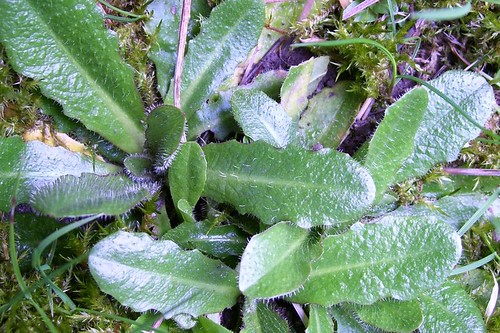
  • hairy cat's ears? (see photo above: if you recognize this as something else, please tell me.)
  • and three separate varieties of moss.
More variety than I expected; I never really looked all that closely before. This is a good exercise in observation.

Laurie walked me up and down the row of trees, pointing out the different varieties; my head was spinning by the time we'd finished. Hemlock and cedar and some variety of pines, maybe a Douglas fir. A couple of plane trees, a young cherry in bloom, three vine maples, a couple of alder, and a recent addition, just sprouting leaves. I don't know what it is, yet.

Next post: the two, four, six, eight and many-footed residents of this plot. And the preliminary survey of the vacant lot.

~~~~~~~~~~~~~~~~~~~~~~~~~~~~~~
Flickr Blogger Bioblitz photo pool

Stumble Upon Toolbar

Sunday, April 22, 2007

Busy, busy day, ending with beetles

A quick post, because I am so tired.

17 hours ago, we were on the road. First, the Fraser Valley Antique Fair in Queen's Park, New Westminster. We go to a fair every couple of months; the Fraser Valley one has been a favourite. It's a pity (from our point of view) that it seems to be gradually turning into a "Collectibles" fair. Bottles, postcards, sports cards, toys, "vintage" kitchen stuff. Interesting, in a way, but not the Japanese porcelain that Laurie is hunting.

He did find a nice teapot. Not antique, but old. And I picked up a pair of abalone salt shakers.

And saw this, that I liked, but have no place for: it's big!Laurie says they should have been ashamed, hanging that material up where kids -- kids! -- could see it.

Next, a stroll around the neighbourhood and the park, taking photos.

Coffee and shopping for organic foods, at 6th and 6th.

3:00 PM, a first birthday party. We didn't stay for supper, although the mole enchiladas they were making looked wonderful.

Birthday girl, getting ready to walk.

Home again. Out to do a first walk-around with the camera for the Bioblitz. It was cold and threatening to rain, so I brought in a couple of pine cones, shook them out and examined the beasties scurrying for cover. The usual millipedes, sowbugs, baby slugs. A frantic thing like a mini-daddy-longlegs. A bunch of black and white beetles, about 3.5 mm long. And an even tinier one I had never seen before, green and barely 0.8 mm long.

How to find out what that is, I am not sure. It can wait until tomorrow. I am going to bed.

Stumble Upon Toolbar

Friday, April 20, 2007

629 comments and counting ... Response to VTech.

What can one say about the events of last week? That has not already been said? What can one add to the comments on a post that already has elicited (so far) 629 responses? Not much, so I'll just point to that post; it speaks to and for me.

A professor at Virginia Tech writes:

"We believe in people, in their joys and pains, in their good ideas and their wit and wisdom. We believe in human rights and dignity, and we know what it is for those to be trampled on by brutes and vandals. We may believe that the universe is pitilessly indifferent but we know that friends and strangers alike most certainly are not.
...

Those of us with the slightest shred of deceny do not tell widows to deal with it, to get over it. That the world can be callous is no reason to be so myself. I know that no family could ever get over this loss, that no family should ever be expected to get over this loss -- either by themselves, by religious rhetoricians bearing false platitudes, or by inane political pundits -- but that not getting over the loss does not preclude some other kind of happiness, some other source of joy, at some other time. Not now, not in this moment, not when they have moved on, but only when it comes to them one day, like light dawning slowly.

We know the world is cold, and that only people can make it warmer. We believe we can live in this imperfection, like a child can live without fulfilling her desperate wish for wings. We rail against injustice and tragedy, not the absence of deeper guarantees."

Complete post (with 2 Updates, so far) on here, on Daily Kos.

Stumble Upon Toolbar

Three AM.

It's the end of another too-full day, and almost the start of the next.

I used to tell myself, back when the kids were growing up, "Just a few more years, until they're teens -- make that gone off to college -- make that settled down -- make that don't need a babysitter -- well, anyhow, soon now, things will slow down. And I will catch up on all the stuff in to-do file."

Silly notion.

A big file landed on my desk this afternoon. On top of a promised-and-deadlined translation. And the weekend was already overbooked.

I was tearing my hair out, when I looked up from the screen and saw this outside my window:
maple buds... and put aside my paperwork and went out to pre-survey my plot for the bioblitz. A chickadee was calling, "Here, pretty!" and the robin told me to "Cheer up!"
So I did.

Who wants life to be slow, anyhow? That's boring!

Stumble Upon Toolbar

Thursday, April 19, 2007

Red Samphire, Salicornia var. rubra, pickleweed, saltwort...

... or you may know it as "swampfire" or "sea asparagus".

I like "swampfire"; that is what it looks like, from a distance.

salicornia rubraDriving from Kamloops to Merritt, three summers ago, we passed an area of low-lying ponds and marshes fringed with tall green grasses, a welcome sight in that dry country. And by one of them, a long spill of blood-red. There was a gate in the fence, and a parking space; we stopped and walked down.

I had expected flowers. Or at the least, red seed pods. Not this: segmented, leafless, fat stems, red from the ground up, up to about 8 inches tall. Like a succulent, but not like any one I had seen before. I pulled up a few, roots and all, to take home for identification.

red samphireWe couldn't find it in any of our BC books, but it showed up in a Canada-wide reference book; it grows, the book said, in the prairie provinces, Saskatchewan and Manitoba. (I have since found it in a BC Online guide, E-Flora BC. And it is common in Australia.) It grows in alkaline and saline soils, near sloughs and salt marshes.

I didn't realize how well aclimatized it was to the salt, until I ran into another variety of the same plant, Salicornia pacifica, on the beach at Boundary Bay. Reading up on this, I found that, not only does it tolerate salt, it needs it to survive.

The plant has a unique way of dealing with the salt; some salt-marsh plants secrete the salt to the surface of the leaves, leaving them covered with shining crystals. Salicornia, instead, moves the excess salt it takes from the soil into vacuoles in the stem tips, where it is contained behind a protective membrane. When the salt content becomes too much, the cell dies and drops off. Which is a good way to get rid of it, but so efficient is saltwort at this job that it needs to replenish the supply. In technical terms, it is an obligatory halophyte.

Samphire, both red and green, is edible, a good source of vegetable oil and can be used as a flavourful addition to salads; Googling around, I found that it is sold in the UK as a vegetable, which can be simply boiled up and eaten with butter, or added to recipes. Market gardeners irrigate it with sea water.

And from my old blog, I copy this recipe, from "Cooks Afloat":

SUMMERTIME WILD PEA-SAMPHIRE-ORANGE SALAD

1 cup sea asparagus
1 cup shelled beach peas
1 orange, peeled and chipped
2 tbsp toasted pine nuts


Dressing:

2 tbsp balsamic vinegar
2 tbsp orange juice
1 tbsp olive oil
1 tsp Dijon mustard
pinch of salt
1/4 tsp sugar.


Sea asparagus, known as American glasswort or Pacific samphire (Salicornia pacifica), is a succulent, salty-tasting plant with leafless jointed stems. The blue green plant grows around tide flats and salt marshes.
Beach pea (Lathyrus japonicus or littoralis) is a perennial herb that grows on sandy beaches. The leaves are rounded and japonicus has tendrils. American vetch has similar seed pods-but is toxic.
In early summer, gather only the tender upper stems of sea asparagus, wash thoroughly to remove salt. Cover with water, bring to a boil and drain immediately. Add a small amount of fresh water. Steam until tender-crisp, about 5 minutes. Drain well. Steam the beach peas for 5 minutes.

Toss beach peas with asparagus and let cool. Arrange on plates and top with orange and nuts. Toss dressing ingredients together and pour over salad. Serves 2.

Sounds good, but I think I'll try the samphire on its own, first.

Stumble Upon Toolbar

The pine siskins, again

They were back at the feeder today, and I got a couple of good shots.

Look at that sharp bill!

pine siskinHere's the pair, still as unafraid as before. I could have reached out and touched them.

pine siskinA couple of days ago, one was on the old fuschia planter, collecting a large beak-full of fibers from the coconut matting, and being quite picky about it, too. So they're nesting in the vicinity. And I hope the weather co-operates.

Stumble Upon Toolbar

Monday, April 16, 2007

The Whole Blooming Neighbourhood

Strathcona! My favourite Vancouver neighbourhood. Just on the edge of Chinatown, a community of older Chinese families turned artist's colony. Heritage houses and enthusiastic gardeners; the sun belt.

I wrote about it on my old blog, after I first stayed and fell in love with the place. You can read more of the background and see a bit of the local colour here and here and here and here and here. (In reverse chronological order. Do click on those ridiculously tiny thumbnails.) Or click on the Strathcona label, on this blog.

We arrived at my daughter's house around 5:00 last Saturday. Still early, and the sun was bright. I had time for a slow look around the garden and a walk down the block to the park.

Stepping out the front door, this is what I saw:
Strathcona streetAt the bottom of the steps, in a handkerchief garden, the tulip tree was in flower. For the rest, purple hyacinth, yellow and orange tulips and I think that is a white narcissus. Snuggled into a corner, a clump of forget-me-nots.


And euphorbia. I never did like euphorbia; it has an imperialistic bent, and needs careful and enthusiastic regulating. But it is such a beautiful spring green!

Some tiny pink blooms down among the tangled new growth. I have no idea what they are.


Down the block, an artist's studio in an old "Paneficio" (Bakery). Ivy, tulips, assorted greenery. The tree on the right is a fig. Later in the summer, it drapes fruit-laden branches over all the windows.

The horizon (and studio) are badly tilted; I think I was a little tipsy already with all the beauty around me.
On the way back, I took a side-trip down the alley, following a robin. He posed for me briefly before he took to the trees.

Almost home again. "Vintage" houses across the street, sunken into the ground with the years. (Or the street widened and built up. Long ago, these were narrow dirt alleys up and down steep hills.)

And folks were arriving. I could smell coffee and hear the laughter. I joined the party:

Stumble Upon Toolbar

Sunday, April 15, 2007

Party! Granddaughters! Food!

No post yesterday: I went to a party at my daughter's house, instead.

And there are a couple or three photos that beg to be shared.

Goodies, before the snackers started in: that's goat cheese, in front. Yum!
My oldest granddaughter, busy with the youngest ditto, and Annika, the hairiest family member, temporarily banished to the front porch.

And the youngest granddaughter, one year old next week, with an aunt. The scarring on her hands is from the first stage of reconstructive surgery for syndactilia (joined fingers; it runs in the family, and is usually just an extra flap of skin, but Sofia got the full dose.)
Next post; the party was held in the heritage house in Strathcona. Spring is in full sway, and I have the photos to show it.

Stumble Upon Toolbar

Saturday, April 14, 2007

Good Planets is Up! And it's great!

Oh, what a beautiful way to start the weekend! It's still Friday night here on the west coast, and look what shows up on my blogroll! Vicki, at A Mark on My Wall, put together a gorgeous "Good Planets". Yay!

(Well, if you want to be pedantic about it, it isn't Friday; it's past 1AM already. But I haven't gone to bed yet, so that makes it still Friday for me. So there!)

And, to add to the surfeit of beautiful things, here's a view across White Rock beach last week. Laurie took the photo facing directly into the sun, a breaking of the "rules" if there ever was one. It worked for him, but not for me on my digital. Whether that's because he's much more experienced than I, because film is more flexible, or because my camera isn't all that wonderful, I don't know.

Whichever it was, he caught the light glinting on the wet seaweed at his feet, the shallow beach puddles and on the deeper water beyond.

I spent a year in White Rock as a child; I whiled away many a summer afternoon on this beach, splashing through the puddles (warm as a bathtub) or wading half-way out to Blaine, across the border, before the water was up to my chin, then swimming back in. Hours of silence, except for the calling of the gulls; the beach is wide, and my brothers were mere distant specks against the sand. I never go back without rembering the feel of the sand ridges under my toes.

white rock sand

Stumble Upon Toolbar

Friday, April 13, 2007

Travelling to Paris? Best route?

  • Ask the professionals:
  • Diva Jood is a good one.
  • Go to her post, Travel Instructions.
  • Follow her simple procedure.

Easy, isn't it? And you can't beat the price!

Stumble Upon Toolbar

Paired-off pine siskins, and the habits of squirrels

As the weather warms up, activity in my little patch of garden out back does, too. A robin sings out each evening just after sunset, "Cheer-up! Cheer-up!" His song is more frenetic than the ones I remember from last summer; much faster, with few pauses for breath. I wonder, is this characteristic of the mating season? Or just a younger robin, in a hurry?

pine siskin
I discovered a pine siskin* at the chickadee feeder a few weeks back. He was digging steadily into the black sunflower seeds, and alone, instead of flitting back and forth with a flock. I didn't recognize him; I never thought of pine siskins as loners, and instead considered other LBBs, like sparrows and finches.

But yesterday and today, he was back. With a mate. We got a good look at them this time. They're clearly pine siskins. The two of them sat on the perches of that feeder, not minding Laurie and me as we snapped photos from the window a couple of feet away. They did know we were there; the female cocked her head at us for a moment, and went back to the sunflower seeds. Later, they chased each other back and forth through the cedars. Mating behaviour. That may explain their separation from a flock.

I hope they decide to nest close by.
pine siskins at feederThe pair, with the female checking us out. A bit blurry, because the feeder was spinning quite rapidly. The chickadees set it going, popping on and off those perches, and it stays in motion for quite a while. (Which all but one of the juncos find just too off-putting; they hang around on the ground beneath, instead, looking for crumbs. Finches, nuthatches and the siskins, and of course the chickadees, don't seem to mind the acrobatics involved.)

The four-footed residents of this stretch seem limited to squirrels, grey and black, the occasional skunk (smelled, not seen) and, rarely, a mouse. No cats, no dogs, even though it is open to the street at the far end.

So the squirrels are quite at home, with no predators. They collect nesting material, set out for them or not. They drink from the bird bath. They dug up all my expensive crocus bulbs and ate them; they dismantled most of a cone from a big cone pine tree; they tore out my cactus and devoured my succulents. They bury stuff in the soft soil where I just set out seedlings, killing the plants in the process. Occasionally, I will find one on the screened window, making yet another fruitless attempt on that chickadee feeder.

Laurie tries to scare them off sometimes. It never works, but the birds make themselves scarce for a bit. I replant, and put upside-down plant pots on top of my crocuses over the winter. Much good it does me; I got two measly blooms this spring.

And I am still too soft-hearted. When it snowed, I put out extra food for them. I must confess to having occasionally tossed them a peanut or two, just because. (Don't tell Laurie.)

Recently, sorting out "stuff", I found a sun-bleached jaw-bone of some large-ish animal I had brought back from the bush near Chase Creek. I moved it outside, to the lower shelf of a side table on the patio. This afternoon, Laurie and I were standing at the back door, looking for the bushtits, and saw one of the squirrels on that shelf, gnawing, like a dog, at the end of the bone.

Is this like taking calcium supplements? Or just sharpening his teeth, as Laurie suggests?

big cone pine
Big cone pine cone. Great squirrel food. Photo from here.

~~~~~~~~~~~~~~~~~~~~

*I know, I know, I wrote bushtits earlier. I meant pine siskins. Don't ask me why I always mix up certain words; I have no idea. It's not incipient Alzheimer's, unless I've had it since the middle of last century.

Stumble Upon Toolbar

Wednesday, April 11, 2007

Dead Serious Post

Iraq.

I usually stay away from this topic. Not that I don't care, but that I can't do anything about it. And words without action are usually hollow. Usually.

But I have to pass this on; a voice that must be heard. Mike Dunford, on The Questionable Authority writes from personal experience. "Howling", he titles his post.

Read it.

Stumble Upon Toolbar

Tuesday, April 10, 2007

Save the Pigeons!

Sure, we all use Google, but did you know that Google keeps pigeons cooped up and working -- hard -- for their living? That they abduct free-living pigeons? That they run press gangs to take young, innocent, impressionable pigeons off their home roosts?

You didn't? They admit it; see!

"Google uses only low-cost, off-the-street pigeons for its clusters. Gathered from city parks and plazas by Google's pack of more than 50 Phds"
Look here!

pigeon and sparrowsThis one has escaped the PhDs, so far.

Stumble Upon Toolbar

Ospreys, nesting. No photos of the golfers.

On the way from Kamloops to Merritt, that July of 2004, we passed a golf course by a lake. In the blazing sun, (and it was HOT!) red-faced golfers trundled their clubs over the green. I looked away, to the cool lake. And there, in front of us, in plain view of all those oblivious golfers, was a telephone pole with a huge nest on the top.

We stopped instantly. And here are some of Laurie's photos:

The parent osprey (mother? Do fathers also tend to the young?) leaving the nest.

Standing guard.

Someone up there is curious about us:

Another view, cropped to get a decent look. Click on the photo to note what looks, to me, like a spotted back. Is it?

Question to those in the know: is that the chick, or is it the other parent, sitting on the eggs?

We were there, at the side of the road across from the golfers, for quite some time. No-one so much as glanced our way.

Moral of the story: golfers are insane. Or birders are. Or both.

Stumble Upon Toolbar

Monday, April 09, 2007

My Two Cents Worth

... on the Great Framing Debate.

I've been reading the heated (and sometimes outraged) discussion in ScienceBlogs and other sites. The question under consideration, as I understand it, is whether scientists have been at fault in their communication of science topics to the general public; whether (or not) they need to re-package their output.

And I would like to add my tiny voice to the racket. Now, I am not a scientist, nor do I play one on TV, although if I'd had my "druthers", I would have, should have become a microbiologist. Too late now. But I have always read science books and news, and now, blogs. So, as an interested lay person, with a few decades of history to remember, I think I have something to say.

Brian Larnder, of Primordial Blog, is dead on, in my opinion. He writes,

"After all the dust has settled and the ruffled feathers put back in place, the only valid thing that will come out of this whole sorry mess is the point that scientists need to somehow become better at getting their message out to the public. Most would agree, but I think the thing that everyone is missing is that it is not the messengers, but the message that the public has a problem with."
Note that bolded part. (His bolding.) I repeat; it is not the messengers, but the message that the public has a problem with.

Take it through history, as I remember it. I grew up in the 1940s, 1950s. "Science", back then, was almost miraculous; people's voices changed when they said, "Scientists say ..." It was the age of the "miracle drugs", antibiotics and hormones. Everything that ailed you would eventually be fixed with these two, it was thought. "Science" would give us speed, communication, dialogue; in short, a chance at peace. As long as we steered clear of the "Atom bomb" and then the "H-bomb", but that was science, too. "Science" held our life or death in its gloved hands.

It was the age of advertisers donning lab coats, of "9 out of 10 doctors recommend ..." It was the heyday of Popular Science magazine, full of drawings of futuristic car/airplane hybrids and walk-on-water boats. Science was where it was "at".

And people listened, and learned.

Then came Sputnik. Remember that? The Russians putting the first satellite into space? I was in high school at the time, taking Math and Physics and Chemistry because they were fun. But I was the only girl in Math or Physics; the other girls took typing and "Home Ec."

Sputnik changed all that. Suddenly the push was on to train "scientists"; to out-do the Russians, of course. As many as possible were encouraged to consider a career in science. Even girls.

And scientists were courted and praised and invited to "give a talk". We talked DNA at parties, quantum physics in church. (Oh, yes, the latest in science was co-opted to spice up the sermons.)

Fast-forward to today.

We have learned that science has not fulfilled all our dreams. Life is still hard. The bugs are resistant to our antibiotics. The atom hasn't killed us all yet, but it has given us Love Canal and Chernobyl. They tell us that the toys they gave us will poison us, that the flu season will bring new super-bugs, that the oil will run out and the temperature will go up.

This is not what people wanted to hear. "Science" is no longer reassuring. There are no more "miracle drugs".

So they have stopped listening. Or wanting to listen. Better to sing happy songs about God's love, and learn "The Secret". Better to get the latest cell phone and download ever more new songs and pictures. Or hear the trumped-up "intimate secrets" of the no-name-brand celebrity of the day.

Don't talk to them about "science". They will call you "elitist" and "in the pay of ...". They will not invite you to "give them a talk". Not any more, they won't. It's not fun anymore.

And that, in my opinion, is where the problem is; not with the communication skills, or lack of, of those earnestly expounding scientists.

My opinion only. Rant concluded.

Stumble Upon Toolbar

The Easter bunny!

We walked yesterday, Easter Sunday, along the Mud Bay dike. It was a grey day, a bit windy along the shore, but warm enough.

The grasses in this area stay green throughout the winter; the rest of the plants are sprouting now. Horsetails are about 6 inches tall:

The elderberry is in flower, and the lupins are up. Laurie says it's quite early for them. I wasn't paying enough attention last year, so I wouldn't know. But something doesn't seem quite "right". We saw very few birds; a couple of crows and a house finch or two. We heard a red-winged blackbird. But there were no shore birds at all, no bird tracks in the mud. No hawks, no sparrows, not even any starlings. Last year, I know, there were great flocks. Worrisome.

At low tide, a vast expanse of empty mud, as far as the eye can see.

We scrambled among the detritus thrown up by the winter storms along the seaward edge of the dike. Wood, logs, trash, chunks of foam, a barnacle-covered skiff. I found a coconut washed up among the dead eel-grass, still sloshing full of coconut milk. I wonder how far that has come? From Mexico, or further south? Or just fallen off a house-boat moored at Ladner?

At the far end of the trail, in a sheltered meadow, a rabbit sat watching us, until we got out the cameras again. Then she left, scampering under the blackberry canes. In a tree overhead, there was a nest. Must have been hers; don't Easter bunnies bring eggs? Then they must have nests. Stands to reason, doesn't it?

Anyhow, here's the proof:


Question: do the little yellow chicks come out of bunny eggs? When they grow up, do they lay bunny eggs?

Stumble Upon Toolbar

More mushrooms. And a couple of lichens.

There was a delay with the photos I promised the other day, but they're finally here and usable.

First, the mushrooms. These are still from our stay near Chase 3 years ago. Again, this is dry country, hot in the summer, very cold in the winter. Scrub conifers, mixed forest, open grassland. We were there, off and on, from July through September.

A little red mushroom, quite shiny. There were yellow ones like this, and a few purple ones, too, looking like prune plums fallen off a tree.

And a nice little earth tongue. Also in cream.

And lichen: this one looks like wolf lichen, Letharia vulpina to me. This was used and traded by the native peoples as a dye for baskets and other items. Lichens of North America says,

"This lichen is sufficiently poisonous that the Achomawi in Northern California used it to make poison arrowheads, but the Okanagan-Colville (note: that's just south of Chase, where we were.) made a weak tea of it to treat internal problems,..."
It would make a good dye, for sure. A lime-yellow, sulphur-yellow; too strong a colour to look natural; more like a dollar store plastic toy colour.

A large leaf lichen. On conifers, live or dead.

Besides these, we saw a variety of leaf and crustal lichens, ragbag lichen, and plenty of fishnet lichens. We watched a large ground-dwelling leaf lichen, probably a Peltigera, developing along the trail over the summer, as we came and went. It grew in a spiral pattern, getting to about 10 inches across before the first frost.

Next: the Easter bunny, in the wild.

Stumble Upon Toolbar

Sunday, April 08, 2007

Mushroom fruiting changes tied to global warming


GrrlScientist
passes on the results of a study involving 52,000 sightings of mushrooms over a 50-year period.

"A unique research project has revealed that rising temperatures are affecting fungi in southern England by allowing mushrooms to grow during the winter when they never did before, and to fruit earlier and later, as well as more often."
I had noticed something that ties in; the coral and the tapioca slime that we discovered in the Watershed Park last week, according to the Guide, should be showing up in July or thereabouts, through the fall. Not in the springtime.

tapioca slimeI'll be checking expected dates more carefully from now on.

Stumble Upon Toolbar

Saturday, April 07, 2007

Mushrooms from Chase, BC


Last Sunday, I wrote about the mushrooms we had seen at Chase, a few years back, after the rains started. So now London Drugs is having a sale: orders of 12 photos or more uploaded to the internet are FREE! I don't know what got into them; there seems to be no per-customer limit, no "with purchase" qualification. And up to the 15th of this month. I asked; they encouraged me to bring in 3 or 4 batches a day.

So Laurie has dug into the cabinet of photos from that year, and pulled out a stack of negatives; maybe we'll manage to get that whole "working vacation" onto the web before they lower the boom.

Here is the first installment; a collection of mushrooms from the second week of September, 2004.

Shaggy mane. Good eating, but very short-lived. Notice the two taller mushrooms; they would be from the day before, already turned mostly black and deliquescing. (Liquifying; self-digesting.) The tiny brown balls on the ground behind are puffballs.
More puffballs. Near Chase Creek, under the conifers, the ground was covered with these. And the whole area smelled of them; earthy, a bit nutty.
I don't know for sure what these are. Gilled mushrooms, fairly large, with a slimy concave top.

Tiny brown and reddish mushrooms along a wet log. Notice the coral mushrooms on the ground at lower right. And a ripe puffball underneath the log, ready to pop at the first drop of rain.
And more coral mushrooms. These were also plentiful.
Tomorrow's photos: a few more mushrooms, an osprey nest with young, great scenery, and samfire. Y'all come back!

Stumble Upon Toolbar

Friday, April 06, 2007

Seagulls on Posts

Odd, how they avoid unprocessed trees.

Seagull and moon.
seagull and moon
Three seagulls on steeple, watching the sun rise.
seagulls on steepleAt the Steveston wharf, watching the sun set.

seagull and boatCross-beams work, too.

seagull docksAnd fallen logs.

seagull

Stumble Upon Toolbar

Thursday, April 05, 2007

Bits and Pieces

Or, things I meant to post but didn't get a . Now, to see if I can remember everything:

Carnivals, first.

Bev, at Burning Silo, hosted the latest Circus of the Spineless, #19,last Saturday, including my "Muddy Buddies" series. And slugs, snails, moths and more, including a link to a Black Widow spider that makes shivers run down my spine. Memories, memories; I have to post my spider stories one of these days.

And she reminds us that a host is needed for the next Circus: "Our APRIL host is as yet unknown. Perhaps it will be one of you! The Circus is looking for a home for the next edition, so please do consider hosting. If you’d like to volunteer, please email Tony a.s.a.p."

On lovely, dark and deep, a chickadee subs for Scott Catskill to host the 46th edition of I and the Bird, travelling around the world to observe the observers. I never knew a chickadee could fly so far! He came by here, too, but I must have been looking at eagles instead, and missed him. Too bad.

Next edition, the end of April: "send your submissions for I and the Bird #47 to Jochen of Bell Tower Birding at joroeder AT yahoo DOT com by April 17th (the earlier you send it in the easier it is for Jochen)"

Oh, and don't forget the Blogger Bioblitz coming up at the end of April. Bev is collecting useful field guides on her site; check it out.

Tidbits from the blogosphere:

Jon Voisey, at the Angry Astronomer, posts a photo of an angel -- an angel of light, yet! Make of that what you will! -- seen at St. Peter's Basilica in the Vatican, in Pareidolia: Part n + 5.

A cartoon is going the rounds. I can't see it, even for the umpteenth time, without a chuckle of recognition, so I collected it.
Charlie, over at Charlie's Bird Blog, solved a mystery that has been bugging me some; why do some of our local mallards look so unmallardlike? Was that a wigeon with a green head that I saw the other day? Or what?

Turns out that mallards hybridize more easily than any other waterfowl, breeding with up to 40 other species of ducks and geese! Charlie explains, and shows photos of several mixes.

And if you haven't already, check out today's Dharma Bums. That's one courageous robin!

If there was something else, and there probably was, I have forgotten it.

Added later on: Celeste, at Dzonoqua's Whistle, has a nice coral mushroom.

Around home:

The nuthatches are back. And the house finches, just a pair. And some other LBB (Little Brown Bird) that I can't identify, yet.

A squirrel was tugging at a wool rug I have over my supplies cart, obviously collecting fibres for her nest. I put out a bunch of well-worn flannel as a substitute. I want that rug!

Dug great holes in my garden and planted new perennials, moved old ones around. Fertilized and mixed good earth in the clayey parts. Dug out roots. Good, satisfying work. But I hadn't realized how stiff I had gotten over the winter; how my back ached afterwards!

Stumble Upon Toolbar

Wednesday, April 04, 2007

Cow pie on a stalk, Watershed Park

We often walk in the Watershed Park. It is on a steep slope, mostly second- and third-growth mixed forest, relatively un"improved", except for trails, official and kid-built. We usually stay on the main trails at the top and east side, which are more or less on the flat. Last week, we headed downhill, dodging dog-walkers.

We had seen some damage earlier, from that bad storm this winter, but here on the slope, it was much worse. Trees were down everywhere; even though workmen had been in with chainsaws, a couple of times we had to clamber over large logs blocking the path.

A sample of felled small stuff.

fallen branches

And a snapped and splintered cedar.

cedar

We left the trail when it turned straight downhill, and cut across the shambles. The Park was taking the mess in its stride; new growth was well on its way. By this time next year, those fallen branches will be part of the ground cover.

It is dark under the evergreens, but new branches catch stray rays of sunlight. Huckleberry? I'm not sure.
new branches

A crown of new evergreen fern:

evergreen fern

Leafy moss, close-up:
moss

Moss and lichens in clumps up a tree trunk:
moss and lichen

And there were fungi, hard at work decomposing, digesting dead matter, breaking down old wood: just what this smitten forest needs. We saw small brown gilled mushrooms, collybia or mycena, corals just starting up, umpteen varieties of polypores, or shelf fungi, small and large. And these, that I managed to get photos of.

Brown cup mushrooms:


The lemon jelly or witches butter that I posted earlier:


A row of tiny toothed polypores. The "teeth" are on the bottom, and are more like short tentacles hanging down. This is a close-up; these were so tiny I didn't know they were toothed until I saw the photo.


A large "cow pie" on a short stalk. This is a woody, dry polypore, about 8 inches across.
cow pie

And tapioca slime. Two photos, neither one half-way satisfactory, but between them, you can get the idea. They fall somewhere between boiled cauliflower and overcooked oatmeal.


One thing I have learned about mushrooms; they are so variable, from one site to another, that those I find here will not be the same as those just down the hill to the west, in Burns Bog. Even the look-alikes will vary on close examination. The very ground we walk on is home to "Endless Forms Most Beautiful", as Sean Carroll titled his book. Awesome!

Stumble Upon Toolbar

Sunday, April 01, 2007

On identifying mushrooms

A few years back, Laurie and I spent part of a summer in a cabin in the BC interior, near Chase. We had electricity and water, but no phone, not even cell coverage. No TV, no radio, no computer. We spent hours scrambling through the bush, exploring. It is dry, scratchy territory; mixed forest, lichens, dead branches. In the clearings, prickly weeds, rocks and more lichen. My legs, in shorts because of the heat, were covered in scratches.

Along the road, the puffballs were plentiful, though small for eating. And we found the occasional shaggy mane, also edible. Laurie wasn't into eating wild mushrooms, though, so I left them to rot on the ground. On the dead wood everywhere, turkey tail and the like grew in rows. On the side hill, I found blobs of orange jelly, and artist's conk. Laurie collected a huge one for me; I still have it on top of my bookcase.

We went back again at the end of the summer, to close up the cabin for the winter. Now it was cold, and raining most of the time. We had work to do outside, so we ventured into the bush with raingear and boots. And found the woods full of mushrooms, of all sorts, all imaginable colours, all sizes. Slimy yellow ones, small and large. Slimy brown, pink, plum-coloured. Boletes, yellow and brown. Russulas. Coral mushrooms in huge clumps. Tiny yellow tongues and clubs sticking out of the soil. Rows and rows of tiny puffballs on the stumps. Insect egg slime, yellow and red. And the normal "mushroom" mushrooms, the tiny umbrella-shaped ones that fairies dance around.

And "tree mushrooms". Well, not really. Something, maybe squirrels, maybe some of the local birds (nuthatches, chickadees, Clark's nutcrackers) was harvesting the boletes and taking them up into the trees, where we would see them, half-eaten, wedged into the crotch of branches.

I collected samples, oodles of samples. After dark, back in the cabin, warm and fed, I examined them, took spore prints, dissected and measured them. And squinted at them through my hand microscope, with the aid of a flashlight (there was no appropriate lamp). Made detailed notes: texture, smell, hairy or non-hairy, scaly or smooth, pores or gills, gills attached, semi- or non-, wide or narrow, veiled or non-v, rings?, cup? ... And on and on. Then, for hours, I pored through my Field Guide to Mushrooms, trying to identify them.

And I learned something valuable. That identifying mushrooms is not an occupation for amateurs. That it is better just to take them as they are, to delight in them when they spring into view - in such unexpected places! and forms!, to learn about their life, hidden and public, but not to intellectualize them; it's impossible. Even for the experts, it's difficult.

The Guide tells me, about the Basidiomycetes, the largest division of mushrooms,

"Classification of classes, orders, families, genera and species within this subdivision is determined partly by the method of spore dispersal, partly by the size, shape, surfce and color of the spores, and partly by the response of the basidia and spores to chemical reagents. Field examination of the mushrooms is important but often insufficient to determne identification with certainty."
On another page, it reccommends carrying a microscope on collecting expeditions!

Maybe Laurie is wise not to eat wild 'shrooms. Be that as it may, I am content to discover them in the wild, exclaim over them, photograph them, maybe dry a few. I skim through my Guide now and again, to get a general idea of what I'm looking at; it helps me to notice features I might have passed over, unappreciated.

But I really don't need to know "the response of the basidia and spores to chemical reagents."

What we found in the Watershed park will have to wait until tomorrow. I'm going to bed.

(And here's one of my dried mushrooms; a happy feller.)

Stumble Upon Toolbar

Two slime molds ...

... found yesterday in Watershed Park.

Lemon jelly slime. (Or maybe Witches Butter, a mushroom.)
lemon jelly slime mold
And what Laurie calls, "cauliflower". Official name, tapioca slime. Lousy photo; the slimes are is just too glistening for work with a flash. Maybe Laurie got better shots, with his camera and film. I hope.

tapioca slime moldMore on these, and the rest of what we found, tomorrow.

Stumble Upon Toolbar

Updating the Settings; Feedback Appreciated

Following advice on readability, I have changed the colours of the blog. I would welcome any comments, pro, con or indifferent.

Thanks, all.

Stumble Upon Toolbar
Related Posts with Thumbnails