Showing posts with label plants. Show all posts

Saturday, May 12, 2012

As good as a rest

Coming home this afternoon, we were tired and footsore, but the colours were so tempting in the first nursery we passed, that we had to stop and walk all around the tables of bedding plants and the big yard full of trees and shrubs.

Statue in the shade, and Laurie in the background, blending in.

Basket stuffers

Almost green dogwood

Pink stripy dogwood

Lilac buds

White lilac

And red, red maple

Water droplet on hosta leaves
And on the hosta next to this one, I found a spider:

Long-jawed orb weaver. A common enough spider here in BC, but I'd never seen one. She was hanging in her web with the legs close together, underside out, so she looked more like a dried pine needle than an animal. If you look closely at the web, you can see bright dots of glue at the junctions.

When I shook the leaf, she dropped to the edge. At least I got a side view. Her head, compared to the abdomen, is quite short, and half of the apparent length is taken up by huge "jaws", actually the chelicerae. The male's would be bigger still. 

 "... The better to eat you with, my dear," said the wolf.


Thursday, May 14, 2009

It's a Secret

A couple of years ago, one of the friendly locals near Boundary Bay encouraged us to visit the "Secret Garden". I asked for directions, and he waved towards the beach; "Down there, turn right; it's up near the end. You can't miss it."

We did. We have driven and walked up and down that area, and never saw it. It's a Secret.

Last Saturday, we parked near a walkway to the beach that we have used often. As we collected our gear, a family biked towards us. The woman called ahead to her kids, "Do you want to go into the Secret Garden?" I took the opportunity to ask where it was. She pointed inland. "Just down there at the end of the block. You'll see it."

Not really. At the end of the block, a dirt trail led down a weedy right of way and curved out of sight. No sign of a garden. We followed the trail around the corner, and -- now, finally, we couldn't miss it.


A tall wooden fence, draped with vines and flowers, hid the garden behind.


Akebia vine

Inside the gate, a root monster welcomed us to his green lair.


The Secret Garden is the creation of Brian Whitehouse, a retired roofer, whose house backs on to this right of way. Eight years ago, he and his wife started gardening on the gravelly, weedy site. Gradually they have transformed it into a quiet haven.


Unrolling ferns.

The garden fills a long, narrow strip (about 10 - 12 metres wide) shaded by the high walls of the adjoining homes. The south side is therefore in almost constant shade; here grow an assortment of ferns, hostas, rhododendrons, bleeding hearts and other shade-lovers.


Baby fern


Bleeding heart


Trilliums and hosta leaves


What is this? It's beautiful.

The northern wall is in full sun and the plants are chosen accordingly.


Ginkgo tree, sprouting new spring leaves.


Stonecrop


Spiky plant. Another I don't recognize.


Heuchera

The plantings are enlivened with a variety of containers and found items:


Echeveria in a hanging basket


A piling with a hole serves as a shaded planter


Old lumber, a rusted motor, a metal pipe pouring out green leaves


London Pride around a rock pile.

At the far end, where the ground is (as yet) unworked, planks set on stumps hold pots of seedlings and potting tools. Leftovers and broken shards, to be used later, lie against the wall.


Broken clay images in a pot of shards.

On the way out, we pass a lawn mower. I wonder if it gets oiled and used in the summertime.


Just inside the gate, as we go out, I stopped to examine this green mound. It is a plant so tiny, so dense, that the individual leaves can't be made out and fingers don't penetrate the surface, a plant as improbable as the gardener who tends it.

.

Thursday, November 06, 2008

Time wasters

I've been wasting time, reading and watching the wrap-ups on yesterday's news. Not that I had the time to waste, but when has that ever stopped me?

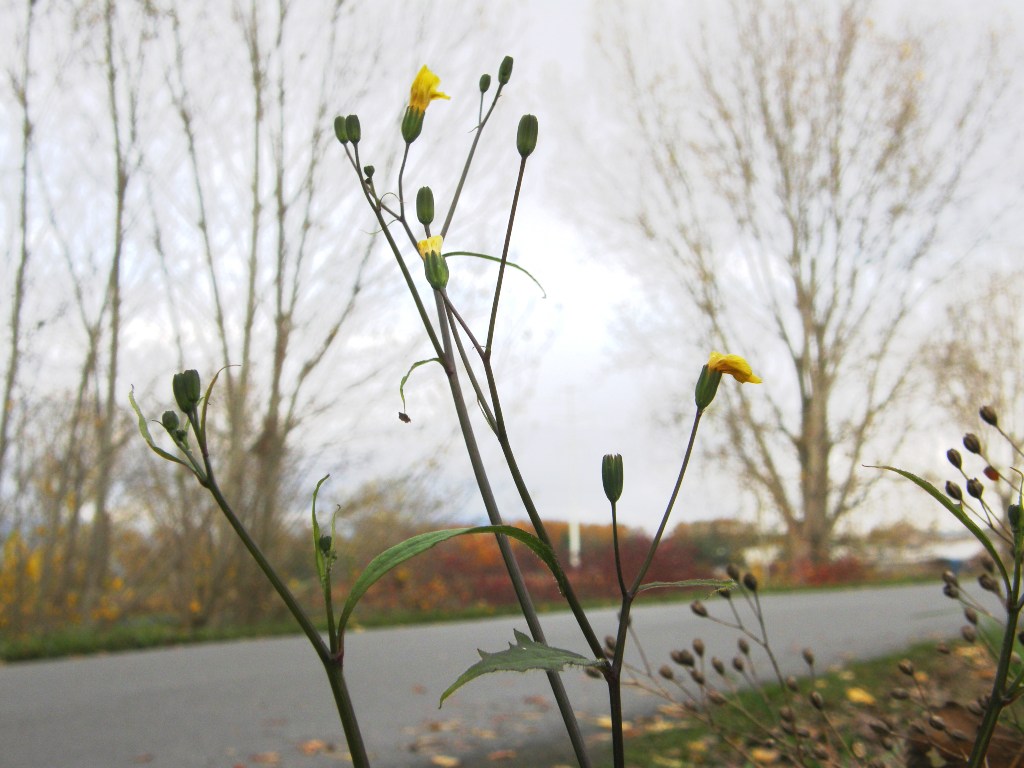
And I lost another hour or so, reading my Plants of Coastal British Columbia, trying to identify this:


A tall, spare plant, with tiny yellow flowers. An aster of some sort. I find these yellow weeds; hawkweed, hawksbeard, cat's ear, sow-thistle, nipple-wort, etc., extremely confusing. I wonder if there's any simple way to remember which is which. They're worse than bees!

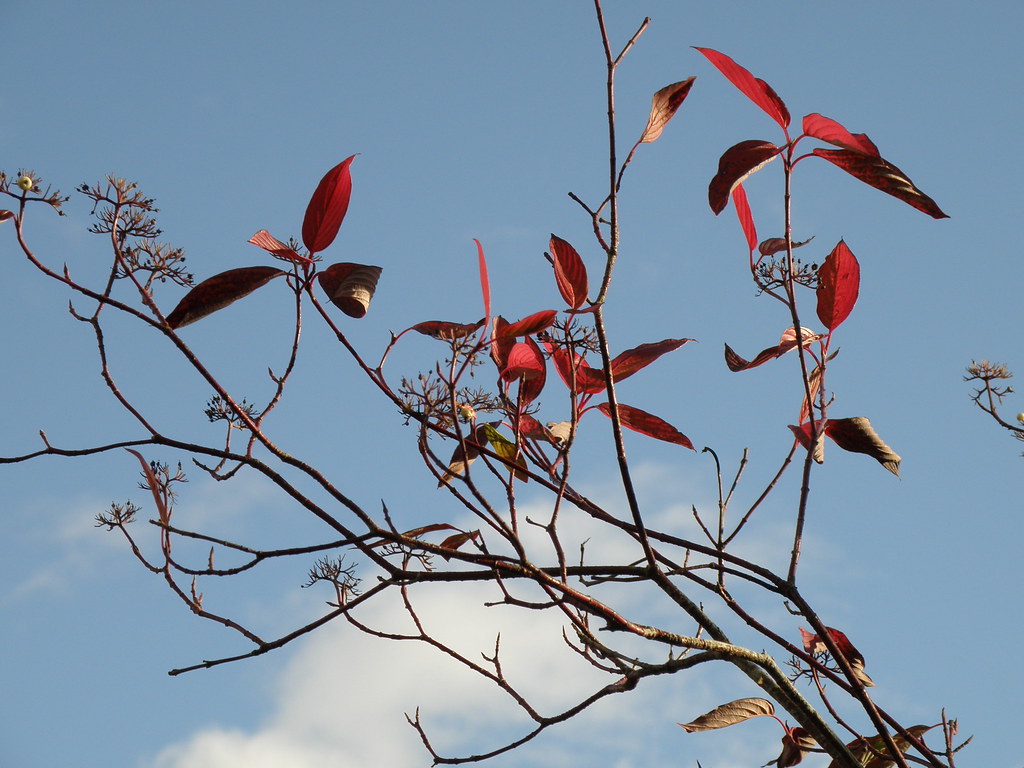
And this one should be a red osier dogwood.


A medium to tall shrub, leaves with prominent veins, red in the fall, flowers and white berries (only two here) in terminal clusters.

Nice that some things, at least, are simple.
.

Tuesday, April 24, 2007

Sidetracked! Bioblitzing Boundary Bay

This was not in the plans: the air around home was bad today, and Laurie's lungs were protesting. The best thing we know to do for that is to head to the shore.

So we "blitzed" the Boundary Bay beach, instead of my vacant lot.
On the beach, we found seaweeds, crabs (dead and alive) seagulls and mallards, and millions of small snails. (I have the species written down somewhere; I'll find it soon.) More or less the usual.

Coming back, we cut across the dunes. We had not been there in the spring time before; the dried beach grasses we expected were still scarce. Instead, we found these:
I have never seen these. Does anybody know what they are? Here are two more views: these are all taken from an ant's-eye viewpoint. I had to lie full-length on the sand to get them. It was silky-soft and warm, down there out of the wind.


This one looks familiar. I think I can find it in my books.

Sourgrass sprouts and tiny moss.

The moss, close-up:
More moss, with lichen, on a log:
And tiny yellow and white lichens (I think) on a burnt log:
A miniature blue flower:
And some of the grass-like plants that will cover the dunes later in the season:
Farther up the beach, close to the slough, we found silverweed:
And over the slough, violet-green swallows chased mosquitos. A beautiful end to the walk, but almost impossible to track with a camera. I got a bit of video and this photo:

Supper-time. Tired and happy. And feeling good!

And tomorrow, if it's not pouring rain, the vacant lot.

~~~~~~~~~~~~~~~~~~~~~~~~~~~~~~
Link to Flickr Blogger Bioblitz Photo pool.

Thursday, April 19, 2007

Red Samphire, Salicornia var. rubra, pickleweed, saltwort...

... or you may know it as "swampfire" or "sea asparagus".

I like "swampfire"; that is what it looks like, from a distance.

salicornia rubraDriving from Kamloops to Merritt, three summers ago, we passed an area of low-lying ponds and marshes fringed with tall green grasses, a welcome sight in that dry country. And by one of them, a long spill of blood-red. There was a gate in the fence, and a parking space; we stopped and walked down.

I had expected flowers. Or at the least, red seed pods. Not this: segmented, leafless, fat stems, red from the ground up, up to about 8 inches tall. Like a succulent, but not like any one I had seen before. I pulled up a few, roots and all, to take home for identification.

red samphireWe couldn't find it in any of our BC books, but it showed up in a Canada-wide reference book; it grows, the book said, in the prairie provinces, Saskatchewan and Manitoba. (I have since found it in a BC Online guide, E-Flora BC. And it is common in Australia.) It grows in alkaline and saline soils, near sloughs and salt marshes.

I didn't realize how well aclimatized it was to the salt, until I ran into another variety of the same plant, Salicornia pacifica, on the beach at Boundary Bay. Reading up on this, I found that, not only does it tolerate salt, it needs it to survive.

The plant has a unique way of dealing with the salt; some salt-marsh plants secrete the salt to the surface of the leaves, leaving them covered with shining crystals. Salicornia, instead, moves the excess salt it takes from the soil into vacuoles in the stem tips, where it is contained behind a protective membrane. When the salt content becomes too much, the cell dies and drops off. Which is a good way to get rid of it, but so efficient is saltwort at this job that it needs to replenish the supply. In technical terms, it is an obligatory halophyte.

Samphire, both red and green, is edible, a good source of vegetable oil and can be used as a flavourful addition to salads; Googling around, I found that it is sold in the UK as a vegetable, which can be simply boiled up and eaten with butter, or added to recipes. Market gardeners irrigate it with sea water.

And from my old blog, I copy this recipe, from "Cooks Afloat":
SUMMERTIME WILD PEA-SAMPHIRE-ORANGE SALAD

1 cup sea asparagus
1 cup shelled beach peas
1 orange, peeled and chipped
2 tbsp toasted pine nuts


Dressing:

2 tbsp balsamic vinegar
2 tbsp orange juice
1 tbsp olive oil
1 tsp Dijon mustard
pinch of salt
1/4 tsp sugar.


Sea asparagus, known as American glasswort or Pacific samphire (Salicornia pacifica), is a succulent, salty-tasting plant with leafless jointed stems. The blue green plant grows around tide flats and salt marshes.
Beach pea (Lathyrus japonicus or littoralis) is a perennial herb that grows on sandy beaches. The leaves are rounded and japonicus has tendrils. American vetch has similar seed pods-but is toxic.
In early summer, gather only the tender upper stems of sea asparagus, wash thoroughly to remove salt. Cover with water, bring to a boil and drain immediately. Add a small amount of fresh water. Steam until tender-crisp, about 5 minutes. Drain well. Steam the beach peas for 5 minutes.

Toss beach peas with asparagus and let cool. Arrange on plates and top with orange and nuts. Toss dressing ingredients together and pour over salad. Serves 2.

Sounds good, but I think I'll try the samphire on its own, first.
Powered By Blogger