Friday, August 31, 2012

More island sunsets

... because it's Friday.

8:04 PM. Over Williams Beach

8:10 PM. Ferry heading south down Georgia Strait. From Williams Beach.

8:24 PM. (Different day) From Oyster Bay.

8:33 Crab hunters return to shore. Oyster Bay.

7:55 PM. Over our garden fence at Edgewater.

8:42 PM. Paddleboarder heading home to Stories' Beach.

A Skywatch post.

Thursday, August 30, 2012

Crowded beach

At low tide on a beach like the one at the Edgewater motel, most of the residents are in hiding.

The beach from the top of the steps, with the tide still going out.

The base is mostly flat sandstone; on top of this, rocks lie scattered, loose, as if tossed by a stone-throwing giant. From the middle intertidal zone down, sea lettuce carpets the sandstone, with sea stars for decoration; rockweed clings to most of the rocks. There's not much more to be seen, unless we're ready to get our knees wet.

Peering under a large rock, we find a large brown and beige anemone, reddish seaweed, and encrusting sponges, pink and red. And another purple star.

Rolled over, another rock exposes bryozoan colonies, and a host of tiny spiral tubeworms. The bryozoans may be Derby hats; the white circles are empty cases.

Dwarf tubeworms, Spirorbis sp. The worms themselves (about 2 to 5 mm long) are red, so the smaller, thinner tubes look pink.

Now to get our noses to the sandstone: with Laurie leaning down, camera ready, I would flip a rock or two, and then we'd snap away wildly, before everything scooted under fresh cover.

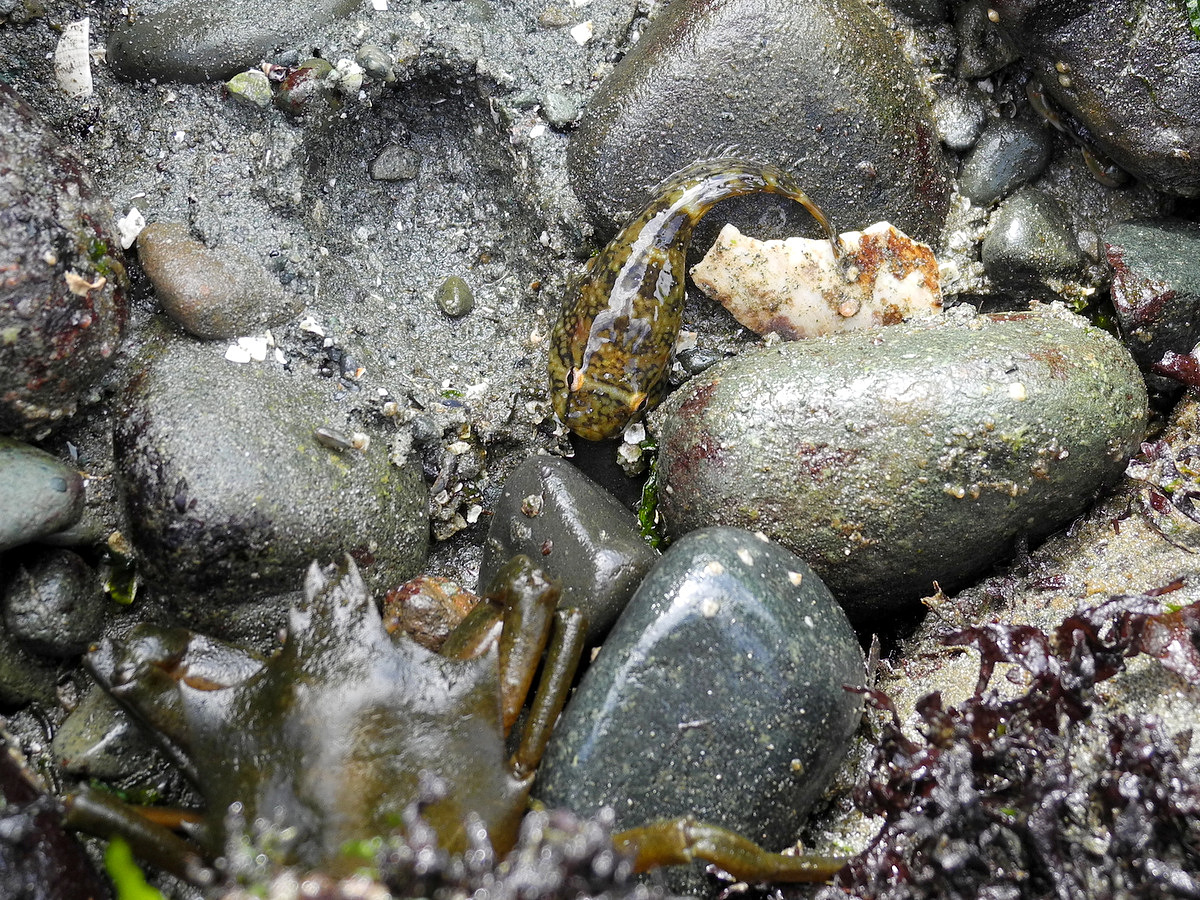
A sandy spot, with Northern kelp crab (Pugettia producta) and cling fish.

As we took a series of photos, I noticed a change in the cling fish. After the first startled thrashing about, he lay still, but he was developing new colours. In the first two photos (too blurry, because he was spinning, as they do; this one is the third we took) he was almost black. A minute and a half later, see the difference:

Click on this to see the spots; orange, green, brown. I love those yellow eyes, too!

Next rock; wet sandstone, with grungy icing. A lively, varied community, legless to multi-appendaged. 

Going left to right, top half: a bit of purple starfish, a green rockweed isopod (Idotea wosnesenskii), three whelk shells (maybe containing whelks), a green shore crab, a sea urchin gift-wrapped in sea lettuce, a grainy hand hermit crab in a black stained whelk shell, another shore crab, a snail (possibly Amphissa), and two more whelk shells, one at least used by a hermit and decorated with a limpet.

Bottom half, left to right: beside that brown stone, a tiny, smooth shell, probably holding a hermit crab. Next, a very small gunnel, five more whelk shells, at least one with an upturned grainy hand hermit. The second one is carrying two slipper snails.

All this under a small rock I could pick up with one hand!

Another view of the same scene. Everybody's shifted around, some heading for cover, some just wandering.

Next rock:

A velvety purple ribbon worm, Paranemertes peregrina. The white stripe is on his underside.

Purple ribbon worm and flatworm.

Flatworm heading for cover, watched by a pair of shore crabs.

There are areas on this beach where the animals are in the rocks, rather than under them.

These little anemones live in round holes in the sandstone. The holes were probably carved out by other animals, such as limpets or clams.

Zooming in.

And in. I've cleaned off the glittery sand grains, to show the anemones more clearly. When the tide comes in, they rise out of the holes and spread out their tentacles, covering the bottom with a green polka-dot pattern.

And one last anemone, on its own under the edge of a rock.

Wednesday, August 29, 2012

Starry shore

Critters, critters, and more critters. And acres of seaweeds, to boot. That's "our" beach. I've sorted out the photos from our one-hour visit; too many for one post.

I'll start with the easy ones, and even then, there are a couple of mystery beasties.

The upper intertidal zone, looking south towards Oyster Bay. Difficult walking, unless we stick to the slabs of sandstone.

Middle intertidal zone, looking north towards Stories Beach. The greenery is rockweed, sea lettuce, and a dark, stringy weed, all very slippery underfoot. The birds are Bonaparte's gulls.

The top of the subtidal zone, which we didn't reach this visit, is partly sand, part rocks, and difficult to wade in because of a steady current.

A tangle of bull kelp, tossed up by the tide.

A small piece of an unidentified seaweed.

More stars:

This one is redder than most purple/ochre sea stars.

Can you see the three starfish here? 
 There's a common purple star at the bottom, then the orange one above it, not the same species. The skin is smooth; it may be the leather star. And up at the top right, a small, fat, beige and grey one, well camouflaged. It doesn't match anything in my books.

A green, patterned star, also unidentified.

 Near the tip of the lower left arm, there is a shiny brown speckled animal. I hadn't seen it until I was examining the photos. I don't know what it is, but I suspect some sort of small nudibranch, possibly the barnacle-eating nudibranch.

A large brittle star. The central disc is about the size of a dime. Probably the long-armed brittle star

There were three or four together of these stars on the sand under a rock; it's hard to tell how many when they're a tangle of squirming arms. I fished this one out to a rock, to keep it from burrowing down before we got a photo. They're fast!

A poor photo of a scrunched up sunflower star. 

To get this, I had to balance on two wobbly, slippery stones separated by a deep stream of running water, and bend 'way over to look underneath another rock. But he was so vividly orange, I had to try!

Just more purple stars. Papa star, Mama star, Baby star.

And a great blue heron, fishing for gunnels at water's edge.

Tomorrow, little critters under the rocks.


~~~~~~~~~~~~~~~~~~~~


Once again, a reminder: Rock Flipping Day is Sunday, September 9th. Instructions, history, etc.

Tuesday, August 28, 2012

Stars, for starters

"Our" beach, the beach just below the Edgewater motel, on the south end of Campbell River, is the main reason we return to the area every chance we get. It's flat, but stony, seaweedy, slippery, treacherous. No place for swimming or wading, except with extreme caution. But every inch of it is alive.

Because of Laurie's injury, this beach was almost off-limits for us this trip. There's a long staircase down the cliff face; 113 steps, then a scramble across the upper edge of the beach before the walking gets easy. We dared it only once, stayed for a short hour, and climbed back up, stopping for a long rest half-way.

Up top, Laurie went directly to bed; it was too much for his ripped leg, which was bleeding again. We didn't risk a second trip.

And still, in that cautious hour on the beach, we turned up an astounding number of animals. I've just about finished sorting my photos from that morning and there are two dozen worth posting, still needing resizing, etc. And I've still got Laurie's collection to review and mix in.

For now, I've resized only this one; I'll start posting the rest tomorrow.

Starfish pile-up

These are Pisaster ochraceus, which translates as "ochre starfish". In English, they are called either ochre starfish or purple starfish. Orange or purple, they're the same species.


~~~~~~~~~~~~~~~~~~~~


Reminder: Rock Flipping Day is Sunday, September 9th. Instructions, history, etc.


Monday, August 27, 2012

More Discovery Harbour Marina reflections

Not boats this time.

Marina shed

Riprap along the shore

Yellow sponge, with building reflections

Not a reflection. Large spined kelp-like seaweed.

At Discovery Harbour Marina, Campbell River.

~~~~~~~~~~~~~~~~~~~~


Reminder: Rock Flipping Day is Sunday, September 9th. Instructions, history, etc.

Saturday, August 25, 2012

"Attracted to light"

August 9th, Campbell River. 9:45 PM. The sunset had faded and we had returned to our motel room in the dark. We settled down to read until bedtime. Then a tiny speck of white wandered across the table in front of Laurie. He called me over; at first I couldn't see what he was pointing at. It was so tiny, almost transparent, blending in perfectly to the blond wood tabletop.

Once I'd seen it, capturing it was easy; it walked on its own straight into my little bottle. I went for the camera.

Now there was a problem. The motel didn't come equipped with movable lighting. Nor had I brought my usual lamps. And flash with a white bug just doesn't work. But I remembered that Laurie had a tiny dollar-store flashlight; maybe if I got it close enough to the critter, it would work.

Again, my subject was co-operative. Released from captivity and deposited on a paper towel in front of the flashlight, it walked right up to the glass, and sat on the rim.

The rim is 2 mm. wide, which makes the fly about 2.25 mm long.

Such a pale, hairy little beastie! With black feet and dotted-line antennae.

It's a moth fly, in the Family Psychodidae, subfamily Psychodinae. I've looked through all BugGuide's photos and didn't find one with this wing pattern, but everything else matches.

I have found one of this family at home in Delta, but it was much darker:

The same size, shape, and hairiness. The same cute antennae.

Interesting notes from BugGuide:

  • Moth flies (Psychodinae): adults ... are attracted to light;
  • adults feed in polluted water and on flower nectar;
  • ... very weak fliers, covering only a few feet at a time in short erratic flights. Outside, they can be blown considerable distances by the wind.
  • They lay their eggs in the gelatinous film that coats the inside of drains, especially in bathtubs and showers;
  • the larvae feed on algae, fungi and bacteria in sewage and organic sludge.

~~~~~~~~~~~~~~~~~


Reminder: Rock Flipping Day is Sunday, September 9th. Instructions, history, etc.

Very Big, BIG, Beetle

We've been told that the beach below our motel in Campbell River is a favourite site for fossil hunters. With that in mind, when I saw this ...


... I was immediately convinced that it was a humongous fossilized beetle.

Well, not exactly convinced. Not really. Not even slightly. But I do have a good imagination.

The "head" is over a meter long. The antennae are longer still. The rock is just one of the great slabs of sandstone that cover the beach. The green fuzz on it is rockweed.


And don't forget; September 9th is Rock Flipping Day! Pass it on!

Friday, August 24, 2012

Rock Flipping Day coming up!

Yikes! Or, "Bloody 'ell!" as Laurie would say. I just realized that next month, only a few days away, is September. And I had forgotten all about Rock Flipping Day! I repeat; bloody 'ell!


I have been seriously remiss; I had planned to announce it early, and possibly find someone else to help with it. But life has been too varied, and my attention was elsewhere. Sorry, everyone.

Let's make it for the second Sunday in September, like last year. That will be the 9th of September. Mark your calendars, and please, pass the word along. (If you're a teacher doing this with your class, the Friday or Monday is fine.)

And because it's late, and I've had an exhausting day already, I'll just cut and paste the instructions from last year:

History:

Rock Flipping Day was started by Dave Bonta and Bev Wigney in 2007. The idea is simple; in Dave's words,
... we pick a day for everybody to go outside — go as far as you have to — and flip over a rock (or two, or three). We could bring our cameras and take photos, film, sketch, paint, or write descriptions of whatever we find. It could be fun for the whole family!

37 bloggers joined in that first September.
On 9/2/2007, people flipped rocks on four continents on sites ranging from mountaintops to urban centers to the floors of shallow seas. Rock-flippers found frogs, snakes, and invertebrates of every description, as well as fossils and other cool stuff.

Instructions:

If you're joining in for the first time, here's a quick rundown of the procedure.
  • On or about September 9th, find your rock or rocks and flip it/them over.
  • Record what you find. "Any and all forms of documentation are welcome: still photos, video, sketches, prose, or poetry."
  • Replace the rock as you found it; it's someone's home.
  • Post on your blog, or load your photos to the Flickr group. (Even if you don't have a blog, you can join.)
  • Send me a link. Or you can add a comment to any IRFD post.
  • I will collect the links, e-mail participants the list, and post it for any and all to copy to your own blogs. (If you're on Twitter, Tweet it, too; the hashtag is #rockflip.)
  • There is a handy badge available for your blog, here. (Or copy it from this post.)
Important Safety Precautions:

A caution from Dave:
One thing I forgot to do in the initial post is to caution people about flipping rocks in poisonous snake or scorpion habitat. In that case, I’d suggest wearing gloves and/or using a pry bar — or simply finding somewhere else to do your flipping. Please do not disturb any known rattlesnake shelters if you don’t plan on replacing the rocks exactly as you found them. Timber rattlesnakes, like many other adult herps, are very site-loyal, and can die if their homes are destroyed. Also, don’t play with spiders. If you disturb an adjacent hornet nest (hey, it’s possible), run like hell. But be sure to have someone standing by to get it all on film!

About Respect and Consideration:

The animals we find under rocks are at home; they rest there, sleep there, raise their families there. Then we come along and take off the roof, so please remember to replace it carefully. Try not to squish the residents; move them aside if they're big enough; they'll run back as soon as their rock is back in place.
Previous Rock Flipping Days:
  • 2007 (In the halls of the mountain millipede)
  • 2008 (IRFD #2)
  • 2009 (The early bird gets the worm.)
  • 2010 (Mongoose Poop?)
  • 2011 (We Haz Critters)


Thursday, August 23, 2012

Cleanup crew under the dock. And a few stars.

At the Discovery Harbour Marina* in Campbell River, we divided our time between looking at boats and reflections and peering into the depths of the murky water, looking for life. In spite of the bright sunlight, or maybe because of it, since it highlighted all the dust and floaters on the surface, it was almost impossible to see more than a few metres down, so most of what we saw was in the narrow gap between the first dock and the shore.

I cleaned most of the bright surface interference off these photos, and adjusted the contrast to make things more visible.

The largest sea cucumber I have ever seen. I estimated it at about a foot and a half long. An inoffensive scavenger, busy vaccuming the rocks.

In the corner between two docks at right angles, the chains were draped with huge seaweeds colonized by many different animals. I think those red sprays are feather duster tubeworms. The yellow mass is a sponge. I don't know what the white blobs are.

Leather star. This starfish eats sponges, anemones, and sea cucumbers. To the left, barely visible, is a good-sized kelp crab.

Two small sunflower stars.

A medium-sized sunflower star. We saw a much larger one, but it was too deep for a decent photo. I counted over 20 arms on the visible part of the star, about 3/4 of the whole. This one would have about 15.

The sunflower stars are major predators. A man who passed us as we were looking at the largest one, angrily called them oyster pirates. They eat any invertebrate they can find, including other starfish, although their favourite foods are sea urchins and bivalves (clams, etc.). We didn't see any sea urchins this trip, but plenty of sunflower stars.

*K Dock, just past Moxie's.
Powered By Blogger