Just had to pass this on.
Laurie, on his blog, "Poems by an Old Reprobate", has a fictional alternate-universe character called Tich Backhouse, who invariably makes me laugh with his creatively spelled "wit and wisdom".
"Tich" has just posted a "leckcheer" on the purpose of life. Science (according to Tich), the state of things and the future of humanity on this old earth; Tich has it all. (Or "orl", as he writes it.)
Go look.
Friday, November 30, 2007


When all waterfowl look alike.
Off the south end of Crescent Beach, last week, hundreds of dark-coloured birds were making their way around the point into the bay. The sun was behind them, so we high-tailed it down the beach, trying to catch up to at least the tail end of the flock where the cameras would be able to function.
We did catch up. But did we get a good photo of them? You know we didn't.
 If you click on this to see it full size, you can just (barely) see the line of flying birds, out close to the land over there.
Starting farther out, a goodly number were flying south, just above the water, mere flapping Vs against the sun.
Closer in, still in silhouette, small birds with their heads tight down against their bodies, rubber-ducky style. They seemed to be just floating, not doing anything, but the flock moved gradually southwards. Many of the ones closer to us seemed to be floating with their heads down, almost underwater. Dabbling without upending?
Closer to us were the actively diving birds. Some of these had long, curving necks, with white fronts. Some seemed to be crested. I would swear a few were loons; Laurie pointed out a surf scoter with the white patch on the back of the neck. But it was hard to tell; most were still too far to see clearly. And they wouldn't sit still. One would pop to the surface, and we would aim the cameras in its direction, and it was gone. I got several photos of circles in the water where a bird had been.

The most frustrating were a group of quite small, slender birds that came in quite close, wading distance. They were fishing; the only time they stayed on the surface for more than a second or two was when they were trying to swallow a small fish who had other ideas.
The fish were about 4 inches long, slender and very active. (Who wouldn't be, rudely snatched from your peaceful swim by a nasty alien wielding knives?) But they all got eaten; at least, I didn't see any get away.
Our photos, enlarged to full size, show only a smudge of white on the side, white in front, and the slender neck. Some seem to have a white keel, but many, upending to dive, did not flash white at all.
 A collage of all the "best" shots, at their full size. Even Laurie's film camera didn't do better.
They don't exactly look alike: I was wrong. But I wouldn't swear to the identification of any of them. No matter; it was a beautiful afternoon, the weather was wonderful, the sunset astounding; these flocks of waterfowl were the final, perfect touch.
We had one other treat in store for us. We had come down another long set of steps to reach this beach (I didn't count this time, but the climb was comparable to the "1001 steps"), and we were hurrying to get back before dark. I was out of breath half-way up, but Laurie charged on ahead.

At the very top, while he waited for me, he did a little victory dance, heels drumming on the wooden walkway. And immediately a loud complaint, a series of screeches and squawks, arose from the top of one of the tall evergreens overhead. Nothing moved. I climbed the last few steps and we stood, looking for the source of the protest. A squirrel? No. Too loud, too raucous. But what local bird shouts like that?
I said, "He didn't like your dance," so Laurie did another good rat-a-tat-tat.
And a red-tailed hawk flew out of a tree just overhead, and headed north, hollering as he went. He must have found another perch just out of sight, because we could still hear him as we trudged up the street to the car. "Dratted humans! Just as I was settling down for a nap! Screech!"
We did catch up. But did we get a good photo of them? You know we didn't.
 If you click on this to see it full size, you can just (barely) see the line of flying birds, out close to the land over there.
Starting farther out, a goodly number were flying south, just above the water, mere flapping Vs against the sun.
Closer in, still in silhouette, small birds with their heads tight down against their bodies, rubber-ducky style. They seemed to be just floating, not doing anything, but the flock moved gradually southwards. Many of the ones closer to us seemed to be floating with their heads down, almost underwater. Dabbling without upending?
Closer to us were the actively diving birds. Some of these had long, curving necks, with white fronts. Some seemed to be crested. I would swear a few were loons; Laurie pointed out a surf scoter with the white patch on the back of the neck. But it was hard to tell; most were still too far to see clearly. And they wouldn't sit still. One would pop to the surface, and we would aim the cameras in its direction, and it was gone. I got several photos of circles in the water where a bird had been.

Tail end of the flock, catching up.
The most frustrating were a group of quite small, slender birds that came in quite close, wading distance. They were fishing; the only time they stayed on the surface for more than a second or two was when they were trying to swallow a small fish who had other ideas.
The fish were about 4 inches long, slender and very active. (Who wouldn't be, rudely snatched from your peaceful swim by a nasty alien wielding knives?) But they all got eaten; at least, I didn't see any get away.
Our photos, enlarged to full size, show only a smudge of white on the side, white in front, and the slender neck. Some seem to have a white keel, but many, upending to dive, did not flash white at all.
 A collage of all the "best" shots, at their full size. Even Laurie's film camera didn't do better.
They don't exactly look alike: I was wrong. But I wouldn't swear to the identification of any of them. No matter; it was a beautiful afternoon, the weather was wonderful, the sunset astounding; these flocks of waterfowl were the final, perfect touch.
We had one other treat in store for us. We had come down another long set of steps to reach this beach (I didn't count this time, but the climb was comparable to the "1001 steps"), and we were hurrying to get back before dark. I was out of breath half-way up, but Laurie charged on ahead.

At the very top, while he waited for me, he did a little victory dance, heels drumming on the wooden walkway. And immediately a loud complaint, a series of screeches and squawks, arose from the top of one of the tall evergreens overhead. Nothing moved. I climbed the last few steps and we stood, looking for the source of the protest. A squirrel? No. Too loud, too raucous. But what local bird shouts like that?
I said, "He didn't like your dance," so Laurie did another good rat-a-tat-tat.
And a red-tailed hawk flew out of a tree just overhead, and headed north, hollering as he went. He must have found another perch just out of sight, because we could still hear him as we trudged up the street to the car. "Dratted humans! Just as I was settling down for a nap! Screech!"
Thursday, November 29, 2007
Work, work, work, work
... but I met the deadline.
How is it that every job takes 3 times as long as you budgeted for it, and needs something that you can't find?
I'm off to bed. But here's a photo, anyhow: Laurie's favourite vase from the Culture Crawl, made by Red Iron Studios.
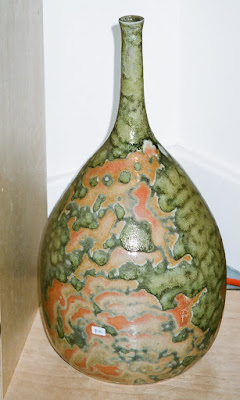
'night, all.
How is it that every job takes 3 times as long as you budgeted for it, and needs something that you can't find?
I'm off to bed. But here's a photo, anyhow: Laurie's favourite vase from the Culture Crawl, made by Red Iron Studios.

'night, all.
Tuesday, November 27, 2007
Follow-up on kelp crawlers
A local naturalist, in the comments to my previous post, suggested that the creatures we photographed may have been tunicates, possibly Ciona. Thanks, Hugh.

I have spent most of the evening looking at photos of tunicates of this area, and reading what I could find on their locations. Hugh could be right; Ciona looks possible.
There are five invasive species of tunicate in the area, Ciona savigny, Styela clava, Didemnum sp., Botrylloides violaceus, and Botryllus schlosseri; of these, only Ciona looks like it may match. The colour is right, the shape is almost right, and some of the groupings show circles that may be siphon mouths.
Two similar native species, Corella inflata and Corella willmeriana, are smaller and rounder. They don't match mine. Besides, Corella inflata dies within a few days if exposed to sunlight.
Many tunicates eat anenomes, but Ciona savigny is a filter feeder, eating bits of waste. There are obviously no anenomes on this kelp.
Most of the tunicates live at greater depths, out of the sunlight, but a few are found under docks and floats. Most of them, including Ciona, fasten to firmer ground, though; pilings, rocks, even mussels. These were on kelp.
A couple of the things look definitely like Melibe leonina, which is transparent and usually found on eelgrass. I found one mention of it on kelp.
Several of the other shapes could be Melibe, as well, either singly or in groups. Do Melibe hang out together in flocks? Or could this be a mixed bag, Melibe and Ciona? Do they mix?
And should I report these as invasive species? And to whom? The address I have is for across the border.
Every question leads to a list of questions, doesn't it?

I have spent most of the evening looking at photos of tunicates of this area, and reading what I could find on their locations. Hugh could be right; Ciona looks possible.
There are five invasive species of tunicate in the area, Ciona savigny, Styela clava, Didemnum sp., Botrylloides violaceus, and Botryllus schlosseri; of these, only Ciona looks like it may match. The colour is right, the shape is almost right, and some of the groupings show circles that may be siphon mouths.
Two similar native species, Corella inflata and Corella willmeriana, are smaller and rounder. They don't match mine. Besides, Corella inflata dies within a few days if exposed to sunlight.
Many tunicates eat anenomes, but Ciona savigny is a filter feeder, eating bits of waste. There are obviously no anenomes on this kelp.
Most of the tunicates live at greater depths, out of the sunlight, but a few are found under docks and floats. Most of them, including Ciona, fasten to firmer ground, though; pilings, rocks, even mussels. These were on kelp.
A couple of the things look definitely like Melibe leonina, which is transparent and usually found on eelgrass. I found one mention of it on kelp.
Several of the other shapes could be Melibe, as well, either singly or in groups. Do Melibe hang out together in flocks? Or could this be a mixed bag, Melibe and Ciona? Do they mix?
And should I report these as invasive species? And to whom? The address I have is for across the border.
Every question leads to a list of questions, doesn't it?
Help wanted; identify these, if you will
Last week, at Crescent Beach, we noticed this large bull kelp caught on the pilings of the pier. The tide going out dragged it into the sunlight, and we could see these white jelly-like things on it.

I had never seen anything like this before. Can anyone identify them?
Laurie climbed through the railing onto a slime-covered board a few inches wide and bent 'way around the corner to take this shot. I almost had a heart attack.

I hung over the railing, zooming in as far as I could.
Cropping and increasing contrast to show the things more clearly. Click on the photo for a full-size view.
How about it? Does anyone recognize them? Are they what they look like to me?
Help!

I had never seen anything like this before. Can anyone identify them?
Laurie climbed through the railing onto a slime-covered board a few inches wide and bent 'way around the corner to take this shot. I almost had a heart attack.

I hung over the railing, zooming in as far as I could.
Cropping and increasing contrast to show the things more clearly. Click on the photo for a full-size view.
How about it? Does anyone recognize them? Are they what they look like to me?
Help!
Sunday, November 25, 2007


Friday, November 23, 2007
What's inside the Paneficio Studios?
Blogging the Culture Crawl: fourth of maybe seven.

I promised you a look inside the old bakery, the "Paneficio". I have written about it on a couple of previous occasions, with a photo or two of some of the storefront display, most recently here. But this is another of the working studios, not a gallery; we had never been inside.
Paneficio Studios houses 6 artists at the moment; we entered first through the door on the corner, where the old Paneficio sign hangs. Valerie Arntzen has this space. The display inside was similar to the crosses of baking tins that we had seen in the window earlier, but much more varied. She combines Mexican "milagros" and statuettes with bleached bones and found objects in a variety of containers as frames; a meditation, it seems to me, on mortality and hope. (I could be so far wrong that I'm not even in the same country, but that is what her work suggests to me.) This link will take you to her portfolio on Picasa.
I had wanted to talk to her, but she was giving an interview to a reporter the whole time we were there. Another day, maybe.

A bucket of found objects; supplies for future work, in the junction between Valerie's display area and the next artist's.

A painter's work space. Sharon Petty or Esther Rausenberg, I'm not sure which. More Mexican motifs.

A vase, something pink and feathery, broken bottles. And paint brushes.
This front room is divided into three "roomlets" or largish cubby holes. At the back, a door led out into a narrow hall or alley, still under the Paneficio roof, but seeming to be the passageway between buildings. floored with boards on mud, and now used for storage of old lumber and what's-its. It went on for a fair distance, then, just before a door opening onto a real alley, we found a studio door on our right. People were coming out; we went in.
We were in a large, open metal-working shop. Right in front of us, this coffee table held a card, giving the owner's name. Arnt Arntzen.

Arnt is a furniture designer, working in recycled wood and metal. He writes,
(I discovered something about artists: they use different lighting than we do. I had set my camera for indoor lighting, and most of my photos came out in strange colours, especially these. Looking later at Arnt's lighting fixtures, I realized that he used a mixture of fluorescent, tungsten, daylight from skylights, and what looks like surgery lights from a hospital. To get a true idea of what we saw this day, follow the links to the artists' galleries.)

Part of Arnt's workspace. Those tall, shiny things are propellers (airplane? boat?)
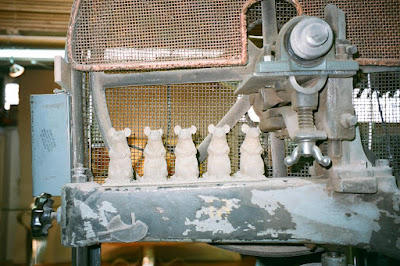
Wooden mice on a piece of machinery.

A half-finished chair, made of one of those propellers, hanging from the ceiling. You can see three varieties of lighting in this photo.

Unfinished wooden bowls shoved under a rack.

More stuff hanging from the ceiling.

A little side table.
Arnt also makes the "totems" that I have shown before; there was an unfinished one in a corner.
But there were 300 artists to see; I dragged myself away. Out into the hallway/alley, out the door to the lane, back to the street. Around the building, passing a door to other studio spaces, closed at the moment.

Door #2 of the Paneficio.
And around the corner, to doors #3 and 4:

One of Arnt's totems, outside the studio of Jordan Bent, painter.
Jordan's studio was an amazing experience; painting after painting, in vivid, Mexican colours, incorporating the familiar and the fantastic to create worlds unknown, each telling a story that grew and changed as you looked.
His website explains that, "His work is an exploration of longing, a detail of searching, an illustration of the weight of duty."
I took one photo, and a helper came over to ask me to desist. He did give me permission to use this one on my blog, however. It doesn't begin to do justice to the painting; I should never have used the flash on high-gloss paint.

So: all in all, beautiful work, lousy photography. Next year, I'll do better.

I promised you a look inside the old bakery, the "Paneficio". I have written about it on a couple of previous occasions, with a photo or two of some of the storefront display, most recently here. But this is another of the working studios, not a gallery; we had never been inside.
Paneficio Studios houses 6 artists at the moment; we entered first through the door on the corner, where the old Paneficio sign hangs. Valerie Arntzen has this space. The display inside was similar to the crosses of baking tins that we had seen in the window earlier, but much more varied. She combines Mexican "milagros" and statuettes with bleached bones and found objects in a variety of containers as frames; a meditation, it seems to me, on mortality and hope. (I could be so far wrong that I'm not even in the same country, but that is what her work suggests to me.) This link will take you to her portfolio on Picasa.
I had wanted to talk to her, but she was giving an interview to a reporter the whole time we were there. Another day, maybe.

A bucket of found objects; supplies for future work, in the junction between Valerie's display area and the next artist's.

A painter's work space. Sharon Petty or Esther Rausenberg, I'm not sure which. More Mexican motifs.

A vase, something pink and feathery, broken bottles. And paint brushes.
This front room is divided into three "roomlets" or largish cubby holes. At the back, a door led out into a narrow hall or alley, still under the Paneficio roof, but seeming to be the passageway between buildings. floored with boards on mud, and now used for storage of old lumber and what's-its. It went on for a fair distance, then, just before a door opening onto a real alley, we found a studio door on our right. People were coming out; we went in.
We were in a large, open metal-working shop. Right in front of us, this coffee table held a card, giving the owner's name. Arnt Arntzen.

Arnt is a furniture designer, working in recycled wood and metal. He writes,
In this world of mass production, I feel it is important to design pieces that can not be mass produced. this is achieved by cutting my own wood from trees that have already been cut down and left to rot or from demolished buildings. Much of the metal comes from scrap yards or is found.This studio fascinated me; I could have spent hours here, poking among the materials collected along the walls, hanging from the roof, jammed onto the benches. Or just admiring the finished and half-finished pieces; everything was so unexpected, but at the same time, just so right.
(I discovered something about artists: they use different lighting than we do. I had set my camera for indoor lighting, and most of my photos came out in strange colours, especially these. Looking later at Arnt's lighting fixtures, I realized that he used a mixture of fluorescent, tungsten, daylight from skylights, and what looks like surgery lights from a hospital. To get a true idea of what we saw this day, follow the links to the artists' galleries.)

Part of Arnt's workspace. Those tall, shiny things are propellers (airplane? boat?)

Wooden mice on a piece of machinery.

A half-finished chair, made of one of those propellers, hanging from the ceiling. You can see three varieties of lighting in this photo.

Unfinished wooden bowls shoved under a rack.

More stuff hanging from the ceiling.

A little side table.
Arnt also makes the "totems" that I have shown before; there was an unfinished one in a corner.
But there were 300 artists to see; I dragged myself away. Out into the hallway/alley, out the door to the lane, back to the street. Around the building, passing a door to other studio spaces, closed at the moment.

Door #2 of the Paneficio.
And around the corner, to doors #3 and 4:

One of Arnt's totems, outside the studio of Jordan Bent, painter.
Jordan's studio was an amazing experience; painting after painting, in vivid, Mexican colours, incorporating the familiar and the fantastic to create worlds unknown, each telling a story that grew and changed as you looked.
His website explains that, "His work is an exploration of longing, a detail of searching, an illustration of the weight of duty."
I took one photo, and a helper came over to ask me to desist. He did give me permission to use this one on my blog, however. It doesn't begin to do justice to the painting; I should never have used the flash on high-gloss paint.

So: all in all, beautiful work, lousy photography. Next year, I'll do better.


Thursday, November 22, 2007
Interlude
Today, the sun was shining, the wind was not blowing. It was bitterly cold, but beautiful; in the afternoon, we bundled up and went to Crescent Beach.


The water was as smooth as glass.

Except when the occasional boat left a wash.

Like this.

Photo op.

I wish you well, CF and CP.

Ambling home with the tide.

Ducks and seagulls. Out farther, a few loons, mallards and geese.

End of the afternoon.

Last gasp. I set the camera for "Backlit" and aimed straight into the sun. Probably fried the camera's brain.

Except when the occasional boat left a wash.

Like this.

Photo op.

I wish you well, CF and CP.

Ambling home with the tide.

Ducks and seagulls. Out farther, a few loons, mallards and geese.

End of the afternoon.

Last gasp. I set the camera for "Backlit" and aimed straight into the sun. Probably fried the camera's brain.
Wednesday, November 21, 2007
Wobble Pots and Wonky Teapots
Blogging the Culture Crawl: third of a bunch.
I promised to look inside the Paneficio, but London Drugs Photos machine called in sick, so the photos will be ready tomorrow. I hope.
Instead, we'll wander down the street and look at a few ceramics studios.
Our first stop was Gailan Ngan; we had been pressing our noses to her windows every time we were in Strathcona, and never finding her there. This time, we would find her.

A wobble pot. Yes, that is its name. Her website explains;
I love to look at other people's work spaces. (Not mine; I always think, "Oh, I've got to clean that up!") So, here is a corner of Gailan's:

On down the street, we found the Red Iron Studios, and the pottery by Rod Wuetherick. Nice mugs, beautiful vases (later I'll post Laurie's photo of his favourite), bowls, and some delightfully wacky teapots:

Laurie calls this one the "Tin Man".

Against the window, the light fights with the pot. But then, this pot fights with reality in general. Imagine trying to pour hot tea out of that spout!
A quote on Rod's site warns us:
And on to the next: Kathleen Murphy. No wobbling here, no jagged lines. Smooth, serene shapes, gentle curves. And vases that seem to stand on a point.


My favourite one, but look at that tiny base!
And something a little more practical, in the blue-y light from the window.

And no, we didn't buy any. Not this time. But we will be back, cash in hand.
I promised to look inside the Paneficio, but London Drugs Photos machine called in sick, so the photos will be ready tomorrow. I hope.
Instead, we'll wander down the street and look at a few ceramics studios.
Our first stop was Gailan Ngan; we had been pressing our noses to her windows every time we were in Strathcona, and never finding her there. This time, we would find her.
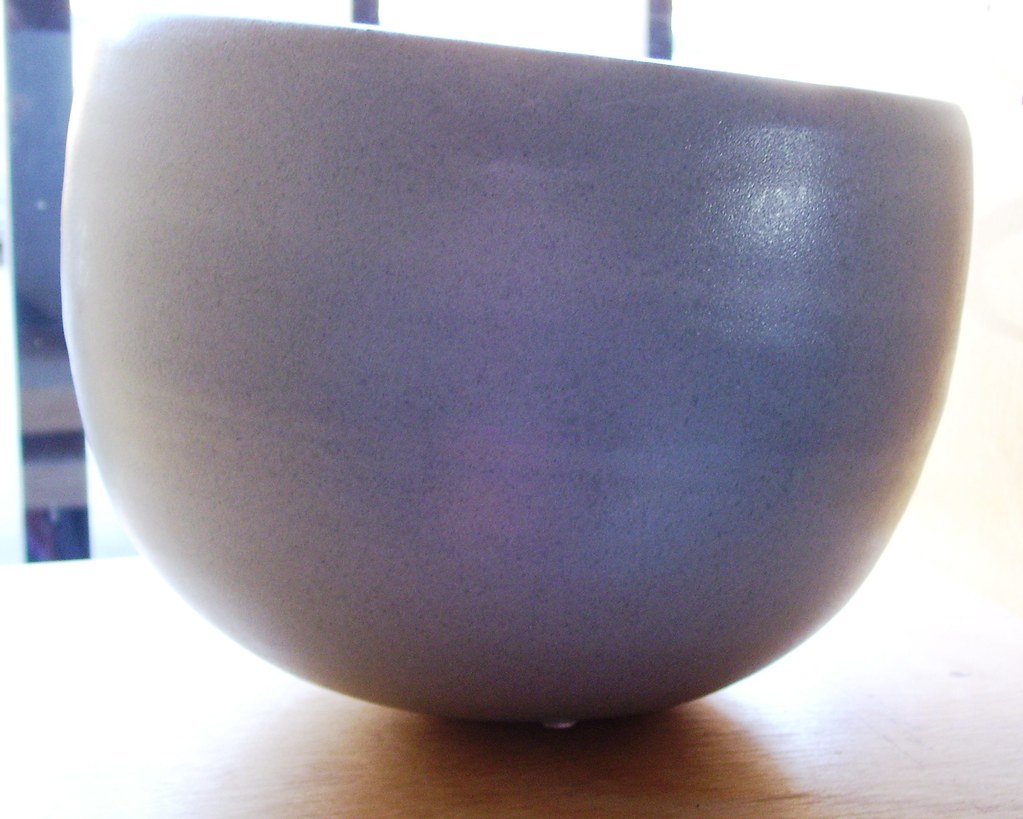
A wobble pot. Yes, that is its name. Her website explains;
Her ceramics blend a playful, sculptural energy with crisp, functional design. Her tableware includes an ongoing series of meditatively simple bowls, plates and cups, as well as her new “wobble pots,” footless, kinetic pottery that rocks gently, but safely, on your table. Designed to be stacked, these sets work as a unified sculpture when not in use.And they do wobble, gently. And right themselves nicely, like one of those tipsy dolls we used to play with. The cups look like they would nestle happily in a hand, but I wouldn't want to fill one too close to the top.
I love to look at other people's work spaces. (Not mine; I always think, "Oh, I've got to clean that up!") So, here is a corner of Gailan's:
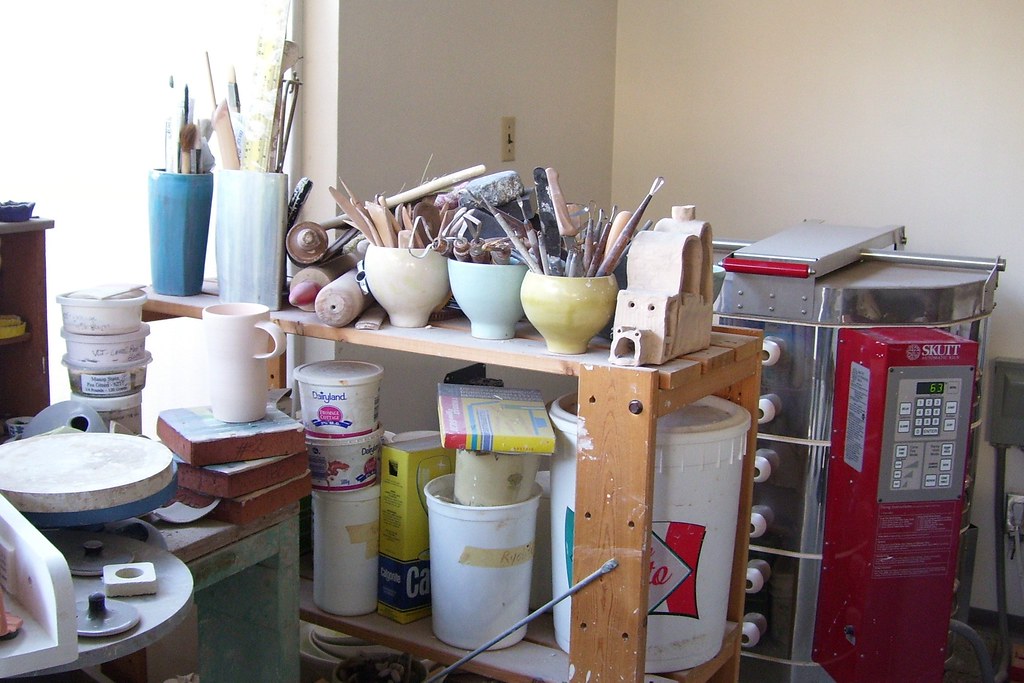
On down the street, we found the Red Iron Studios, and the pottery by Rod Wuetherick. Nice mugs, beautiful vases (later I'll post Laurie's photo of his favourite), bowls, and some delightfully wacky teapots:
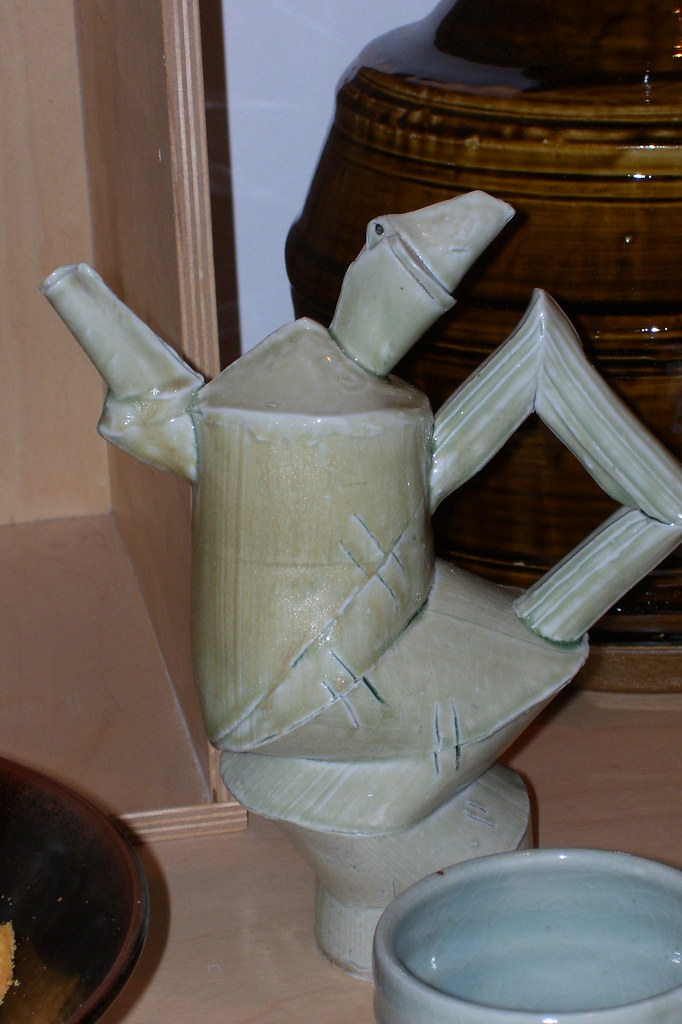
Laurie calls this one the "Tin Man".
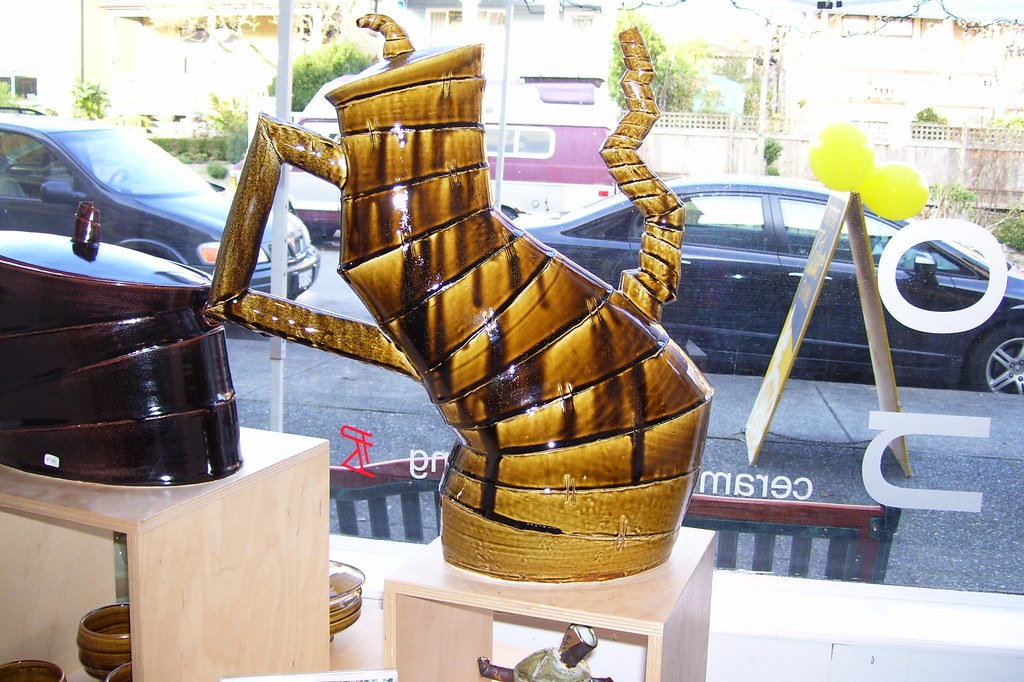
Against the window, the light fights with the pot. But then, this pot fights with reality in general. Imagine trying to pour hot tea out of that spout!
A quote on Rod's site warns us:
"A bunch of pots together is the worst place to view individual pieces--And he's right. These pots, and the next group, really should be looked at one at a time. Imagine them sitting in state in the centre of your favourite table, maybe with your best cloth on it. See the difference?
it's like having all your friends in an elevator"
-Jack Troy, at Hiroshi Ogawa's kiln opening
And on to the next: Kathleen Murphy. No wobbling here, no jagged lines. Smooth, serene shapes, gentle curves. And vases that seem to stand on a point.


My favourite one, but look at that tiny base!
And something a little more practical, in the blue-y light from the window.
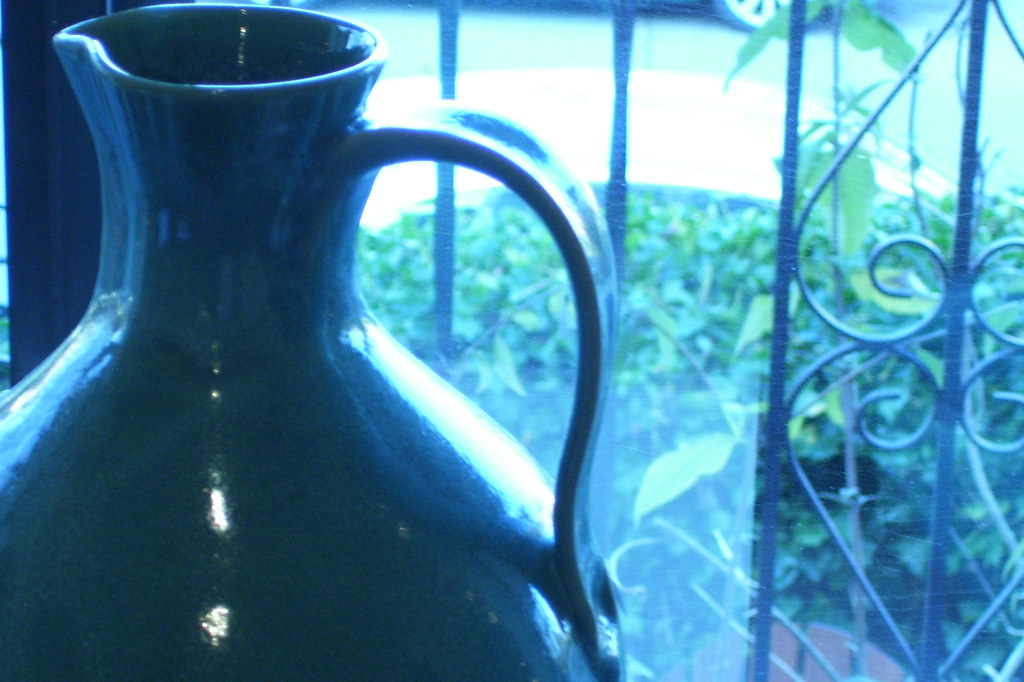
And no, we didn't buy any. Not this time. But we will be back, cash in hand.
Tuesday, November 20, 2007
Crawling and Climbing and Trying Not to Trip
Blogging the Culture Crawl: second of a bunch.
300 or more artists (the actual number is uncertain, because some artists never registered*, they just hung the yellow balloons outside their doors, instead) opened their studio doors in Strathcona, Vancouver, over the last weekend to the general public. Some of them, it is true, sell from their studios year round, but most display their work elsewhere. We joined the crowds "crawling" from door to door Sunday afternoon.
The weather contributed; it had been raining, but Sunday dawned clear and grew warmer as the day progressed. We dawdled down the streets, cameras in hand.
Most of Laurie's film photos are still in the shop, so I will wait until we have them in hand to pick out the best for you. But for now, I can post about a couple or three visits where I know he took no photos.
I wouldn't have noticed this one, but my granddaughter knew the site. At the back of an unkempt yard, bounded by weeds and a rotting shed, down a crumbling cement walk past doors unpainted for decades, and up two stories worth of rickety outside steps, wooden and a bit slippery, this little critter greeted us:


Detail of wall on the landing.
The door opened into a tiny space between kitchen/hallway on the left and a small room on the right. This was the living/work/display area for the artist, Christie. A sofa, funky 1930s linoleum on the floor, a display table, two clothes racks, more clothes hung on a wall. Not much else. A sign announced, Ladies*Bridal*Grad. Aha! Jess is thinking of next spring's grad parties already; that's why she knows of this place.
I am not much into clothes; I expected to be bored, a bit. But no: in the window, the Mary Craig's line of jewelry gleamed, with the sunlight streaming through it and the browning oak leaves just outside.


I give you two photos, even though they are similar, because I couldn't choose between them. The second really needs to be seen full size to get the full effect of the layering. Click on it to see what I mean.
The display area was mostly taken up by a line called "Carny Love"; funky dresses, short-shorts, little vests, all made of 1950s-style fabrics. My daughter bought a scarf/collar, which she wore for the rest of the afternoon.

In the mirror, the artist, loving her work.
We left, watching our step on the way down.
Later, up more steps, concrete and just a dozen or so, and down an uneven walkway between two building, single file, in a basement suite, we found a warm, clean haven. Beige carpeting, a wood fire in a glass-fronted stove, creamy walls. And on these walls, framed embroideries, in off-whites. Beautiful, minimalist work; I wished I could have somehow fitted one into my decidedly non-minimalist decor.

These old boxes and books were the only bit of colour in the room. The cups on top are made of embroidered felt. And the light was so strong that it overpowered my poor camera, hiding two of the cups.
Unfortunately, I can't credit these to the artists; I brought home a card, but it seems to have fallen out of my pocket. And they are not listed with the registered "Crawl" participants.
The third fabric artist we found was another non-registered hostess. This one was housed in a second basement apartment, with her door underneath the back staircase of the house. Inside, we were greeted with the aroma of buttered popcorn; Brenn Kapitan, the artist, had laid out individual cups of fresh popcorn, bottles of water and cups of cider for the refreshment of her exhausted visitors. Wonderful! (No-one else, so far, had been so thoughtful, and it was now past sunset.)
Great enthusiasm here: her boyfriend, Andrew Williams, had a table in back, displaying his unique idea for instant heirlooms; tea-light holders made of lumber from vintage homes. Brenn told us all about it, then went on to show off her own sketches and collages, pausing between phrases to greet new visitors and offer them drinks.

Detail of a collage, unfortunately fuzzy because of the jostling of visitors in the narrow room. I really should have gone back and taken several, to be sure. Forks and spoons, old-fashioned dress, money, and ?MacDonald's? There's a meaning here, but what is it?
*Mary Craig writes to tell me that she did register, but too late to get on the website and brochures. And that the studio belonged to her friend Christie, who has the Carny Love line. Mary does the jewelry.
Next: What's inside the Paneficio.
300 or more artists (the actual number is uncertain, because some artists never registered*, they just hung the yellow balloons outside their doors, instead) opened their studio doors in Strathcona, Vancouver, over the last weekend to the general public. Some of them, it is true, sell from their studios year round, but most display their work elsewhere. We joined the crowds "crawling" from door to door Sunday afternoon.
The weather contributed; it had been raining, but Sunday dawned clear and grew warmer as the day progressed. We dawdled down the streets, cameras in hand.
Most of Laurie's film photos are still in the shop, so I will wait until we have them in hand to pick out the best for you. But for now, I can post about a couple or three visits where I know he took no photos.
I wouldn't have noticed this one, but my granddaughter knew the site. At the back of an unkempt yard, bounded by weeds and a rotting shed, down a crumbling cement walk past doors unpainted for decades, and up two stories worth of rickety outside steps, wooden and a bit slippery, this little critter greeted us:

Some kind of arachnid. Your guess is as good as mine.

Detail of wall on the landing.
The door opened into a tiny space between kitchen/hallway on the left and a small room on the right. This was the living/work/display area for the artist, Christie. A sofa, funky 1930s linoleum on the floor, a display table, two clothes racks, more clothes hung on a wall. Not much else. A sign announced, Ladies*Bridal*Grad. Aha! Jess is thinking of next spring's grad parties already; that's why she knows of this place.
I am not much into clothes; I expected to be bored, a bit. But no: in the window, the Mary Craig's line of jewelry gleamed, with the sunlight streaming through it and the browning oak leaves just outside.


I give you two photos, even though they are similar, because I couldn't choose between them. The second really needs to be seen full size to get the full effect of the layering. Click on it to see what I mean.
The display area was mostly taken up by a line called "Carny Love"; funky dresses, short-shorts, little vests, all made of 1950s-style fabrics. My daughter bought a scarf/collar, which she wore for the rest of the afternoon.

In the mirror, the artist, loving her work.
We left, watching our step on the way down.
Later, up more steps, concrete and just a dozen or so, and down an uneven walkway between two building, single file, in a basement suite, we found a warm, clean haven. Beige carpeting, a wood fire in a glass-fronted stove, creamy walls. And on these walls, framed embroideries, in off-whites. Beautiful, minimalist work; I wished I could have somehow fitted one into my decidedly non-minimalist decor.

These old boxes and books were the only bit of colour in the room. The cups on top are made of embroidered felt. And the light was so strong that it overpowered my poor camera, hiding two of the cups.
Unfortunately, I can't credit these to the artists; I brought home a card, but it seems to have fallen out of my pocket. And they are not listed with the registered "Crawl" participants.
The third fabric artist we found was another non-registered hostess. This one was housed in a second basement apartment, with her door underneath the back staircase of the house. Inside, we were greeted with the aroma of buttered popcorn; Brenn Kapitan, the artist, had laid out individual cups of fresh popcorn, bottles of water and cups of cider for the refreshment of her exhausted visitors. Wonderful! (No-one else, so far, had been so thoughtful, and it was now past sunset.)
Great enthusiasm here: her boyfriend, Andrew Williams, had a table in back, displaying his unique idea for instant heirlooms; tea-light holders made of lumber from vintage homes. Brenn told us all about it, then went on to show off her own sketches and collages, pausing between phrases to greet new visitors and offer them drinks.

Detail of a collage, unfortunately fuzzy because of the jostling of visitors in the narrow room. I really should have gone back and taken several, to be sure. Forks and spoons, old-fashioned dress, money, and ?MacDonald's? There's a meaning here, but what is it?
*Mary Craig writes to tell me that she did register, but too late to get on the website and brochures. And that the studio belonged to her friend Christie, who has the Carny Love line. Mary does the jewelry.
Next: What's inside the Paneficio.
Subscribe to:
Posts (Atom)
