Showing posts with label beaver tracks. Show all posts

Sunday, December 11, 2022

Igloo in the wild

One of these days ... I'm always hoping to see one of the beavers that live in a beaver lodge I've been visiting for 6 years, summer and winter and in between. And I've never seen a beaver there. Tracks, yes.

The beaver lodge, today, under snow.

Do you see it? The mound at the edge of the pond, with a couple of sticks pointing to the right. Snow makes an excellent camouflage.

Snow is also a good blanket, keeping the heat in. It's warm inside that lodge; the entrances are underwater, so no drafts get in, and the beavers' body heat is enough to warm the whole place.

On the far side of the pond there's a larder of sorts; cattails and alder branches. They eat the roots of the cattails and the bark off the branches. And there, I saw tracks.

Cattails and beaver markings.

The snow lay undisturbed on top of the ice everywhere else, but here among the cattails, something has been busy. The long tracks are probably left by dragging beaver tails. In two spots, I could see the marks of individual paws.

The messy snow at the bottom of the photo is from another winter visitor; the highway snow plows. I did see these. One day, one day I hope, a beaver.

~~~~~~~~~~~~~~~~~~~~~
Un dia de estos. Un dia, será. Pero hoy no. Siempre espero ver un castor cuando visito su madriguera. Estoy allí varias veces al año desde hace 6 años. Y nunca he visto ni un castorcito, Las huellas, sí.

Foto #1; la madriguera bajo nieve. ¿La ves? Un montecito a la orilla de la laguna. La nieve sirve muy bien de camuflaje.

La nieve también ayuda a mantener la madriguera a una temperatura cómoda, actuando como una cobija. Las entradas a la madriguera están debajo de la superficie del agua, así que no les llega ni un soplo de viento en el interior, y el calor de los cuerpos de los castores residentes es suficiente para calentar el espacio.

Al lado opuesto de la laguna hay un abasto de comestibles estilo castor; un totoral rodeado de alisos. Los castores comen las raices de las totoras y la corteza de los alisos. Y allí vi huellas de castor.

foto #2: Totoral bajo la nieve. La laguna está cubierta de hielo con unos cuantos centímetros de nieve encima. En toda la laguna, esta nieve está sin manchas; nieve virgen. Solamente en este sitio estaba revuelta. Se ven las marcas donde arrastraban sus colas grandes; también vi dos marcas de patas.

La nieve revuelta en la parte inferior de la foto fue hecha por otro visitante invernal: el quitanieves que mantiene la carretera abierta. De estos, vi dos. De los castores, ninguno.

Un dia será. Eso espero.

Monday, December 05, 2022

View from the bridge

The Quinsam River is a small river, little more than a creek in places, and about 35 km. long. It winds and loops its way down to meet the Campbell River just upstream of the estuary. The road I was following crossed it on a small bridge about halfway along its length. I found a place to park and walked back.

A quiet, shallow waterway.

A closer look. There's ice along the edges, coated with a thin layer of snow.

As usual, I find once I've come home, that I missed something right in front of me. Do you see it here?

Look at the ice.

Zooming in:

Do you see the tracks? The maker came out of the hole on the left, walked on ice and snow to the hole on the right. And I never saw him!

I'll zoom in some more:

What animal was this?

I can't decide, looking at the tracks, whether he was dragging a tail or not. Was it a beaver? Is there a lodge under that snow load?

This was well out of town, some 4 or 5 kilometres from the closest house, and in prime beaver country; many small streams, little lagoons, lots of red alder for munchies and construction work. But was he dragging a tail or not?

I'll go back in the summer to look for a lodge.

~~~~~~~~~~~~~~~~~~~~~~~~~~~~~~~
El rio Quinsam es un rio pequeño, apenas un riachuelo en algunos sitios, y dando vueltas y haciendo círculos, baja desde el laguito Quinsam a unirse con el rio Campbell cerca del estuario, unos 35 kilómetros, contando todas las vueltas que hace. El camino que yo seguía cruza el rio más o menos a la mitad de su recorrido. Busqué un sitio para estacionarme y regresé a pie.

Fotos:
  1. Un rio tranquilo, poco hondo.
  2. Visto más de cerca. A las orillas, hay hielo cubierto de un poco de nieve.
  3. Y como de costumbre, llego a casa y me doy cuenta al ver las fotos, de que algo se me escapó. ¿Lo ves? Mira el hielo.
  4. Haciendo zoom. Las huellas salen de una apertura entre la hierba, cruzan hielo y nieve para desaparecer adentro de otra entrada. ¡Y yo, que ni lo vi!
  5. Cortando la foto aun más. ¿Serán huellas de un castor?
No puedo decidir, viendo las huellas, si el animal arrastraba tras sí una cola. Si era un castor, tendría una cola pesada. ¿Habrá una madriguera debajos de la nieve?

Esto está fuera del pueblo, como a unos 4 o 5 km. de la habitación humana más cercana. Y es terreno ideal para los castores, con muchos riachuelos y lagunitas, muchos alisos rojos para comer y para las obras de construcción. Pero, ¿arrastraba la cola? ¿Sí, o no?

Voy a regresar en el verano para buscar la madriguera.


Sunday, September 22, 2019

More beaver lore

When my granddaughter was little, I took her places; to the parks, on gentle hikes, sometimes up steepish hills. She ran ahead, and I followed as quickly as I could. Sometimes, I had to rescue her; not often.

These days, when she visits, I take her to my favourite places, sometimes up and down steep hills. And she still runs ahead. And I still follow her, but slowly, cautiously. She hasn't had to rescue me yet, though.

I took her to see the beaver pond.

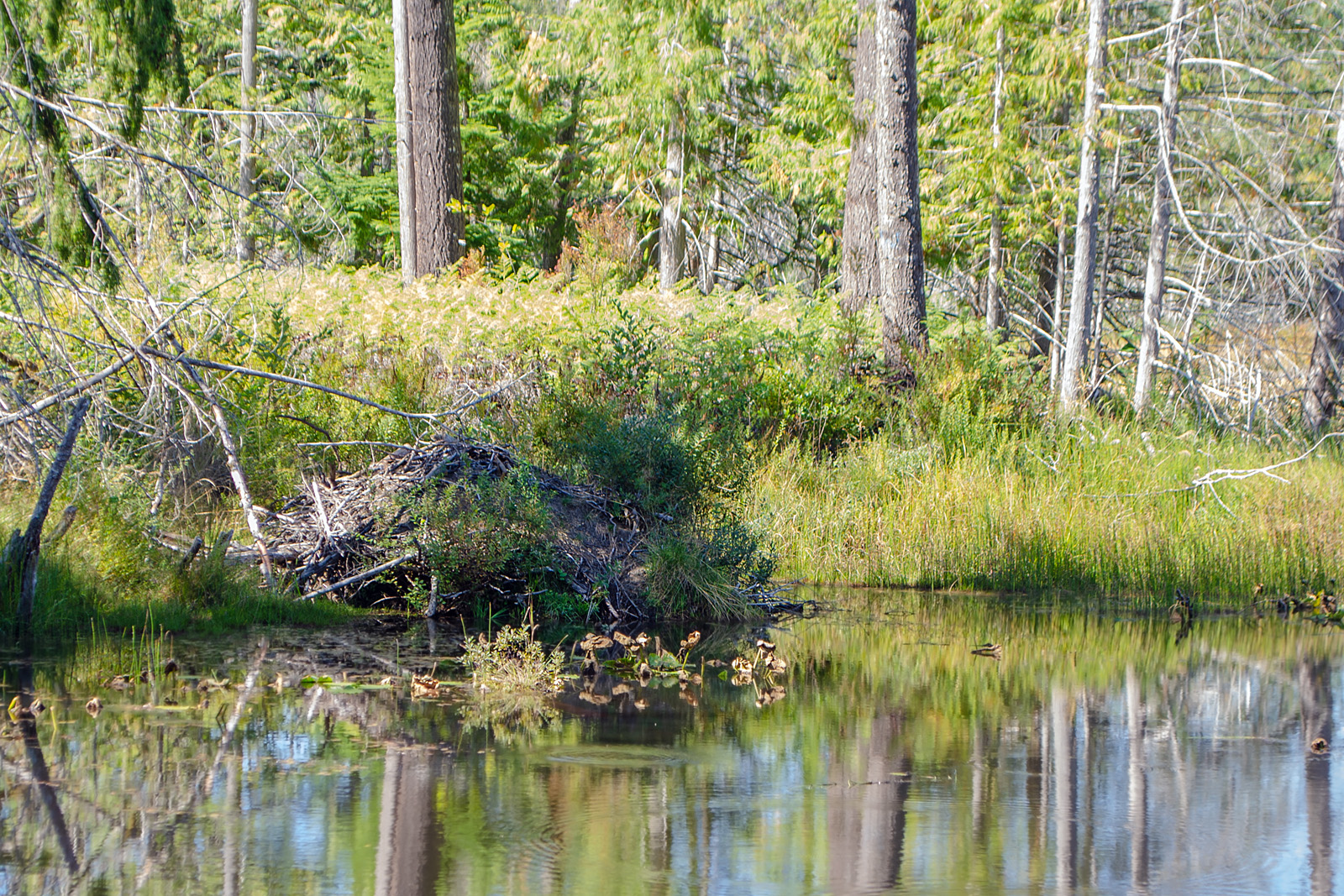
The beaver lodge, as I have always seen it, from the side of the highway.

We went down the back trail, to look at the pond from the other side.

The water lilies are almost all dried and brown now. Good beaver food.

On the way back, she headed off, straight through the bush where I had sort of wished I dared go, to see the beaver lodge from the back side. I followed her, one careful step at a time until I reached her, standing on a rise, looking down on the lodge.

The lodge, from the back side. The beavers have made a sort of trail over the muddy back end.

After that, we had to hike up the road and scramble through the bush to the other end of the pond, to get another view. I didn't make it down the last hill, and looked for mushrooms while she took water-level photos. On the way back, we passed a gap in the trees that gave us a glimpse of a muddy bank. And it was full of beaver tracks!

Beaver tracks, going and coming. The heavy tail blurs many of the tracks as the beaver walks, but there are a few, in the left angle of the X of branches, that show the five strong toes. It looks like the beaver's trail heads into the bush just behind them.

The beaver's front paws are smaller, the rear ones are as big as my hands. The hind toes are webbed, but not the front ones.

Since beavers live near water, their tracks are often found in mud, which gives good detail to the prints. Beaver tracks show webbing on the hind feet. Hind tracks can easily be six to seven inches long. All feet have five toes. The prints show five toes on the hind feet and four toes on the front feet. The fifth front toe sometimes registers, but not on all surfaces. Front tracks can be two to three inches long. Claw marks show in the tracks. Beavers walk plantigrade, or flat-footed. The large tail sometimes leaves a drag mark in the trail. (https://www.bear-tracker.com/beaver.html)

Reading up on beavers, trying to confirm that these were, in fact, beaver tracks (but what else could they be, behind a beaver lodge?) I learned of a couple more features that I should be able to find in the area: scat, sometimes deposited on the edge of the pond, and scent mounds.

Beavers establish scent posts near their ponds. These are composed of a mound of mud, grass and sticks piled up into a dome-shaped mass. The beaver rubs castoreum on the mound. Some of these mounds can be huge, measuring a foot tall and three feet across.(Bear Tracker)

I think I know where to look for these. A project for next summer!

And I still haven't seen hide nor hair of a beaver here!


Powered By Blogger