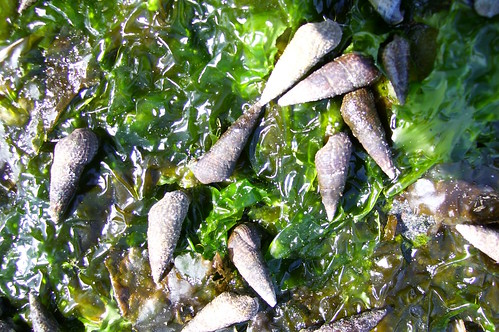
Saturday, February 28, 2009

Upside-down maternity wards

When the tide goes out and the sun shines, the beach residents go into hiding. Some burrow into the sand, others hide in the crevices between rocks, and many move to the underside of rocks and other shells. Flip a rock, and crabs scuttle out of sight to the new underside. Snails, barnacles and limpets are not so agile, but they close themselves down tightly against the heat and light.

I was flipping rocks on Crescent Beach, always remembering to put them back where I found them before the animals there got sunburned. (Crabs that had moved to the new bottom, now had to reverse direction.) On the underside of many rocks, this last week, I found masses of a yellowish, flecked jelly:


Flipped rock, with limpets and jelly.


Closer view of the jelly, with snails. (Sitka periwinkle, Littorina sitkana.) It reminds me of tapioca pudding.

They looked like egg masses to me. But whose eggs?

I had to search long before I found them. Each type of mollusk lays their eggs in a particular formation; the individual stalked "sea grapes" of the whelks, tiny "donuts" of the chink snails, strips, spirals (sea slugs), the eel-grass coating I found on this beach last year (still unidentified), and these blobs. Unfortunately, few books and websites mention these eggs; even fewer show recognizable photos, and fewer still link the photos to the specific creature that lays them. Most of the egg masses that I found had snails on or around them, but they were a mix; mud snails, periwinkles, whelks and black turbans.

I read up on all the snails, and finally found a PDF from the Alaska Natural Heritage Program, on the Sitka periwinkle. Not only does it describe the snails, but it includes a paragraph on reproduction with a description of the eggs. (No photograph, though.) And the descriptions match!


Sitka periwinkle with egg mass.

"After copulation females lay 50-400 fertilized eggs which are enclosed in a thick, transparent, gelatinous material; individual egg masses measure 5-15 mm but communal laying by several females often results in large egg masses measuring up to 10 cm, containing 2,000 or more eggs. ... Egg masses usually attached to and under rocks and seaweed in the upper intertidal zone."
Most of the egg masses I found were these communal sites.

That's a lot of eggs! I did a bit of calculating; at a minimum of 50 eggs per female, a success rate of only 4% will maintain the population. (They need 2 successes per male/female pair.) With 400 eggs, half a percentage point will do. In other words, most of these eggs won't make it.

From the PDF, again:
"Veliger (snail larva) develops shell within a week inside egg case, then hatches in around 30 days and begins to consume jelly of egg mass and diatoms which may have colonized the jelly surface."
Survival of the quickest, I think you could call that.


The individual eggs in the jelly catch the light. They vary, in different masses, from pale yellow to a burnt orange.

Someone had been flipping rocks on the beach before I got there. Where they had exposed egg masses and left them face up, the jelly was dry, and looked cracked and lifeless. It was a good reminder of the importance of leaving things as I found them.

.

Stumble Upon Toolbar

Friday, February 27, 2009

End of a chickadee

The tail end, that is.

I was trying to catch this one at the feeder, but was a split-second too late. But look at those fanned wings and tail! And the little curled-up feet!


The blurred curves below are wing tracks.


More conventional view. Lined up for the feeder. Waiting for me to put the camera down.

Back to planned posts, next. A more cheerful look at the Crescent Beach critters.

.

Stumble Upon Toolbar

Thursday, February 26, 2009

Just when you get your hopes up ...

... winter is back again. I was contemplating the sprouting perennials in my garden this morning, and planning a visit to the nursery for spring blooms. Nothing doing, says the weatherperson, and orders up a winter combo; rain, wind, sleet, finally turning to snow. The worst of it, is that it's not even decent snow; slushy, soggy, drippy stuff, messy to shovel, heavy enough to bend over the little yew that I had just released from its winter bindings, and slippery underfoot, to boot. (Mumble, grumble, whine and mutter; sombody fire that weatherperson!)

On the bright side, the bushtits have discovered my suet cage!


Pincushion.


Isn't he a cutie?

And the varied thrush was back several times today. He (she?) is still very wary; if I so much as get up from my desk, he sees the change in the light and takes off.

A few of my other suet and seed eaters:


A little sparrow.


House finch, in spring duds.


Face-off. "This is my place! My seed bucket! Go away!"


Chickadee. It was so dark by mid-afternoon that I had to use the flash.


First hydrangea leaves. Through my dusty window; it was cold and wet out there.

A few more days until March. Then it will have to be spring, and I'm getting some flowers. Whatever the weather.

.

Stumble Upon Toolbar

Wednesday, February 25, 2009

Red in radula and proboscis

Well, maybe not red, exactly, but you get the idea; it's a cruel, cruel world out there.

I was admiring the snail-like spiral of barnacles on this little rock, when I noticed the upside-down "ice-cream cone" shell combo on the left:


It's a mud snail jammed down inside a barnacle. "Eating the barnacle," was my first impression. Do Batillaria do that? I searched through other photos to see.


Here we go. A bunch of barnacles that are now empty shells. Barnacles with mud snails inside, with little periwinkles, with small whelks, even a barnacle with two different snails crammed into the tiny space. But ... I thought periwinkles were vegetarian!

They are. So are the invasive mud snails. And the Tegula, the black turbans. They feed on algae.

But the whelks, the whole lot of them, are carnivorous predators on barnacles and mussels. Wikipedia also mentions tube worms among their prey.

Using the radula, a scraper/drill/file arrangement (There's a good diagram here.), the snail drills a small hole into a mussel, then injects a paralizing or digesting enzyme. Once the mussel flesh is soup, the snail inserts a long proboscis and slurps it up. With barnacles, the technique varies a bit;

"The snail uses the radula to drill a hole in the barnacle shell at the seam between two plates, and then extends its proboscis through the hole to scrape out the soft tissue. The preferred barnacle is Balanus glandula ..."
From U. Washington.
I gather from this, that the other snails, the mud snail and the periwinkles, are simply feeding on the leftovers or the algae that grow on the leftovers.

Nobody's safe here; the mud snails, in turn, become prey. In this next photo, down on the left, in an empty clam shell (probably smashed by seagulls), a mud snail lies dead, with a small circular hole in the shell. Whether this was Nucella's doing, or some other snail's, I don't know. The moon snail makes larger holes (and are not on this beach, so far as I know).


While you're at it, open the photo full size, and look at some of the other snails. In the opening of several, you can see a small white claw. The original tenants are gone; the current residents are hermit crabs.

And on the outside of a snail just above the centre of the photo, look for a pinkish spot; it is possibly a slipper snail. There was another in one of our other photos. These are filter feeders; they do not drill holes.


A whole congregation of hermits. (Do hermits congregate?) And a few snails "peeled" by crabs.


Hermit crab, out looking for a solitary cave.

A few steps down the beach, I came across another breed of "voracious predators".


These are Paranemertes peregrina, the Purple ribbon worm. They looked almost black on the beach, but they are really a greenish, purplish, dark brown. The belly is creamy.

They are also called proboscis worms, because they shoot out a long proboscis to catch their prey. (Like a frog, maybe? But not as cute as frogs.) They are able to catch and kill polychaete (bristle) worms bigger than themselves. (WSU has a photo of a purple ribbon eating a polychaete.)


Another view. Note the green isopod to its right. The beach hopper, Traskorchestia traskiana, possibly.


And still another green isopod. I thnk this is the Rockweed isopod, Idotea wosnesenski.


Photo lightened considerably, to show two more beach hoppers.

These little guys crawled over and around the worms the whole time I was watching. The worms ignored them. They're looking for more challenging prey.

.

Stumble Upon Toolbar

Tuesday, February 24, 2009

Black turban snails

I love the colours and textures of these shells.


Tegula funebralis, found on Crescent Beach.

Tomorrow; the carnivores.

.

Stumble Upon Toolbar

Monday, February 23, 2009

"Endless forms ..."

"... most beautiful and wonderful ...," Darwin wrote. We looked over a small corner of that almost infinite variety on Crescent Beach last Friday.

In previous years, we have found millions (one small bay to the south of us has been estimated to hold 1.4 billion) of the invasive Asian snail, Batillaria attramentosa. That, and not much else; the native snails had been overwhelmed.

Not this year. Variety is in again. Here's a bit of what we found: (It helps to blow up the photos to full size.)


The stripy, pointed snails in the centre are Batillaria. They come in a variety of patterns and colours, from brown to grey to black and white, checkered to striped. But there, just below the pale brown invader, see that orange, curvy snail? It is one of the Nucella*, probably N. lamellosa. And over at the far left, on the clam shell, a tiny, black, globe-shaped snail could be one of the periwinkles, or maybe a young Tegula. Up on the point of the angular rock, a grey snail has longitudinal ridges. I am not sure what it is.

About Nucella. This snail boasts as many names as patterns and colours. Its colour varies from site to site; so does the pattern and even the thickness and smoothness of the shell.


This collection of Nucella comes from Port Hardy, at the northern tip of Vancouver Island. The photo is the first one from Dan Yoshimoto's page about this species; he has samples from locations up and down our coast, all different. At the bottom, he lists 21 alternate names. One of them, Thais, is the one I found in my Kozloff's "Seashore Life". (It's an older edition; maybe the name has been changed in the newer one.)

More on this snail later, in another post.


Limpets. We found two or three species of these. A couple of periwinkles, Littorina sitkana. Off to the right, an extremely indented fat snail, possibly a Tegula funebralis. Small barnacles, Balanus glandula. Assorted jelly-like organisms; green algae, blood-red algae, possibly a small patch of tar algae, and those yellow masses. (I'll deal with those in another post.)


A pair of snails, on the prowl. One green and ridged, the other black and white, much smoother. But the body, what shows of it, seems similar; licorice tentacles, with white tips, a black and white spot (Is that an eye?) at the base.


These barnacles are Chthamalus dalli. I can tell by the cross-shaped joint of the "mouth". Balanus glandula has a straight line, and another local barnacle, Balanus cariosus, has a squiggly line.


Aren't these pretty? Batillaria and a checker-board, ridged limpet. Colliselta pelta? Maybe. The barnacles are B. glandula, again.


Another pair, green and purple, although I think the green is a coating of algae. Here one is showing off the creamy body, as well as the black tentacle and eye spot.

And aren't those tiny barnacles pretty? They look almost like marzipan candies. Yum!

*I could be wrong on any of these identifications. Or most of them. To be more or less sure, I would have had to bring samples of them all home.

.

Stumble Upon Toolbar

Sunday, February 22, 2009

Treetop romance

Afternoon on Crescent Beach, Part 1: The eagles.

At the southernmost entrance from the street to Crescent Beach, two engraved rocks lurk under the salmonberry bushes.


"Spring - daylight - low tides
in the eel-grass beds
herring come to spawn"


"eagles follow"

Well, it's spring, but we haven't seen the low tides, nor the herring spawning. But the eagles are certainly following. Along the shore both at White Rock and at Crescent Beach (we visited both this Friday), almost every tall tree sported at least one.


Coming in for a landing.


Crow-watching over White Rock beach.


Going visiting.

In one of the evergreens, an eagle was calling and calling, barely pausing for breath. (Such a squeaky, shrill sound from such majestic birds! I am tempted to offer them a throat lozenge.) We walked in that direction for a while, and finally came opposite the caller's tree. I saw one eagle, then the next time I looked, two. They sat, quietly at last, for a minute or two.


"Well, hello, there! You finally got here! I've been calling you for hours!"


A minute later, both eagles were on one branch, with a privacy screen in front.


Fuzzy photo, but it shows the exultant spread of wings.


Still busy back there.


Tender moment over, they each rested on their own branch. When we passed on our way back, half an hour later, they were still there.

Awwww! Young love!

Next; "Endless forms, most beautiful." The water creatures.

.

Stumble Upon Toolbar

Friday, February 20, 2009

Crab or Great Horned Owl?

"Better not try anything with me, friend. I can take on you and two more; just me and my shadow!"


This afternoon, on Crescent Beach. I didn't rile him up; that was the little girl who found him first. He was mad, and ready to tackle the world by the time I pointed a camera at him.

And the beach was teeming with life; I'll be posting about it all week, once I've sorted the photos and done a bit of research.

.

Stumble Upon Toolbar

And the bug season begins, at last

Yay! Spring has come to our hilltop! These crocuses* were blooming in a neighbour's garden:


The palest of pale mauve crocuses.


Another pair.


With a few yellow crocuses for variety.


And, in a patch of succulents, these deeper mauve ones.

But look closer! The very first insects of the season!


Tiny beetles.

Unfortunately, I was resting from Wednesday's labours, and Laurie went out alone. (Well, not quite; he took along the camera for company.) So I didn't get a close-up, and I didn't bring a beetle home. I'll do that tomorrow.

And what do you think this is?


Maybe you have better eyes than I do; I couldn't make head nor tail of it, until ...


... I blew it up. A crow, stretching wings and tail, while he keeps a careful eye on that human nosing around the gardens down there.

* I can never be sure about the plural of "crocus". One crocus, two "crocuses"? Or two "croci", as some people insist on writing? I finally looked it up. It's "One crocus, two crocus, three crocus ..." Or, if you prefer (and I do), "two crocuses".

.

Stumble Upon Toolbar

Thursday, February 19, 2009

Musings while in recovery

I'm too tired, after a day of babysitting, and traumatized, from almost 48 hours without an internet connection, to put together a coherent post. The best I can do is a series of wandering thoughts.

1. Because I had to reboot the computer and the modem as part of the attempt at locating the problem (which didn't help, at all; the outage was at the other end) and because the computer was useless, anyway, (Why do they put the help files online these days? When you need them for trouble-shooting, you can't get them. That's akin to the isp staff that e-mailed my dad to tell him that his e-mail was currently not available while they upgraded. Really! So helpful!) I unhooked everything, cleared and moved the desk, and sorted out the wiring. The desk had been in the same position for about 5 years.

It took all day Tuesday to do that, and to return everything to its place and hook it all up again.

It wasn't as dusty behind the desk as I would have expected. I only found one spider, which I carefully shooed into a crack before I vacuumed.

I keep an air filter running behind the computer at all times, to make sure it gets only the cleanest, most dust-free air possible. Tuesday, I vacuumed the computer thoroughly from every angle, and through every vent. Then I put a fresh, new dust bag into the vacuum, reversed the hose, and blew through the rear fan outlet. I should have done this outside; a huge cloud of fine dust spewed out of the intakes and all over the room. So I had to vacuum and dust everything in the room again.

Dust is not good for computers. Moral of the story; must clean computer much more frequently.

2. Travelling around with an almost-3-year-old, I stopped to watch a backhoe at work on a crumbling garden installation. It was picking up rotting beams, stacking them to one side, and levelling a small hill. After we started home, I was treated to the following conversation:

Sophia: "Backhoe bites wood."
Me: "Yes, a backhoe bites wood. And mud."
S: "Not people?"
Me: "No, not people. It doesn't bite people. Just wood and mud."
S: "Not Sophia?"
Me: "No, not Sophia. Just wood and mud."

And then a monologue, all the way home: "Bites wood. Bites mud. Not people. Not Sophia. Not people. Wood. Mud. Bites wood. Bites mud. Not Sophia. Not people. Bites ..."
If repeating a fact 10 times cements it in memory, I'm sure she's got this one down for life.

3. Eileen (Cicero) writes of squirrels being "ever so persistent." They are. So are kids. (Which is why you can't hide Christmas presents from them, and why (I think) some teens are such good hackers.) In the mall, we stopped to look at the loonie grabbers, the brightly-coloured bouncing "airplanes" and bunny rabbits and Noah's Arks. One, a kid-sized ice-cream truck, was still going, after the previous kid had left it. Sophia climbed in and entertained herself pushing all the buttons. ("Yum! Chocolate! My favourite!" the red one elicited.) Another kid, a boy around 5, climbed in, too.

The truck used up its loonie, and stopped. Sophia pushed buttons vainly. But the boy jiggled the coin return lever with one hand, and pushed the Start button with the other. Off they went again, for the full ride.

On the third time round, the trick failed. The kid kept trying, until his mother came over to take him off to pre-school. She told me he'd discovered the trick some weeks before. She's got a hacker in the making there.

4. The Great Backyard Bird Count. We did count, but without too much profit. Juncos, chickadees, crows, and pigeons, of course. Eagles, 10 in one small clump of trees along the Ladner Trunk Road. 4 Northern Harriers in and beside a field, a mass meeting of gulls along the highway to Richmond. Not much else.

Part of the problem was that we were on the go most of the weekend; we made observations from the car as I drove. And I took no photos. These two are from the week before:

crows
A dozen crows. Otherwise known as a murder.

woodpecker
Wally's Woodpecker. This wouldn't have worked for the bird count, would it?

And Laurie did get a close shot at a hawk from the car, as I drove. Unfortunately, the car hit a bump just as he pressed the shutter:

hawk
Hawk backside. And, on the lamp, a liberal application of white hawk poop.

5. And tomorrow, I hope, life will return to its normal tempo. (I can dream, can't I?)

.

Stumble Upon Toolbar

Wednesday, February 18, 2009

I'm alive, again!

My ISP has been down since Monday night, and just came back on-line a few minutes ago.

Seems like forever. But I got some postponed chores done, during that eternity.

I'll be back on schedule tonight.

Stumble Upon Toolbar

Monday, February 16, 2009

The Suet War, continued

Squirrels vs. Me and the birds, Round 3:

(Round 1, Round 2.)

It's been over a week since I hung the suet basket on sturdy wire. The squirrels continue their assaults on it, to no avail. The big black squirrel that stole the first batch tried his hand, of course, and gave up in disgust. A couple of greys worked at it for a while, until Scruffy chased them off.

(With all the running up and down, dashing from branch to branch, dodging Scruffy's angry teeth and chatter, the little maple was shaking from the ground up.)

And now, with the field to herself, it's Scruffy's turn. And she proves as talented, in her own way, as the first thief:


"Hmmm... Looks easy enough."


The toehang.

But look at that toehanging technique again. The knees face the camera, while the toenails grasp the branch. The bottom of the foot is now towards the camera. How does she do that?

Look at your own legs and arms; we can manage that swivel with our arms, but definitely not with the legs.

Ah, but that's not all that swivels:


The Spinal Twist yoga position.

Here, the knees and belly face the camera, while the upper torso is turned to show us her shoulder blades. (The white markings are scar tissue from an old injury.) She's still holding on with the toes, but one foot seems to be losing its grip.

7 seconds later, she has fallen:


"Oops!"

When she falls, her hind legs drop, but she propels herself upward, ending up on the branch above.

She tries again, this time, hanging by only one foot.


"Look, Ma! One foot, and a tail!"


"How about one toenail?"

How long can she hold that pose? So far, it's 12 seconds.


And then she spins and grabs with the second hind foot.


"Nom, nom."

I have noticed, before, how the squirrels use their tails for balance, curving it inwards to stand on the edge of the feed bucket, or dropping it on the far side of a branch. In some of these photos, it almost seems that Scruffy is using it for grasping, like a tame version of the monkey's prehensile tail.

I looked it up; opossums and porcupines have prehensile tails; squirrels do not. But some rats are able to use their tails in this manner, hanging from branches, at least briefly. (Wikipedia.)

Scruffy is probably using hers for balance; a bit of weight on the far side of the branch. If, in this manoeuvre, the tail rests on the branch, so much the better, but the tail does not have the ability to actually grasp the branch.

Be that as it may, she can't break the cage down, and finally gives up and checks out the ground for crumbs.


"Not much suet here, but maybe there are some sunflower seeds?"

So, I won this round. The current score is Squirrels 1, Home team 2.

Go, Team!

.

Stumble Upon Toolbar

Sunday, February 15, 2009

Interlude

Enough of winter! Valentine's Day calls for sunshine and flowers. So we headed to the Banana Belt; the streets one block north of the US border, in Beach Grove.

The sunshine was iffy, but the gardens cooperated:


Pussy willows.


The metallic, glittery eye of a (fake) frog.


Frost-hardy flowers.


Tinies; primulas hiding under the leaf litter.


Pink heather.


First snail of the season.


Very yellow. A primula shows off its corrugated leaves.


Little drooping light bulbs. Snowdrops.


Clumps of snowdrops in a yard packed with them.


Eros dreaming over his burnished globe. We join him, in miniature, among the growing things.

And the day ends where it begins, with love.

.

Stumble Upon Toolbar

Saturday, February 14, 2009

For all you fans of Lee Valley Tools ...

... here are a few photos of the store itself:


Display cabinets and empty heads.


Prepaid Pick-up. Express.


Parking lot monitor.

Somehow, I don't think Lee Valley Tools will be looking to hire me as PR manager. Their loss.

.

Stumble Upon Toolbar

Friday, February 13, 2009

Urban skywatch

We spent the morning in Vancouver yesterday; an early medical appointment, breakfast at our favourite omelette maker's, Lee Valley Tools, lunch at IKEA, and home, laden with bags and boxes. Along the way, we kept the cameras busy:


If you don't think of it as rush hour (well, the pre-rush rush), then it's beautiful.


In a school's windows, the dawn light behind us.


Reflection in a car windshield.


Room with a view.


Crow's nest and crows, along the river.


Light to the east.


10:00 AM. The Knight Street Bridge. Greyness, with warmth beyond.


And all the sky to breathe in.

By the way, don't forget: today, Friday the 13th*, is the start of the annual Great Backyard Bird Count. 15 minutes a day; just right for coffee break.

* Good karma to keep your paraskavedekatriaphobia at bay.

A Skywatch post.

.

Stumble Upon Toolbar

Wednesday, February 11, 2009

Worldess Wednesday


(11:54 PM. Still Wednesday.)

.

Stumble Upon Toolbar

Questions, questions, and a sowbug graveyard

I don't know enough about trees. With the leaves on, and a bit of help, I can usually recognize the more common ones. Without leaves, I'm struggling. It doesn't help that here in the lower mainland, the climate is so mild, and the gardeners so enthusiastic, that many of the trees around the homes and businesses are imported or hybridised. Even in the greenbelts, the newcomers are taking root. (See Huckleberry Days, for example.)

I take a photo of some bark, bring home a leaf or two, and compare them with my books. Sometimes, I find them right away, and there is no doubt about them. At others, well, is this bark like that, or like that? Or maybe like this one from China? Do the leaves match? Almost? Not at all?

This evening I got out all my tree books and leafed through them, looking for the latest find. No luck, at all.


What is this? It's a deciduous tree, not terribly big. There were no catkins nor budding leaves yet.


The other side of the same trunk. Elephant skin. Are these younger branches, coming up from below?


In a couple of spots where the bark has separated from the trunk, this red mass shows up. Is it the inner bark, or some fungus or slime?

Far too many questions.

Inside the trunk, we found a mini-habitat:

At several points around the trunk, where it seems that a branch must have broken off some time ago, there are deep holes.


The young branches have grown up around this one.

I blew my photos up to full size and took inventory. The wood at the top had a crumbly look to it; I could see worm tracks here and there. There may be a few woodpecker holes, but not many. (Compare it to Seabrooke's woodpecker tree.)

In the puddle at the bottom; dead leaves, a few twigs, some rectangular whitish things, and an earthworm (I think). Above that, in the damp; slimy green algae, looking uncannily like sea lettuce. Up at the top where it's dry; white slime (parchment, crust, dry rot?). And between the algae and the puddle; a few sowbug carcasses. They looked like spider frass; while we were at the tree, I looked for webs or spiders, but none were visible.


Another view of the same hole. See the sowbug graveyard?


Not the same hole. This one is dryer, and full of dead sowbugs. The edges of the plates are white, making the bugs look striped, possibly because of a fungal growth.

Those are the first sowbugs, dead or alive, I've seen around here since the cold weather started. Under the bark, though, no matter how it snows and blows, there is a modicum of warmth and moisture for assorted insect, worm and spider life.

On a tree a few feet away, moss and lichen grew. Different chemistry, different organisms. But there are probably sowbugs in the crevices there, too. And spiders. There are always spiders.


Leaf lichen and tiny moss.


.

Stumble Upon Toolbar

Tuesday, February 10, 2009

At least, I'm not tagging anyone


First primrose of spring.

I'm going to be really lazy. I spent a good part of yesterday and the night before on Facebook, writing, posting, reading, and commenting on a meme that's going around.

Now I'm posted out.

So, I'm going to paste my Facebook note here, and call it a day.

It's the "25 things about you" meme. More than we usually do in our blog memes, and since it came to me via family, it was a bit more personal and in depth than usual.

I'm being dilatory because I am chicken.

Here goes:
"1. I'm a sucker for these memes. But I never think I have anything to say.

2. And then I say it, at length. I "talk" too much.

3. I am astounded, amazed, humbled by my kids and grandkids. So brilliant, clear-eyed, talented, beautiful, decent, ... When I grow up, I want to be just like them.

4. I haven't grown up yet.

5. I'm a people-watcher. I find them, all kinds of people, endlessly fascinating. I have learned a lot, just seeing what they do, and how they go about it.

6. I like bugs, and all kinds of tiny beasties. I have a spider living in a jar in the living room and I feed it fruit flies that I breed in another jar. When I was a kid, I used to dream of being a researcher into diseases and their insect vectors, then in University, my favourite course was Microbiology. Too bad I never was able to finish.

7. I read all the time. (That's cheating. Everybody who knows me, knows that.) These days, it's mostly blogs, biology, historical mystery fiction (Ellis Peters, for example), some sci-fi. Donald Westlake just died a few weeks ago, and I've been re-reading all of his books that I still have. (That's crime capers, mostly humorous, other fiction, and "Kahawa", historical fiction.)

8. Only 8 so far? On we go ... Deep down, I'm terrified of people, especially people I know well. Strangers are ok; if they think I'm weird, so what? But with people I know, it's different. I care what they think. But I force myself to ignore the fear. It's irrational, anyhow; if I hide from people, then all they will know is the mask, not me.

9. I only learned that last bit about 20 years ago.

10. I eat strange things. At strange hours. I make concoctions with chocolate and fake sugar, with oatmeal and powdered milk and coconut and other odds and ends, to substitute for the chocolate bars I don't dare eat because of what they do to my blood sugar levels. Some of my creations aren't all that good. Some are, though.

11. I never, ever buy anything on the phone. I never buy anything I see advertised on TV, at least until I've long forgotten that I saw it. I never buy anything I see on a billboard.

That saves me a lot of money.

12. Every place I have lived has been beautiful. I want to go back. I love the deserts, the ocean, the rain forest, the fjords, the Chilcotin, Bella Coola, Vancouver, Mexico, Oklahoma, even Texas.

The log cabin in Bella Coola was the best; I remember the smell of it, the old logs, the view out the window at the golden field across the way, the goats tap-dancing on the roof of my car. I remember the long drive up-valley, with every curve a new revelation.

But the cabin in Silverdale was the best. I loved the view out my front door; the deep valley and the mountains beyond, the silence except for the murmur of the trees, the loft, the beautiful slant-laid wood floor in the bedroom, the frogs in the pond.

Or the house on the shore of Nootka Island, with the creek running under my bedroom and the big double living room, with the oil lamps and the wood stoves, and the view out my window, boats, seagulls, the beach, and once a whale. ...

13. At this rate, I'll never get to 25.

14. I burn kettles. And pots. I get too involved in what I'm doing, and forget. And I'm always finding cold cups of coffee in the microwave.

15. But no, the house in Mexico City was the best. The thick adobe walls, built a hundred years previous, the tall, skinny doors, the balconies and ivy, the courtyards, the magnolia tree over the fountain... I want to go back. To them all.

16. I can't remember names of people I meet. I used to blame myself, and try harder. I've tried all sorts of mnemonics, I've tried repeating each name dozens of times. Nothing works. If I remember the name, I can't remember the face it goes with. (I remember one guy from when I was a teenager; a Mr. Wallace. The name was stored with a sentence: "What A Loud, Loud, Awful Cravat. Eek!" I have no idea what he looked like.)

17. Sometimes I can write poetry. Mostly, I can't. I don't know what turns on the poetry generator.

18. But I can always write doggerel. Bad doggerel.

19. I'm getting on in years, and my body is not as reliable as it used to be. But the days are still good, and the world is wonderful. I enjoy life, even when things hurt. And there's always something new to see, to learn, to record, to do.

20. To collect. I seem to attract oddities. Antiques and dried grass stems. Dishes and round stones. Saltshakers and seashells. Old wood and feathers, boxes, tins. I can't limit myself to one thing. Everything is so interesting!

21. I don't have a favourite music, singer, movie, artist, school of art, colour, food, or author. There are too many good ones, and my mood varies from day to day.

22. Today, Laurie was singing Bob Dylan. My favourite for today.

23. I don't have a TV. I don't miss it. I've discovered that most people who make the first statement, follow it up with the second.

24. I'm a bit of a geek. (Actually, I registered fairly high on the geekery scales when I took a couple of tests.) I like to know how and why things work, and be able to tweak them, so that they do what I want them to. And I think that the Web is the Real World. Laurie disagrees.

25. Whew! Last one. I give names to the squirrels that live in my back yard. And to my spiders. Not to the birds, though; there are too many of them. Those names, I usually remember. Go figure."
I added, on Facebook, a photo of Brownie, the spider. But she's been discussed here already. Instead, here's a bit of early spring colour:


Catkins


.

Stumble Upon Toolbar

Monday, February 09, 2009

Vote for Tomorrow

Out for a quick walk around the block, I looked across the street to the vacant lot. This fall, someone had brought in machinery and levelled the south half of it, stripped it down to the bare gravel, abandoned a bucket there, and disappeared. The bare earth has been sitting there, ever since, staring bleakly at the sky.

But on the far side, a few trees provide habitat for crows:


Lookout and nest.

I noticed their reflections in some newish puddles, and we walked over to look.


The ground underfoot was a mix of fairly solid gravel, and soft mud. Some of the grasses are beginning their work of reclamation. Again.


Oak leaf on mud-stained, wind-blown paper.


The bucket of the backhoe, rusting out.

And in the biggest of the puddles, (still only a few inches deep) a pair of mallards rested:


"Not much to eat here, but at least we have it to ourselves."

At the end of this puddle, there is a message.


"Vote for tomorrow. Vote Green."

Unfortunately, no-one was listening.

.

Stumble Upon Toolbar

Sunday, February 08, 2009

Amorous fruit flies

A pair of the fruit flies I am breeding to feed my current spider.


They are quite enthusiastic about the breeding part of the project, maybe not as much about the last act.

From Wikipedia:

"Females become receptive to courting males at about 8-12 hours after emergence. Males perform a sequence of five behavioral patterns to court females. First, males orient themselves while playing a courtship song by horizontally extending and vibrating their wings. Soon after, the male positions itself at the rear of the female's abdomen in a low posture to tap and lick the female genitalia. Finally, the male curls its abdomen, and attempts copulation."
Actually, from watching the process, I would include a second step, before the tapping, etc.: the male chases the female all over the place, both of them running. This couple had paused for a breather during the chase.

Too bad they won't get a chance to raise a family; they are already in the spider's jar.

.

Stumble Upon Toolbar

Saturday, February 07, 2009

Squirrel 1: Home Team 1

He won that round.

I slept in this morning. When I got up, the suet was gone, the flimsy wire I had used twisted and spread apart.

I'm off to Home Depot to look for a cage.

* Update: I bought a metal suet basket, plus some sturdy wire to attach it to the branch. It's hanging up now. I want to watch the suet thief wear down his teeth on that!

.

Stumble Upon Toolbar

Stop, thief!

Just before the snowstorms started, I picked up a suet cake for the birds. I'd never fed them suet before, and I didn't have the proper squirrel-proof cage for it. There were none in the store, either, so I made a sort of net bag with kitchen twine and fishing line (for strength and un-rottability), and hung it from a branch of the maple tree. (Laurie pulled the branch down for me with a rake, and I tied it, rather messily. I should have at least used the stepladder.)

The birds discovered it quickly; first the chickadees, then the juncos and house finches. The crumbs fell into the London Pride patch, where more juncos, assorted sparrows, towhees, and even a varied thrush congregated to clean up. Scruffy the squirrel tried to reach it, but the string was just a bit too long for her. By now, they've reduced it to maybe one third of the original size.

Today I had a new visitor, just a bit bigger than Scruffy. And maybe a bit more resourceful. See his strategy:


2:25 The basic toe-hang. "Mmm! Good stuff!"


2:26:41 The stretch and swing.


2:27:01 Bringing the string over the branch, for a shorter swing and a more comfortable position.


2:27:14 I could almost see when the thought crossed his mind, "I should take this one home." He bites the string above the first knot.


2:27:37 "Now, if I yank this hard enough ..." The tug-of-war.


2:27:46 "Maybe if I bite the string here ..." Opening up the net.


2:28:00 Reverse direction and give it a good shaking.


2:28:28 Break time. A quick nibble to build up energy for the next stage. "And, yes, I see that you're watching me, but who cares? You can't climb up here."


2:28:46 Reverse direction again. Start rolling and twisting and tugging. Loosen up the net. Over a minute for this stage.


2:29:59 And now, stretch that string, and YANK!


2:30:28 Success! Entire operation, just over 5 minutes.

The string and branch bounced around, the suet plummetted to the ground. I decided it was time to call a halt. That suet was for the birds.

I stepped out the door; the squirrel stopped on his way down the tree to challenge me.


"That cookie is MINE; I liberated it."

He raced down the trunk and over the garden. But I was faster. After I had gone inside, he came right over to the door to claim his property. Too late.

The suet is up again, tied with wire this time. We'll see what happens tomorrow.

.

Stumble Upon Toolbar

Friday, February 06, 2009

Non-historical marker

I've been tidying up my hard drives, and found this. I'd meant to post it, and then forgot.


Strathcona, last November. I've forgotten the address. Doesn't matter; nothing happened there.
.

Stumble Upon Toolbar

Thursday, February 05, 2009

Fishing hole

The Fraser is a busy river, has been since before the white man found it, in the days when war and trade canoes plied the waters from the coast to the canyon. Back then, of course, the shoreline was green. These days, except for a few park reserves and housing development frontages, both shores (all 4 shores, sometimes, where there are islands) from Mary Hill to Steveston and Ladner are piled with storage containers, choked with log booms, busy with factories and warehouses and shipping yards and repair garages and junkyards, scattered with the leavings of a century of industry; smoky, greasy, grungy, rusty; the bird songs overpowered by miscellaneous beepings, tootings, rumblings, clankings.


A nest of rubber and plastic "snakes".

We drove down River Road, dwarfed among all those trucks, to see if the river still lives. And in between industrial sites, we found this:


A short trail leads to a fishing spot.


Straight across from us.


Old, waterlogged boards, and signs of a recent visitor.


Rocks and drowned grasses.


Grass still holding its own.


The spit at the end of Huston Road. Pier belonging to a construction company.


A tiny sandy beach. Fine, clean sand.


Not all the sand is on the shore.


Behind the beach, scrubby bush has captured water-borne logs. Moss covers the oldest. Here, a small fern has found a foothold.


Tiny white shelf mushrooms.


And a pair of mallards.

.

Stumble Upon Toolbar

Wednesday, February 04, 2009

No sense watching the road when it's a parking lot

We got caught in rush hour. At least I had a camera with me :


Nanaksar Gurdwara. Sikh temple, on Westminster Highway.


LaFarge Cement plant. On the south shoreline of Lulu Island.


Alex Fraser bridge. Crossing from Lulu Island to Delta.

We passed an accident on the far side; 4 police cars, 2 tow trucks, one man with a broom. Traffic on that side was halted, all the way across the bridge. On our side, there were no obstructions. But we still inched along all across the island, bumper to bumper, brake lights flashing, until we passed the accident site. ("Move along, there, move along. Nothing to see here; move along.")

As soon as the last police car was in our rear-view mirror, we all resumed normal speed.

There was nothing to see.
.

Stumble Upon Toolbar

Tuesday, February 03, 2009

A tasty stew

I promised you stone soup. Blog-style stone soup.

Years back, my parents travelled the US and Canada in an UltraVan. Periodically, they met with other UltraVan owners at rallying points. (The rallies are still ongoing.) One of the traditions was that on the final evening, each Van owner contributed his/her/their canned goods to the UltraVan Stew. Soup, meat, veg, chili, beans, spices: it all went in one pot. Stone Soup, in other words. Mom said it was always good. (I might not be so positive, but at least it was nutritious.)

So, for today, I'll contribute my stone and a veg,


Rose weevil, last summer.

... and then stir in these goodies from the web:

First: the carnivals, posted, and to come.

The Other 95%: Circus of the Spineless #35: Regeneration, Renewal, Reinvigoration It's back! At long last, we have a host, Kevin Zelnio! And the first installment of the reborn CotS is a winner. Thanks, Kevin.

Festival of the Trees is up at Treeblog. A poetic post, with a bark rubbing, to boot. As well as all the great links.

I and the Bird will be up in a couple of days at Vickie Henderson Art. (You still have a few hours to get a post in to her; today's the final day for submissions.)

I have posts in those three, but not in the next ones. Maybe another time.

Ecstathy: Carnival Of the Elitist Bastards IX: Keepin' yer wits about ye Pirate edition. This one's just plain fun. As well as being dead serious.

Carnival of the Blue #21 « The Oyster’s Garter In verse. Or doggerel. (Sorry, Miriam.) Good ocean-related links. I liked the cuttlefish story and poem.

Great Backyard Bird Count — Great Backyard Bird Count And this is coming up in less than two weeks; February 13 -16. Are you in? I am.

Then there's Blogroll Amnesty Day; the idea is to link to 5 smaller blogs. I don't know about size, so here are 5 that I've found recently, and added to my GoogleReader:

Jehuite This one is in Spanish. The wild vegetation of Mexico. Beautiful photography, some "exotic" plants, some old familiar ones.

The ScienceBlogs Book Club : Bonk, by Mary Roach: Friday Weird Science has found its Patron Saint A two-fer. The Book Club blog, and the link to this book. I have read Stiff, by Mary Roach, and loved it, so this is on my list of must-buys. A warning, though; it is not to the taste of many people. If dead bodies make you squeamish, give it a pass.

The Book of Barely Imagined Beings. Science, with great photos, and interesting posts. Like "Earthworms save planet".

MMmmm…That’s Good Grub* « Drawing The Motmot An artists climbs to the top of the Amazon rainforest to paint, in this post.

Tyto Tony. "Life in a tropical Queensland wetlands". Beautiful bird photography.

And 6: (I can't count.) Wild Light. Photography using only natural light. Astoundingly gorgeous!

And even more goodies for the soup:

A natural history of Runswick Bay: Lugworms. For Wren.

Sunrise, sunset, daylight in a graph. I posted this a year ago, and it keeps turning up in my Sitemeter. I am surprised every time.

And because it was Groundhog's Day yesterday, and I missed it, here's Hugh's story: Momma Vole.

And a last bit of greenery (and reddery):


The weevil again, delicately tiptoeing through a thornfield.

.

Stumble Upon Toolbar

Monday, February 02, 2009

Quiet afternoon, with background quacking

Before I go on to something else, let me show you the last of the Reifel Island photos:


I love the light in this one. An almost-deserted waterway. The ducks are behind us.


Coot, collecting leftovers after the kids went by. Those feet are far too big; they get in each other's way.


"Nobody's using this nest box; I may as well perch on it."


Unidentified hawk on another nest box. Good thing it's not breeding season yet.


Mallard hybrid. I don't think I've seen this particular mix before.


Great blue heron, fishing.


Scaup females. Greater, I think. Or Lesser. One or the other.


Redwing blackbird. The males arrive here first, then the females about a month later. We'll look for them at the end of February.


Bird feeder. With resident squirrel.


Looking out the window of the warming room. A welcome haven in cold weather, heated by a fragrant wood stove.


On the way home, we stopped to see this eagle guarding his nest.

Next: Stone soup.
.

Stumble Upon Toolbar

Sunday, February 01, 2009

A trio of leggy redheads

These three sandhill cranes like kids. I think they're the same ones who "persuaded" Hugh's son to empty his seed bag for them a week ago. This Friday, they hurried to meet us on the pathway, in hopes of more goodies.


Two of the three, looking for a handout.

Yesterday, I wrote that they were youngsters. Later, I began to wonder; don't the red heads mean that they are adults? Time to do a bit of homework.

Amazing how one question leads to another; I ended up with pages of notes on Grus canadense, or Sandhills.

Sandhill chicks, called "colts" (because they're leggy, like young horses?), are reddish brown, with grey underparts. By maturity, they have turned grey, except for the forehead, which is bright red. During breeding season, they smear themselves with red mud, maybe for camouflage purposes; by the end of the season, they are ragged and worn.

So these three are adults, not breeding yet. The adolescents, once the parents have chased them away in order to start a new brood, wander around aimlessly, "hanging out" with their peer group. Somewhere between 2 and 7 years old, they pair off, then stay with their mates year-round, often for life. The lifespan in the wild is about 25 years.


Practicing the dance steps.

Male and female sandhills look alike. (To human eyes, anyhow. They seem to know the difference.)

When the time comes, the adults put on their makeup, and go to the dance. One will start dancing, and the prospective mate will imitate him. Soon, the other sandhills in the group join in until the whole flock is "on the floor".
"Five courtship displays have been identified as part of "dancing," the primary mechanism of pair formation in this species. These displays are the Upright wing stretch, Horizontal head pump, Bow, Vertical leap and Vertical toss. Three courtship displays are used exclusively by paired adults to maintain the pair bond and synchronize reproductive development. These are the Bill up, Copulation and Unison call displays."
From Animal Diversity Web
I've never seen this. Maybe this year, I hope.


Wing stretch; full wingspan, about 6 feet.

Breeding starts, for migratory birds, in April or May. Sandhills resident year-round, like some of the Reifel Island birds, may start earlier, even in mid-winter. Two eggs are laid, in large (2 -3 ft. wide) nests on small, low islands with a good view, in May or June, and hatch a month later. (Which is about the time that Laurie tried to sidle past a protective adult on the trail, and was stabbed for it.)

Both parents incubate the eggs and care for the chicks, with the male doing most of the guarding, while the female sits. The colts leave the nest, at least for the days, a day or two after hatching. They are soon able to feed themselves. At ten weeks, they begin to fly.

We've seen these youngsters, standing ankle-deep in mud, probing for food, while the adults stood guard on the banks.

For this nesting and family-raising endeavour, the sandhill crane pairs claim a territory of an average of 40 to 60 acres, although if conditions are favourable, it may be as small as 3 productive acres. The Reifel Island sanctuary covers 890 acres; room enough for at least 20 families.


Contemplating a possible snack.

What do sandhill cranes eat? Anything. Insects, seeds, frogs, mice and other rodents, plants, fish, snails, snakes, roots, berries, grass, other birds, birds' eggs, ... And the contents of kids' bags and buckets. They'll have your sandwich, too, if you're still carrying it, thank you. After we and the bucket lady emptied our containers for the trio, they followed us down the trail hoping for more.

I was surprised to find, on a discussion board (Hancock Wildlife Channel), a local resident who feeds sandhills out of his hand. And he has the photos to prove it. Brave! I don't think I would have steady enough nerves. Those beaks look dangerous enough, but the eye ... !


Armed and ready. With his eye on you.

One other tidbit:
"Fossil evidence found in Nebraska indicates that sandhill cranes have been around, unchanged, for about 10 million years. That makes them the oldest-known surviving bird species in North America." From The Georgia Straight
Wikipedia clarifies:
"A 10-million-year-old crane fossil from Nebraska is often cited as being of this species, but this is more likely from a prehistoric relative or the direct ancestor of the Sandhill Crane and may not belong in the genus Grus. The oldest unequivocal Sandhill Crane fossil is "just" 2.5 million years old, over one and a half times older than the earliest remains of most living species of birds, which are primarily found from after the Pliocene/Pleistocene boundary some 1.8 million years ago."
2.5 or 10, whichever; that eye does look dinosaurish.

~~~~~~~~~~~~~

Some of the sources for this post:
Wikipedia, The Georgia Straight, NationMaster Encyclopedia, Bird Web (Seattle Audubon Society), US Dept. of the Interior, Animal Diversity Web, Hancock Wildlife Channel, Baker Sanctuary, and Rock, Paper, Lizard.
.

Stumble Upon Toolbar
Related Posts with Thumbnails