There's a serving bowl full of muddy water sitting on my kitchen counter this week. Every time I pass, I stop and peer into it, maybe stir the mud and stems a bit. I top it up every morning with cool, boiled, de-chlorinated water. I keep a camera handy.
It all started when I brought home those leaves of the carnivorous bladderwort, to look for bladders. And when I rinsed the mud off the leaves, a damselfly larva swam out. And there were a couple of caddisfly larvae, too.
I'm too softhearted. I couldn't just dump the leaves and mud when I was done looking for bladders. So everything went back into the big bowl; even tiny critters deserve life.
And the next day, I found another damselfly larva. And two more caddisflies. And then the leaves started adding more green; they don't need roots. And there were more tiny animals:
 |
| A fast swimmer, always at the surface. About the size of a pinhead, say 2mm not counting the wide, rowing legs. On iNaturalist, this has been identified as a Milky Backswimmer, Notonecta sp. |
 |
| One of the caddisfly larvae. |
Caddisfly larvae encase themselves in a tube made of bits of sand or vegetation, tied together with their own silk. Each species has its own building code; some are neat freaks, some make almost jewel-like cases, some, like these, are messy, but each in its own way. The ones I have seen before in local streams, have used evergreen needles as building material, arranged longitudinally. These, from the beaver pond, seem to be using snipped pieces of grass or leaves.
 |
| The tube is open at both ends, allowing for water to flow through. |
These little critters are quite active, moving about from one bit of stem to the next, nibbling as they go.
Exceptionally sensitive to pollution, their presence signals good water quality. (UWM/BugoftheWeek)
 |
| This one's 7 mm. long. iNaturalist suggests it's the Acute Bladder Snail, Physella acuta. |
This snail wanders around, sometimes on the bottom among the detritus, sometimes upside-down, walking under the surface of the water, as a fly does on a ceiling. In a bright light, the shell is transparent. I've seen two, so far.
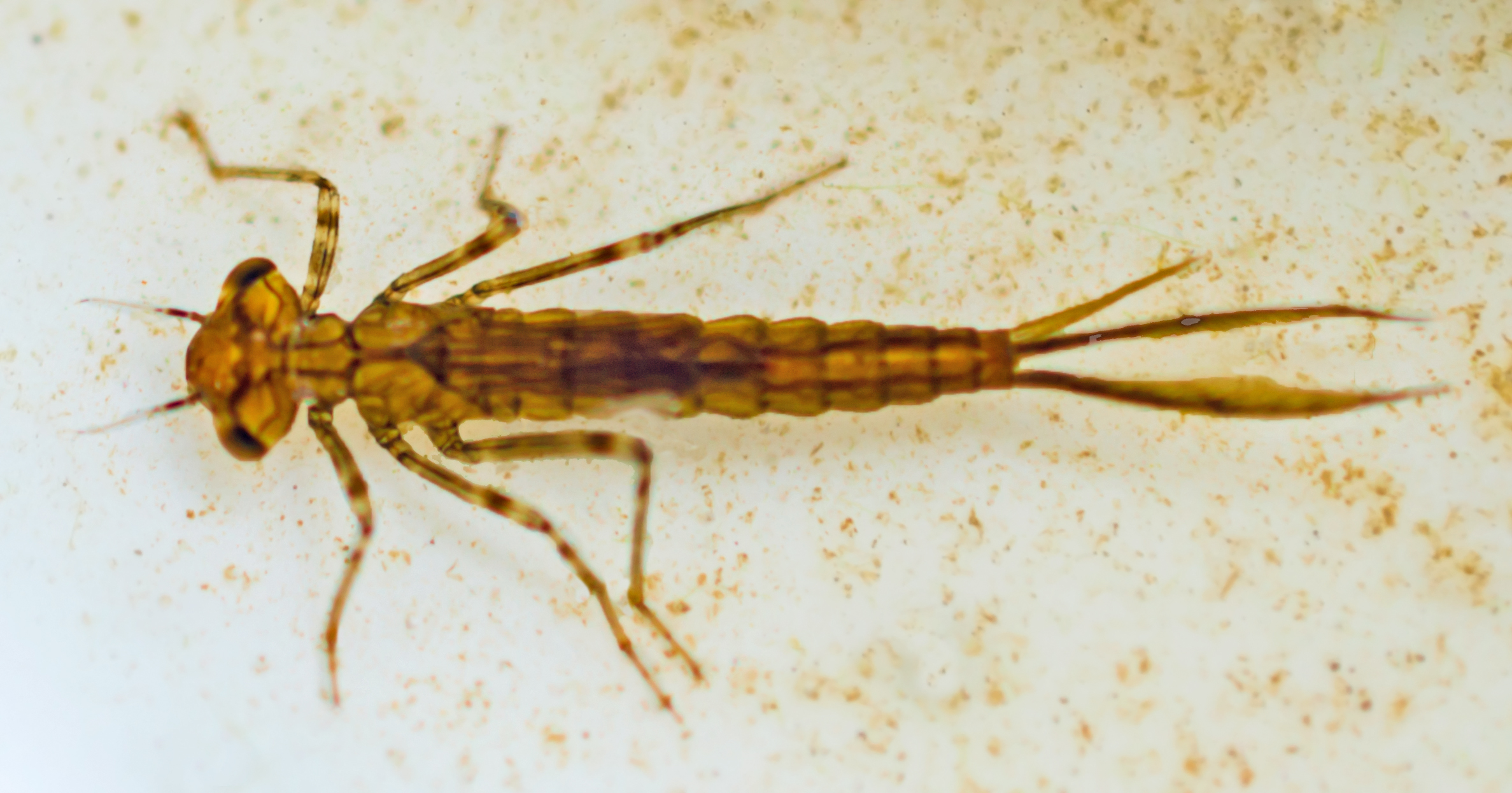 |
| You've seen this photo before. |
 |
| A messier photo shows the leafy structure of the rear appendages, used as gills. |
And then there are several smaller, speedier green critters, too small for the camera, too fast to trap. They look like the amphipods from our shores, but much smaller.
En la cocina esta semana, hay un tazón lleno de agua lodosa. Cada vez que paso, me detengo para examinarlo, tal vez agitar suavemente el lodo y las ramitas. Cada mañana añado agua fresca, hervida, sin cloro. Mantengo la cámara a la mano.
Todo empezó cuando traje a casa esas hojas de la planta carnívora urticularia para observar las vejigas. Y cuando enjuagué las hojas para quitarles el lodo, salió una larva de caballito de diablo. Y dos larvas de frigáneas.
Soy demasiado empática. No podía tirar las hojas y lodo cuando terminaba de observar vejigas. Y todo, hojas, lodo, tallos rotos; todo regresó al tazón; hasta las criaturas más pequeñitas merecen vivir.
Y el dia siguiente, vi otra larva de libélula. Y otras dos larvas de frigáneas. Y luego, las hojas empezaron a crecer; no necesitan tener raices. Y había más animalitos:
- Un animal que nada rapidamente, siempre en la superficie del agua. Mide unos 2 mm., sin tomar en cuenta las patas largas, que le sirven como remos. En iNaturalist, lo han identificado como un nadador de espalda, Notonecta sp.
- Una de las larvas de frigáneas.
Las larvas de las frigáneas se hacen cajitas o tubitos formados con arena o fragmentos de plantas, atados con su propia seda. Cada especie tiene su propia manera de construcción: algunas son muy organizadas; algunas hacen cajitas que hasta parecen joyas; otras, como estas, hacen estructuras d desordenadas, pero cada especie con su tip de desorden específico. Las que he visto antes in los rios locales usaban hojas de las coníferas para construir sus cajitas. Estas, las de la laguna de los castores, parecen usar pedacitos cortados de pasto o de hojas. - El tubito está abierto de ambos extremos, dejando correr el agua. Estas larvitas son muy activas, pasando de una rama a la siguiente, comiendo lo que encuentran.
Siendo extraordinariamente sensibles a la polución, su presencia señala una buena calidad del agua. (UWM/BugoftheWeek)
No parece (a la vista) agua potable, ni en la laguna, ni en mi tazón lleno de lodo y desechos, pero la gatita está de acuerdo, y ahora bebe del tazón, prefieriendo esta agua a la que le doy en su bol limpio. - Y más; hay dos de estos caracolitos. Este mide 7 mm. Sugiere iNaturalist que es el Caracol de Vejiga aguda, Physella acuta. Este caracol anda a veces en el fondo entre los desechos, y a veces boca arriba, caminando bajo la superficie del agua, tal como lo hace una mosca en el cielo de la casa. Con una luz fuerte, la concha es transparente.
- Y hay tres de las larvas de libélula. Esta foto es la que subí antes.
- Una foto no muy buena, pero muestra las dos apéndices en forma de hoja; estas le sirven para extraer el oxígeno del agua.


