Showing posts with label pine cones. Show all posts

Saturday, December 04, 2021

Western white pine cone

On the trail along the shore of Lake Hoomak, down there in the dark (and it is very dark under those trees) many long pine cones lie in the duff. They stand out, even in the dark, because of the white patches on the tips of the scales.
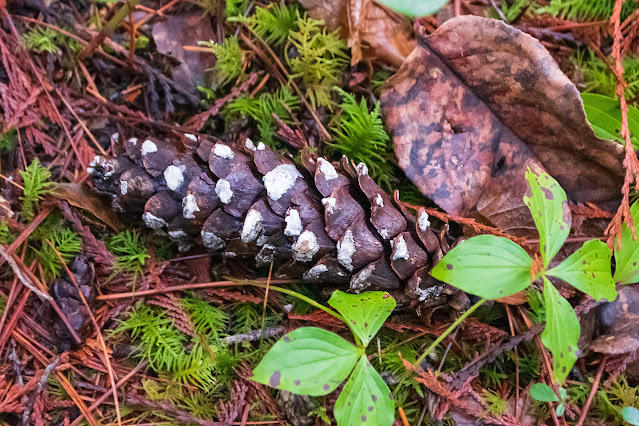
Western white pine, Pinus monticola.

These cones can be up to 30 cm. long. Most I found were about half that.

The white patches are resin. They are hard and dry, harder than the woody scales, drier than anything else in their surroundings.

Note: the camera's eye is better than mine. It sees the colours, even in the dark. To my eyes, the cones looked black until I carried one out into the daylight.

~~~~~~~~~~~~~~~~~~~~~~~
En el sendero que circunda el Lago Hoomak, allí abajo en la oscuridad — y es muy oscuro debajo de los árboles — muchos conos largos de pino reposan en la bosta. Sobresaltan a la vista, aun en la oscuridad, por los parches blancos en las escalas.

Foto: cono de pino blanco occidental, Pinus monticola.

Estos conos pueden ser hasta de 30 cm. de largo. La mayor parte de los que encontré este dia eran más o menos la mitad. 

Los parches blancos son resina seca. Es dura y seca, más sólida que las escalas, que tienen la consistencia de madera blanda, y más seca que cualquier otra cosa alrededor.

Se ve que el ojo de la cámara es mejor que los mios. Ve los colores en la oscuridad. Para mis ojos, estos conos parecían negros hasta que llevé uno a donde entraba la luz del dia.


Sunday, April 13, 2014

Winter quarters

Another few old photos; these are from last October.

Woodbug in rotting pine cone, with snail.

Every fall, I pile some of the current crop of pine cones underneath a potted cedar, to help keep the cold out. In a pot, without the insulation provided by the surrounding soil, a plant is more vulnerable to cold, so even when the plant itself is winter-hardy, I wrap and cover its pot.

Over the winter, the centers of the cones rot, liberating the seeds. Some of these sprout, but that's not the point. The tightly-closed cone becomes a mini-compost pile, its own heat source; even when the ground is frozen hard, the center of the cone stays cool and moist. So it's a winter home for the small animals that don't necessarily go into stasis during these months.

Several times during the cold weather, I bring in a few cones and break them up to see who's living there. There are always a fair number, all wide awake.

In this batch, I found several snails, a family of woodbugs, a few baby slugs, earthworms, two species of springtails, millipedes, and one plant louse. Smaller things scuttled and slithered out of sight as fast as I broke off the scales of the cone; probably more 'pedes, and a spider or three.

Cyanide millipede

Another millipede, sleeping. And the head of a long earthworm, plowing through the composted wood.

Plant louse, exploring a sheet of paper on my desk. Seriously cute.

A pinhead snail, not the same species as the one above. He hid when I moved him to the paper, but a minute later, set out to explore the desk. I put him back in the cone.

When I was done, as usual, I collected the remains of the cones, critters and all, and replaced them under the tree, covered with a layer of duff for warmth.

They made it through the winter; this afternoon, when I moved a couple of pots in the garden, they were all there, with a crowd of their friends and relations.

Wednesday, May 08, 2013

Candles in the bog

On the spur of the moment, on finding the parking lot at the mall crowded with cars lined up waiting for spots, we changed our minds and went down to Burns Bog instead. We weren't prepared, and the only camera we had was the tiny, pocket-sized Sony. And it was so long since I'd used it that I forgot to check its settings, so the flash was set to "Always". In the blazing sun, this doesn't work so well.

No matter; it was an interesting afternoon; I'll have more to say about it later on. For now, this:

We came across an unusual pine tree in an area that had been mostly paved over long, long ago.

Treetop, festooned with "candles".

This may be a variation of the shore pine, Pinus contorta. The needles come in pairs (look closely at the base of the cone below), and are about 3 inches long, slightly curved or twisted. Lodgepole pine needles also come in pairs, but the tree is usually taller and straighter, and not so likely to be found here on the coast.

The trunk and branches are crooked, the bark scaly, brown or grey depending on the light. So far, so good.

Where it seems not to match up, is in the large cones. The erect cones at the tips of the branches are the short-lived male cones. They are about as long as the needles, 3 inches tall or more. Each one, at the tip, wears a clump of shorter needles.

As we moved about the tree, we could see a cloud of pollen being released. I shook a cone on purpose; yellow pollen sprayed everywhere. The cone was sticky and mildly scented.

Male cone, with topknot. Sorry about the glare.

Each pollen grain shields a sperm cell. The grains float on the wind to reach a female cone and fertilize the ovules, deep between the scales. The male cone then disintegrates, while the female matures and becomes woody. Each scale will have a pair of seeds at the base, which, if this is a shore pine, will be released once it matures. (The cones of the Lodgepole pine stay closed for years until a forest fire splits them open.)

Cropped from top photo. Some branches have clusters of "candles". At the base, on two of these branches, are a couple or three fat female cones.

Tangled, rubbery branches, brown, scaly bark.

My guide says, about the shore pine,
"On some peat-bogs*, shore pine forms stunted forests where 100-year-old trees my be less than 5 cm. in diameter."
*Such as Burns Bog, where we found this one.


Powered By Blogger