Showing posts with label grass species. Show all posts

Wednesday, July 19, 2017

It's just there

Bread. Candy canes. Hats. Tacos and birds' nests. Beer and baskets.  Paper, sometimes; also some roofs. Rum and bamboo bicycles. Breakfast cereal. Sushi. Place mats. And so on, and so on. They're all made from grass.

Dune grass, Oyster Bay Shoreline Park

We're grass eaters. The bulk of our food is either grass, or relies on grass in the form of animal feed.

"Grasses now provide us with 3 times more food than do peas and beans, tubers, fruit, meat, milk and eggs put together." (Plants of Coastal BC)

And yet, we - I - mostly ignore the grasses. It's "just grass". A mistake.

Dune grass and unidentified grass, Oyster Bay.

The checklist for plants of Oyster Bay Shoreline Park includes 24 different species of grass, of over 200 species in coastal BC. That's a lot of missed beauty. I've started to pay attention, finally.

One of the Bromes. Cheatgrass, maybe.

The grasses are flowering plants, but the miniature flowers are hidden under an arrangement of bracts and awns. To understand what the guide tells us, we need a new vocabulary: the bract that covers the flower is called a "lemma": two more bracts, beneath the floret, are called "glumes". The whole contraption: glumes, lemma, flower, inner bract, and awn: makes up a spikelet. A bunch of spikelets makes an inflorescence.

Each type of grass has a different arrangement of these parts. It's complicated.


I think this is one of the vernal grasses.

I am going to try to photograph and identify as many of the grasses of the park as possible. Any help with identifications (and all corrections) will be vastly appreciated.

I couldn't identify this one. It's a small grass. (That's my finger at the bottom left.)


Friday, June 13, 2014

Just grass. And spit.

The grasses are probably the most important of the plant families to us humans. I'm ashamed that I know so little about them. I collected heads one afternoon, from one small field; there were more than a dozen different grasses, but I could never identify them.

I occasionally take photos of an interesting head, and then try to find it in my books or on the web. I never do; they're more confusing than caterpillars! My guidebook, Plants of Coastal BC, says there are over 200 species in our area, mostly indigenous.

At Elgin Heritage Park last week, we found a few that I'd never noticed before.

The terrain: flat river delta, soggy wet, even in mid-summer. The grass would be over our heads, but we're standing on the bridge. Behind us, on the opposite side of the bridge, the grass is mixed with taller cattails.

Along the pathway, grasses compete with the blackberries and other shrubs, springing out of the thickets to dangle their seed heads in our faces.

This was really red, almost purple in the sunlight. A tall plant.

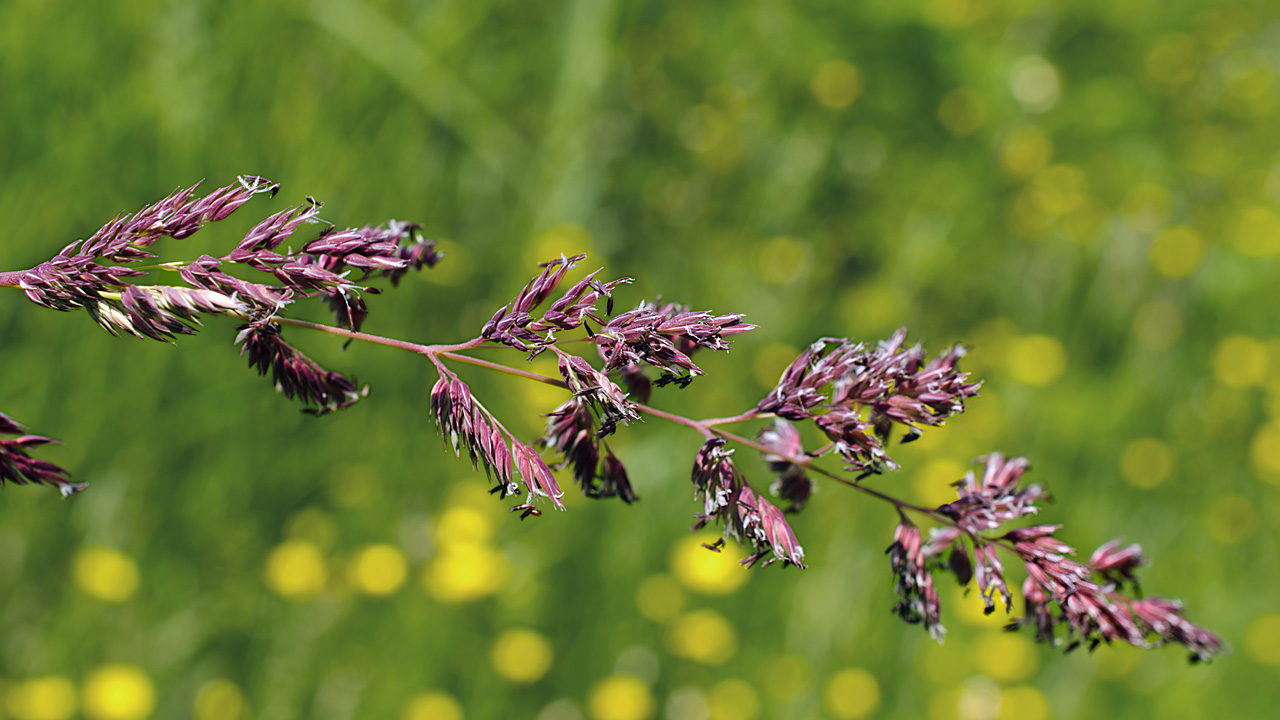
Another one, even more purple against the buttercups.

I think these are the same kind. They are growing on the riverbank, with no competition.

Laurie found this, a fuller, fatter head. It seems, from the photo, since I didn't see the plant, to be a rush. But which one?*

*Laurie says it's probably Cocksfoot grass, Dactylis glomerata.

Note to self: "Sedges have edges, rushes are round." The stems, that is.

Farther from the shore, where the ground rises and dries out, other, shorter grasses grow around the lupins. And this week, they were in the midst of a population explosion:

Spit bug** heaven!
**Nymphs of the Froghopper family, aka Spittle bugs, snake spit, frog spit. Laurie knows them as "cuckoo spit". The one that we see in this area is the Meadow Spittlebug, Philaenus spumarius. I have found them on my roses and the hydrangeas at home.


Powered By Blogger