Showing posts with label barnacle behaviour. Show all posts

Thursday, January 04, 2024

Abandoned to their fate

 Looked like a good idea at the time.

Baby barnacles, free swimmers a few weeks old, start looking for a permanent home, somewhere to glue themselves down headfirst and build themselves a castle. I've noticed they don't settle on small stones on the beach, those that roll up and down rattling in the waves. Or maybe they do and promptly get knocked off; however it happens, the smallest stone I find them on will be over 6 cm. across. But the bigger, the better, the less likely to be rolled over in a storm.

So when these barnacles found a nice, big, heavy crab, it seemed like an ideal choice. Solid, and mobile, to boot, carrying them to all sorts of great eating spots. They grew fat and healthy, tinged with the red coloring of the crab's carapace.
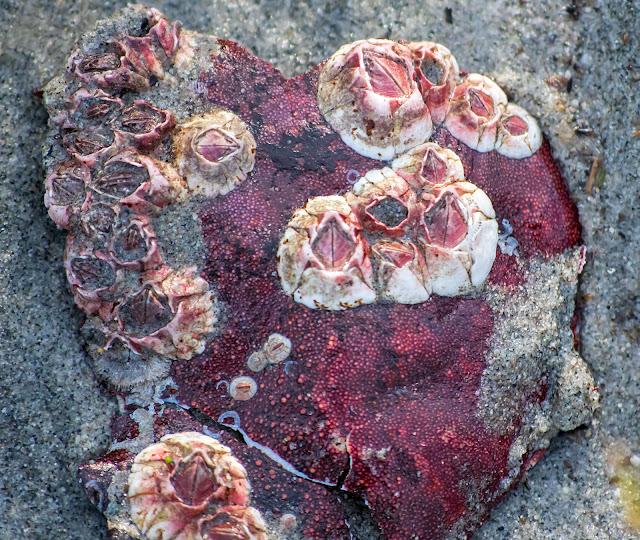
Acorn barnacles on a piece of crab shell.

And then the thoughtless crab one day up and moved out of his shell and just left it lying on the sand, to be tossed and broken in the waves. So irresponsible!

I found them on the shore, still alive, and returned them to the water. But the rest of the shell will disintegrate, and what's a rootless barnacle to do? So sorry!

~~~~~~~~~~~~~~
Parecía ser buena idea en el principio.

Los bálanos jóvenes, nadadores activos con unas pocas semanas de vida, empiezan a buscarse un sitio donde adherirse cabeza abajo y construirse su castillo. He visto que nunca se pegan a las piedras pequeñas, las que hacen traqueteo en la playa, subiendo y bajando con las olas. O tal vez es que los malafortunados que escogen estas piedritas resultan golpeados y aplastados. Lo cierto es que la piedra más pequeña que he encontrado llevando bálanos mide por lo menos unos 6 cm. Pero entre más grande, mejor; así ni las tempestades les pueden hacer daño.

Y cuando estos balanitos encontraron un cangrejo grande y pesado, les pareció un sitio ideal. Sólido y además móvil, que les llevaría a lugares ricos en nutrientes. Se hicieron gorditos y sanos, pintados con el rojo del caparazón.

Foto: un pedazo de caparazón de cangrejo rojo, con su carga de bálanos.

Y luego el maldito cangrejo se mudó: se quitó el caparazón y lo dejó abandonado a la merced de las olas. ¡Increíble falta de responsabilidad!

Los encontré en la arena, todavía vivos, y los regresé al agua. Pero, ni modo; lo que queda del caparazón se va a desbaratar, y ¿qué podrá hacer un pobre bálano sin base? 


Tuesday, March 15, 2022

Open mouth, evert foot

 It's been rainy and windy and cold all day. A good day to stay inside and watch barnacles.

Acorn barnacle fishing.

Barnacles stand on their heads inside their fortified castles, fanning their feathery feet (cirri) in the water, catching tiny fragments of food. There are 6 pairs of cirri; the first three are larger, and often the only ones seen.

The cirri also include gills, so the barnacle is breathing as well as fishing while he fans his legs through the water.

A quick sweep.

To capture these two barnacles with the cirri extended, I took 80 photos. A mouth opens, (not in the barnacle I was focussing on, usually) a hint of cirri appears. Next, maybe the mouth closes again. Maybe the cirri sweep out, vibrate for a moment, then fold back in, all in a short second. Maybe they sweep out, fold in almost too fast for the eye to capture them. They don't stick to any rhythm, and each barnacle has its own personal style.

They're faster than my shutter finger. 

In the photo above, you can also see the tentacles of a tiny anemone. At least these stay open most of the time, although they sway in the current.

The stone these barnacles sit on, with three anemones and a long-legged isopod.

~~~~~~~~~~~~~~~~~~~~
Llovió todo el dia; hubo un viento fuerte y frio. Un buen dia para quedarme en casa observando los bálanos.

Fotos: bálanos buscando su comida.

Los bálanos se paran de cabeza dentro de sus castillos fortificados, extendiendo sus piernas emplumadas (llamadas cirri) para pezcar pequeños fragmentos de comida. Hay 6 pares de estos cirri; los primeros son más grandes, y a veces son los únicos que se pueden ver.

Los cirri también contienen las branquias, así que mientras buscan su comida, también están respirando.

Para sacar estas dos fotos de bálanos en el acto de pescar, tuve que sacar 80 fotos. Una boca se abre, (pero no la del bálano que tenía enfocado, claro); se asoman unos cirri. En seguida, puede ser que la boca se vuelve a cerrar. O tal vez se extienden los cirri, vibrando por medio segundo, y se retraen. O pueden salir y desaparecer tan rapidamente que apenas los ojos llegan a verlos. Y no llevan ningún ritmo, y cada balanito tiene su propio estilo, muy personal.

Son más rápidos que mi dedo en el obturador.

En la segunda foto se ven también los tentáculos de una anémona miniatura. Estas por lo menos se mantienen abiertas por mucho tiempo, agitándose con los corrientes del agua.

La tercera foto muestra la piedra donde están fijos los bálanos, con tres anémonas y un bichito de patas largas, probablemente un isópodo.


Monday, December 19, 2016

Hungry!

Barnacles have their quirks. The large thatched acorn barnacle shuts down tightly when the tide goes out. As it comes back in, and the first waves splash them, they begin to open, tentatively. If I come too close, they see my shadow and slam their doors shut again.

Not so the little common acorn. I had them out of the tank tonight while I scrubbed the walls, and as long as they were damp, they kept on trying to catch something to eat. And they didn't mind me moving the shell they grew on, nor even the camera's flash. They couldn't quite spread their nets as far as they do underwater, but it wasn't for lack of trying.

Looks like mountain peaks, with green lava. Or tentacled Sasquatches.

Powered By Blogger