I'm going about this backwards. Usually, I post something here, then send links to various places; this time, I started with a post to the Arachtober group, starting off the month of spider and kin photos.
But I mentioned this find here yesterday, so here's the story.
This was when I was poking through the duff on the forest floor. I picked up a small piece of bark and turned it over. Nothing much there, but something suggested spidery legs; I couldn't be sure, but they seemed to be moving. Not running, as a disturbed spider would, just waving slightly. I popped the piece of bark in a plastic bag and brought it home.
Under a lens, I found it; a strange-looking beastie with some whitish stuff in front. For a bit, I thought it was dead, but then it waved a leg or two. Not dead, injured, though; and a couple of its 8 legs were cropped off.
The next day, looking at it again, it dropped off the piece of bark onto my desk. And here it is, still moving feebly:
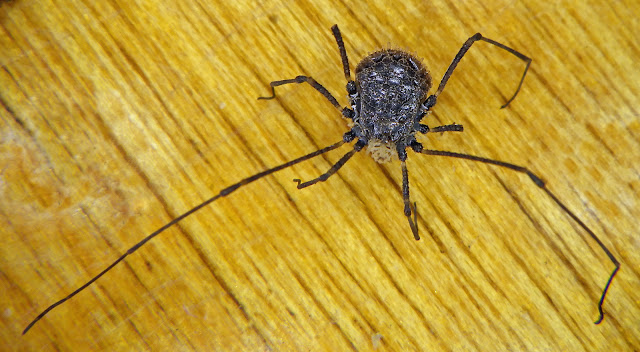 |
| One of the harvestmen, Opiliones. |
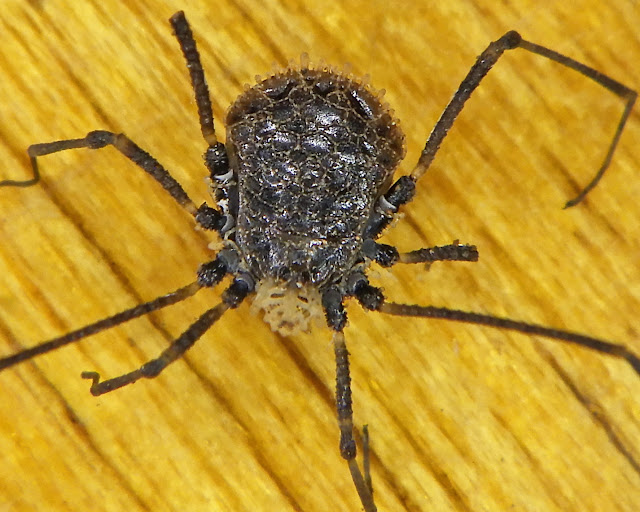 |
| Here, with those two long legs cropped off, to get a better look at the body. |
8 legs; it's one of the arachnid tribe. And with that one-piece body, it's a harvestman. Those extra-long second legs are used as sensory organs, as insects use their antennae. Watch a harvestman walking next time you see one; they feel ahead of themselves with those legs. Their eyes aren't much use for detail work.
But what was that contraption in front of the head? The harvestmen I see around the house have nothing like that. I wondered, at first, if it was some sort of fungal infection, especially considering the row of protrusions around the rear.
Look at them, as my little microscope found them:
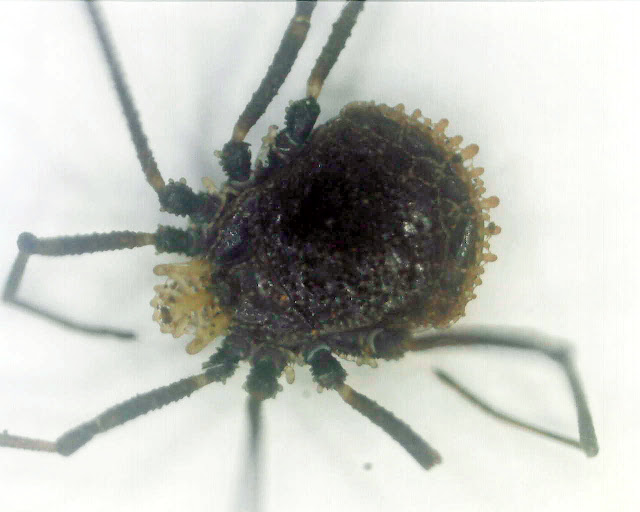 |
| A tidy sort of lattice work in front; someone has called it a doily. Maybe a grandpa's beard. Too neatly arranged to be a fungus. |
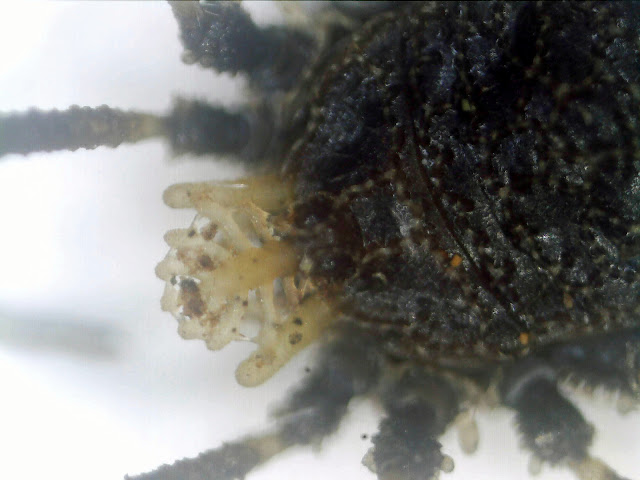 |
| Zooming in. |
With that view, and an image search and a combing through BugGuide and iNaturalist, I found it; there's a group of harvestmen that wear these face decorations. This one is Dendrolasma mirabile, in the Sub-family Ortholasmatinae.
The members of the Ortholasmatinae are among the most spectacular and ornamented in the Dyspnoi. The dorsum of most species is covered with anvil-shaped tubercles that have long horizontal arms intersecting with each other and forming individual geometric patterns like combs, squares or finer reticulate patterns. In most species, the eye tubercle is drawn out to a long spine that is set laterally with long tubercles that are joint at their tips. Together they form an ornamental and elaborate basket over the chelicerae. (Axel Schoenhofer)
So that describes the patterns on its back, and the "basketwork" in front of the mouth; extensions of the eye tubercule!
My poor beastie died on the second day. Otherwise, I would have returned it to the spot where I found it, where its relatives would be living.
~~~~~~~~~~~~
Hoy estoy haciendo las cosas al revés. Normalmente, subo algo aquí en el blog, y luego envío enlaces a varias partes. Esta vez, empecé con subir una foto al grupo de Arachtober, para empezar el mes de fotos de arañas y sus parientes.
Pero había mencionado este encuentro aquí, ayer, y no conté la historia.
Esto era cuando estaba en el bosque examinando la hojarasca en el suelo. Recogí un pedacito de corteza de árbol y miré el verso. Parecía estar limpio, pero algo me sugerió la idea de patas de araña; no podía estar segura, perao parecía que se movían. No corrían, como correría una araña espantada, pero apenas temblando. Metí la corteza en una bolsita de plástico y me la traje a casa.
Aquí, bajo un lente de aumento, lo encontré; un animalito extraño con algo pálido enfrente. Por un momento, creí que estaba muerto, pero luego movió unas patas debilmente. Muerto, no, pero sí estaba traumatizado; dos de las patas estaban rotas.
El dia siguiente, mientras lo examinaba de nuevo, cayó de la corteza a mi escritorio. Aquí está, todavía moviéndose un poco:
1. Uno de la familia de los Opiliones.
2. La misma foto, sin las patas largas, para ver mejor la forma del cuerpo.
Tiene 8 patas; es una del tribu de los arácnidos. Y con ese cuerpo de una sola pieza, es uno de los opiliones. Esas dos patas muy largas se usan como órganos sensibles, como usan los insectos sus antenas. Si observas un opilión caminando, verás que van tocando el suelo por adelante con esas patas. Los ojos no les sirven bien para esos detalles.
Pero ese aparato en frente de la boca; ¿qué es? Los opiliones que veo en casa no tienen nada parecido. Se me ocurrió al principio que podría ser algo como una infección por algún hongo, especialmente considerando también las protuberancias en la parte trasera.
Mira lo que aclaró mi microscopio:
3. Un arreglo bastante ordenado, como un enrejado; alguien lo ha llamado un encaje. O una barba de anciano bien cuidado. Demasiado regular como para ser un hongo parásito.
4. Viéndolo más de cerca.
Con esas fotos, y con una búsqueda por imagen y rebuscando en BugGuide y iNaturalist, lo encontré; hay una sub-familia de Opiliones que llevan esos adornos faciales. Este es Dendrolasma mirabile, de la Sub-familia Ortholasmatinae.
Los miembros de los Ortholasmatinae son entre los más espectaculares y ornamentados de los Dyspnoi. El dorso de la mayoría de las especies está cubierto con tubérculos en forma de yunque, teniendo largos brazos horizontales que se cruzan entre si y forman esquemas geométricas individuales, como peines, cuadros o diseños reticulares finos. En la mayoría de las especies, el tubérculo ocular se extiende, formando una espina larga, teniendo a los lados tubérculos prolongados, unidos en los extremos. Juntos forman una canasta ornamental y compleja encima de los quelíceros. (Axel Schoenhofer)
Eso describe la "canasta" en frente de la boca: ¡son parte del tubérculo ocular! y además el diseño del dorso.
El pobre bichito murió el segundo dia. En otro caso, lo hubiera regresado al sitio de donde lo traje, donde tendría familia.


