Saturday, February 28, 2009

Upside-down maternity wards

When the tide goes out and the sun shines, the beach residents go into hiding. Some burrow into the sand, others hide in the crevices between rocks, and many move to the underside of rocks and other shells. Flip a rock, and crabs scuttle out of sight to the new underside. Snails, barnacles and limpets are not so agile, but they close themselves down tightly against the heat and light.

I was flipping rocks on Crescent Beach, always remembering to put them back where I found them before the animals there got sunburned. (Crabs that had moved to the new bottom, now had to reverse direction.) On the underside of many rocks, this last week, I found masses of a yellowish, flecked jelly:


Flipped rock, with limpets and jelly.


Closer view of the jelly, with snails. (Sitka periwinkle, Littorina sitkana.) It reminds me of tapioca pudding.

They looked like egg masses to me. But whose eggs?

I had to search long before I found them. Each type of mollusk lays their eggs in a particular formation; the individual stalked "sea grapes" of the whelks, tiny "donuts" of the chink snails, strips, spirals (sea slugs), the eel-grass coating I found on this beach last year (still unidentified), and these blobs. Unfortunately, few books and websites mention these eggs; even fewer show recognizable photos, and fewer still link the photos to the specific creature that lays them. Most of the egg masses that I found had snails on or around them, but they were a mix; mud snails, periwinkles, whelks and black turbans.

I read up on all the snails, and finally found a PDF from the Alaska Natural Heritage Program, on the Sitka periwinkle. Not only does it describe the snails, but it includes a paragraph on reproduction with a description of the eggs. (No photograph, though.) And the descriptions match!


Sitka periwinkle with egg mass.

"After copulation females lay 50-400 fertilized eggs which are enclosed in a thick, transparent, gelatinous material; individual egg masses measure 5-15 mm but communal laying by several females often results in large egg masses measuring up to 10 cm, containing 2,000 or more eggs. ... Egg masses usually attached to and under rocks and seaweed in the upper intertidal zone."
Most of the egg masses I found were these communal sites.

That's a lot of eggs! I did a bit of calculating; at a minimum of 50 eggs per female, a success rate of only 4% will maintain the population. (They need 2 successes per male/female pair.) With 400 eggs, half a percentage point will do. In other words, most of these eggs won't make it.

From the PDF, again:
"Veliger (snail larva) develops shell within a week inside egg case, then hatches in around 30 days and begins to consume jelly of egg mass and diatoms which may have colonized the jelly surface."
Survival of the quickest, I think you could call that.


The individual eggs in the jelly catch the light. They vary, in different masses, from pale yellow to a burnt orange.

Someone had been flipping rocks on the beach before I got there. Where they had exposed egg masses and left them face up, the jelly was dry, and looked cracked and lifeless. It was a good reminder of the importance of leaving things as I found them.

.

Friday, February 27, 2009

End of a chickadee

The tail end, that is.

I was trying to catch this one at the feeder, but was a split-second too late. But look at those fanned wings and tail! And the little curled-up feet!


The blurred curves below are wing tracks.


More conventional view. Lined up for the feeder. Waiting for me to put the camera down.

Back to planned posts, next. A more cheerful look at the Crescent Beach critters.

.

Thursday, February 26, 2009

Just when you get your hopes up ...

... winter is back again. I was contemplating the sprouting perennials in my garden this morning, and planning a visit to the nursery for spring blooms. Nothing doing, says the weatherperson, and orders up a winter combo; rain, wind, sleet, finally turning to snow. The worst of it, is that it's not even decent snow; slushy, soggy, drippy stuff, messy to shovel, heavy enough to bend over the little yew that I had just released from its winter bindings, and slippery underfoot, to boot. (Mumble, grumble, whine and mutter; sombody fire that weatherperson!)

On the bright side, the bushtits have discovered my suet cage!


Pincushion.


Isn't he a cutie?

And the varied thrush was back several times today. He (she?) is still very wary; if I so much as get up from my desk, he sees the change in the light and takes off.

A few of my other suet and seed eaters:


A little sparrow.


House finch, in spring duds.


Face-off. "This is my place! My seed bucket! Go away!"


Chickadee. It was so dark by mid-afternoon that I had to use the flash.


First hydrangea leaves. Through my dusty window; it was cold and wet out there.

A few more days until March. Then it will have to be spring, and I'm getting some flowers. Whatever the weather.

.

Wednesday, February 25, 2009

Red in radula and proboscis

Well, maybe not red, exactly, but you get the idea; it's a cruel, cruel world out there.

I was admiring the snail-like spiral of barnacles on this little rock, when I noticed the upside-down "ice-cream cone" shell combo on the left:


It's a mud snail jammed down inside a barnacle. "Eating the barnacle," was my first impression. Do Batillaria do that? I searched through other photos to see.


Here we go. A bunch of barnacles that are now empty shells. Barnacles with mud snails inside, with little periwinkles, with small whelks, even a barnacle with two different snails crammed into the tiny space. But ... I thought periwinkles were vegetarian!

They are. So are the invasive mud snails. And the Tegula, the black turbans. They feed on algae.

But the whelks, the whole lot of them, are carnivorous predators on barnacles and mussels. Wikipedia also mentions tube worms among their prey.

Using the radula, a scraper/drill/file arrangement (There's a good diagram here.), the snail drills a small hole into a mussel, then injects a paralizing or digesting enzyme. Once the mussel flesh is soup, the snail inserts a long proboscis and slurps it up. With barnacles, the technique varies a bit;
"The snail uses the radula to drill a hole in the barnacle shell at the seam between two plates, and then extends its proboscis through the hole to scrape out the soft tissue. The preferred barnacle is Balanus glandula ..."
From U. Washington.
I gather from this, that the other snails, the mud snail and the periwinkles, are simply feeding on the leftovers or the algae that grow on the leftovers.

Nobody's safe here; the mud snails, in turn, become prey. In this next photo, down on the left, in an empty clam shell (probably smashed by seagulls), a mud snail lies dead, with a small circular hole in the shell. Whether this was Nucella's doing, or some other snail's, I don't know. The moon snail makes larger holes (and are not on this beach, so far as I know).


While you're at it, open the photo full size, and look at some of the other snails. In the opening of several, you can see a small white claw. The original tenants are gone; the current residents are hermit crabs.

And on the outside of a snail just above the centre of the photo, look for a pinkish spot; it is possibly a slipper snail. There was another in one of our other photos. These are filter feeders; they do not drill holes.


A whole congregation of hermits. (Do hermits congregate?) And a few snails "peeled" by crabs.


Hermit crab, out looking for a solitary cave.

A few steps down the beach, I came across another breed of "voracious predators".


These are Paranemertes peregrina, the Purple ribbon worm. They looked almost black on the beach, but they are really a greenish, purplish, dark brown. The belly is creamy.

They are also called proboscis worms, because they shoot out a long proboscis to catch their prey. (Like a frog, maybe? But not as cute as frogs.) They are able to catch and kill polychaete (bristle) worms bigger than themselves. (WSU has a photo of a purple ribbon eating a polychaete.)


Another view. Note the green isopod to its right. The beach hopper, Traskorchestia traskiana, possibly.


And still another green isopod. I thnk this is the Rockweed isopod, Idotea wosnesenski.


Photo lightened considerably, to show two more beach hoppers.

These little guys crawled over and around the worms the whole time I was watching. The worms ignored them. They're looking for more challenging prey.

.

Tuesday, February 24, 2009

Black turban snails

I love the colours and textures of these shells.


Tegula funebralis, found on Crescent Beach.

Tomorrow; the carnivores.

.

Monday, February 23, 2009

"Endless forms ..."

"... most beautiful and wonderful ...," Darwin wrote. We looked over a small corner of that almost infinite variety on Crescent Beach last Friday.

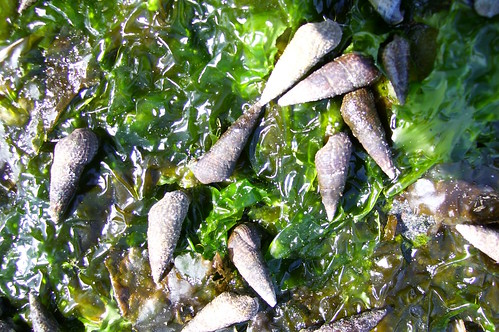
In previous years, we have found millions (one small bay to the south of us has been estimated to hold 1.4 billion) of the invasive Asian snail, Batillaria attramentosa. That, and not much else; the native snails had been overwhelmed.

Not this year. Variety is in again. Here's a bit of what we found: (It helps to blow up the photos to full size.)


The stripy, pointed snails in the centre are Batillaria. They come in a variety of patterns and colours, from brown to grey to black and white, checkered to striped. But there, just below the pale brown invader, see that orange, curvy snail? It is one of the Nucella*, probably N. lamellosa. And over at the far left, on the clam shell, a tiny, black, globe-shaped snail could be one of the periwinkles, or maybe a young Tegula. Up on the point of the angular rock, a grey snail has longitudinal ridges. I am not sure what it is.

About Nucella. This snail boasts as many names as patterns and colours. Its colour varies from site to site; so does the pattern and even the thickness and smoothness of the shell.


This collection of Nucella comes from Port Hardy, at the northern tip of Vancouver Island. The photo is the first one from Dan Yoshimoto's page about this species; he has samples from locations up and down our coast, all different. At the bottom, he lists 21 alternate names. One of them, Thais, is the one I found in my Kozloff's "Seashore Life". (It's an older edition; maybe the name has been changed in the newer one.)

More on this snail later, in another post.


Limpets. We found two or three species of these. A couple of periwinkles, Littorina sitkana. Off to the right, an extremely indented fat snail, possibly a Tegula funebralis. Small barnacles, Balanus glandula. Assorted jelly-like organisms; green algae, blood-red algae, possibly a small patch of tar algae, and those yellow masses. (I'll deal with those in another post.)


A pair of snails, on the prowl. One green and ridged, the other black and white, much smoother. But the body, what shows of it, seems similar; licorice tentacles, with white tips, a black and white spot (Is that an eye?) at the base.


These barnacles are Chthamalus dalli. I can tell by the cross-shaped joint of the "mouth". Balanus glandula has a straight line, and another local barnacle, Balanus cariosus, has a squiggly line.


Aren't these pretty? Batillaria and a checker-board, ridged limpet. Colliselta pelta? Maybe. The barnacles are B. glandula, again.


Another pair, green and purple, although I think the green is a coating of algae. Here one is showing off the creamy body, as well as the black tentacle and eye spot.

And aren't those tiny barnacles pretty? They look almost like marzipan candies. Yum!

*I could be wrong on any of these identifications. Or most of them. To be more or less sure, I would have had to bring samples of them all home.

.

Sunday, February 22, 2009

Treetop romance

Afternoon on Crescent Beach, Part 1: The eagles.

At the southernmost entrance from the street to Crescent Beach, two engraved rocks lurk under the salmonberry bushes.


"Spring - daylight - low tides
in the eel-grass beds
herring come to spawn"


"eagles follow"

Well, it's spring, but we haven't seen the low tides, nor the herring spawning. But the eagles are certainly following. Along the shore both at White Rock and at Crescent Beach (we visited both this Friday), almost every tall tree sported at least one.


Coming in for a landing.


Crow-watching over White Rock beach.


Going visiting.

In one of the evergreens, an eagle was calling and calling, barely pausing for breath. (Such a squeaky, shrill sound from such majestic birds! I am tempted to offer them a throat lozenge.) We walked in that direction for a while, and finally came opposite the caller's tree. I saw one eagle, then the next time I looked, two. They sat, quietly at last, for a minute or two.


"Well, hello, there! You finally got here! I've been calling you for hours!"


A minute later, both eagles were on one branch, with a privacy screen in front.


Fuzzy photo, but it shows the exultant spread of wings.


Still busy back there.


Tender moment over, they each rested on their own branch. When we passed on our way back, half an hour later, they were still there.

Awwww! Young love!

Next; "Endless forms, most beautiful." The water creatures.

.

Friday, February 20, 2009

Crab or Great Horned Owl?

"Better not try anything with me, friend. I can take on you and two more; just me and my shadow!"


This afternoon, on Crescent Beach. I didn't rile him up; that was the little girl who found him first. He was mad, and ready to tackle the world by the time I pointed a camera at him.

And the beach was teeming with life; I'll be posting about it all week, once I've sorted the photos and done a bit of research.

.

And the bug season begins, at last

Yay! Spring has come to our hilltop! These crocuses* were blooming in a neighbour's garden:


The palest of pale mauve crocuses.


Another pair.


With a few yellow crocuses for variety.


And, in a patch of succulents, these deeper mauve ones.

But look closer! The very first insects of the season!


Tiny beetles.

Unfortunately, I was resting from Wednesday's labours, and Laurie went out alone. (Well, not quite; he took along the camera for company.) So I didn't get a close-up, and I didn't bring a beetle home. I'll do that tomorrow.

And what do you think this is?


Maybe you have better eyes than I do; I couldn't make head nor tail of it, until ...


... I blew it up. A crow, stretching wings and tail, while he keeps a careful eye on that human nosing around the gardens down there.

* I can never be sure about the plural of "crocus". One crocus, two "crocuses"? Or two "croci", as some people insist on writing? I finally looked it up. It's "One crocus, two crocus, three crocus ..." Or, if you prefer (and I do), "two crocuses".

.

Thursday, February 19, 2009

Musings while in recovery

I'm too tired, after a day of babysitting, and traumatized, from almost 48 hours without an internet connection, to put together a coherent post. The best I can do is a series of wandering thoughts.

1. Because I had to reboot the computer and the modem as part of the attempt at locating the problem (which didn't help, at all; the outage was at the other end) and because the computer was useless, anyway, (Why do they put the help files online these days? When you need them for trouble-shooting, you can't get them. That's akin to the isp staff that e-mailed my dad to tell him that his e-mail was currently not available while they upgraded. Really! So helpful!) I unhooked everything, cleared and moved the desk, and sorted out the wiring. The desk had been in the same position for about 5 years.

It took all day Tuesday to do that, and to return everything to its place and hook it all up again.

It wasn't as dusty behind the desk as I would have expected. I only found one spider, which I carefully shooed into a crack before I vacuumed.

I keep an air filter running behind the computer at all times, to make sure it gets only the cleanest, most dust-free air possible. Tuesday, I vacuumed the computer thoroughly from every angle, and through every vent. Then I put a fresh, new dust bag into the vacuum, reversed the hose, and blew through the rear fan outlet. I should have done this outside; a huge cloud of fine dust spewed out of the intakes and all over the room. So I had to vacuum and dust everything in the room again.

Dust is not good for computers. Moral of the story; must clean computer much more frequently.

2. Travelling around with an almost-3-year-old, I stopped to watch a backhoe at work on a crumbling garden installation. It was picking up rotting beams, stacking them to one side, and levelling a small hill. After we started home, I was treated to the following conversation:
Sophia: "Backhoe bites wood."
Me: "Yes, a backhoe bites wood. And mud."
S: "Not people?"
Me: "No, not people. It doesn't bite people. Just wood and mud."
S: "Not Sophia?"
Me: "No, not Sophia. Just wood and mud."

And then a monologue, all the way home: "Bites wood. Bites mud. Not people. Not Sophia. Not people. Wood. Mud. Bites wood. Bites mud. Not Sophia. Not people. Bites ..."
If repeating a fact 10 times cements it in memory, I'm sure she's got this one down for life.

3. Eileen (Cicero) writes of squirrels being "ever so persistent." They are. So are kids. (Which is why you can't hide Christmas presents from them, and why (I think) some teens are such good hackers.) In the mall, we stopped to look at the loonie grabbers, the brightly-coloured bouncing "airplanes" and bunny rabbits and Noah's Arks. One, a kid-sized ice-cream truck, was still going, after the previous kid had left it. Sophia climbed in and entertained herself pushing all the buttons. ("Yum! Chocolate! My favourite!" the red one elicited.) Another kid, a boy around 5, climbed in, too.

The truck used up its loonie, and stopped. Sophia pushed buttons vainly. But the boy jiggled the coin return lever with one hand, and pushed the Start button with the other. Off they went again, for the full ride.

On the third time round, the trick failed. The kid kept trying, until his mother came over to take him off to pre-school. She told me he'd discovered the trick some weeks before. She's got a hacker in the making there.

4. The Great Backyard Bird Count. We did count, but without too much profit. Juncos, chickadees, crows, and pigeons, of course. Eagles, 10 in one small clump of trees along the Ladner Trunk Road. 4 Northern Harriers in and beside a field, a mass meeting of gulls along the highway to Richmond. Not much else.

Part of the problem was that we were on the go most of the weekend; we made observations from the car as I drove. And I took no photos. These two are from the week before:

crows
A dozen crows. Otherwise known as a murder.

woodpecker
Wally's Woodpecker. This wouldn't have worked for the bird count, would it?

And Laurie did get a close shot at a hawk from the car, as I drove. Unfortunately, the car hit a bump just as he pressed the shutter:

hawk
Hawk backside. And, on the lamp, a liberal application of white hawk poop.

5. And tomorrow, I hope, life will return to its normal tempo. (I can dream, can't I?)

.
Powered By Blogger